
Chronic osteomyelitis doesn't follow the timeline most families expect. This isn't a two-week course of antibiotics and a follow-up appointment. Bone infections, especially in older adults with diabetes or vascular disease, require months of sustained treatment, and stopping too early is one of the most common reasons the infection comes back. A recurrence isn't just a setback. It's harder to treat the second time, often with more aggressive antibiotics, longer durations, and a higher risk of surgical intervention or amputation.
If your parent has been diagnosed with chronic osteomyelitis, you're likely facing a care situation that doesn't fit neatly into any single setting. Hospitals discharge patients once they're stable, but the treatment isn't over. Home care might work for some families, but the daily demands of IV antibiotic infusions, wound care, and PICC line maintenance can overwhelm even capable caregivers. And not every senior living community is equipped to handle this level of medical complexity. I've worked alongside patients receiving weeks of IV antibiotics through PICC lines in clinical settings, and the sustained attention those infusions require doesn't automatically transfer to a care community running on tight staffing schedules.
This article covers what chronic osteomyelitis treatment actually involves, what to expect from the care timeline, and how to evaluate whether a senior living community can realistically manage your parent's bone infection through completion of treatment.
What Is Chronic Osteomyelitis and Why Does It Require Long-Term Care?
Chronic osteomyelitis is a persistent bacterial infection of bone tissue that has either failed to resolve with initial treatment or has been present long enough to become deeply established. Unlike acute bone infections that respond to a standard antibiotic course, chronic osteomyelitis involves bacteria that have formed protective biofilms on the bone surface. These biofilms shield the organisms from both the immune system and many antibiotics, which is why treatment takes so much longer.
In older adults, the most common pathway starts with a soft tissue infection that spreads to bone. Diabetic foot ulcers are a frequent culprit. The infection moves from the skin through underlying tissue into the bone cortex and eventually the marrow. Osteomyelitis affects the forefoot in roughly 90% of diabetic foot cases, though midfoot and hindfoot infections carry a worse prognosis. Other common causes in seniors include infected pressure ulcers, post-surgical infections, and infections around orthopedic hardware from prior joint replacements or fracture repairs.
The reason chronic osteomyelitis demands long-term care is that the treatment itself is lengthy and medically intensive. You can't rush bone infection treatment. Antibiotics need to reach therapeutic levels in bone tissue, which has limited blood supply compared to soft tissue. The infection has to be monitored with regular blood work, imaging, and wound assessments. And even after treatment appears successful, the recurrence rate for chronic osteomyelitis in adults is approximately 30% within the first 12 months, which means monitoring continues well past the end of the antibiotic course.
The Long Treatment Road: What Osteomyelitis Management Requires
The treatment timeline for chronic osteomyelitis typically spans four to eight weeks of parenteral (IV) antibiotic therapy, followed by a transition to oral antibiotics that may continue for an additional several weeks to months. For your parent, this means the acute treatment phase alone can last two months or more, and the full course of medical management often stretches to six months or beyond when you include the post-treatment monitoring period. Understanding each phase helps you evaluate what kind of care setting can realistically support the full process.
IV Antibiotic Therapy and PICC Line Care
The cornerstone of chronic osteomyelitis treatment is prolonged IV antibiotics, typically administered through a peripherally inserted central catheter (PICC line). A PICC line is a long, flexible tube threaded through a vein in the arm until the tip reaches a large vein near the heart, allowing medications to be delivered directly into the bloodstream over extended periods. For most chronic osteomyelitis cases, IV antibiotic therapy lasts four to six weeks, though more complicated infections, particularly those involving resistant organisms like MRSA, may require up to eight weeks of IV treatment.
PICC line care is a clinical skill, not a casual task. The line must be flushed regularly with saline solution (and sometimes heparin) to prevent blood clots from blocking the catheter. Dressings over the insertion site need to be changed weekly using sterile technique, with the surrounding skin cleaned using chlorhexidine solution and allowed to air dry. The injection caps on the line are typically changed every four days. Every time medication is administered or the line is accessed, the connection point must be scrubbed with alcohol for 10 to 15 seconds to reduce infection risk. If the PICC line becomes occluded, a clot-dissolving medication may be needed, and if thrombosis is suspected, imaging is required. Accidental dislodgement is a particular concern with elderly patients, especially those with cognitive impairment or restlessness, and occurs in roughly 9% of cases in hospitalized seniors. A dislodged PICC requires replacement, which means another procedure and potential treatment interruption.
I've seen how much sustained focus PICC line management requires in clinical settings where staffing ratios are built for exactly this kind of care. The infusion itself can take 30 minutes to several hours depending on the antibiotic, and a nurse needs to monitor for reactions during administration. In practice, this is where things break down when patients move from hospitals to care communities. The initial urgency fades as the visible wound improves, but the antibiotic compliance, flushing schedule, dressing changes, and sterile technique must continue with the same rigor at week five as at week one. A missed flush can clot the line. A contaminated dressing change can introduce a new infection directly into the bloodstream. These aren't theoretical risks. They're the complications I've watched develop when protocols slip.
Surgical Debridement
Many chronic osteomyelitis cases require surgical debridement to remove dead and infected bone tissue. Antibiotics alone can't penetrate necrotic bone, so a surgeon physically removes the damaged sections to give the remaining healthy bone a chance to heal. For diabetic foot osteomyelitis, this might mean removing a toe, part of a metatarsal head, or another bony segment through what's called conservative surgery, designed to preserve as much of the foot's structure as possible. After surgery, your parent will need wound packing and regular wound assessments to ensure the surgical site is healing without reinfection.
Lab Monitoring for Antibiotic Side Effects
Prolonged antibiotic therapy carries real risks for older adults, and regular blood work is required to catch problems early. Doctors typically track inflammatory markers like erythrocyte sedimentation rate (ESR) and C-reactive protein (CRP) to gauge whether the infection is responding to treatment. ESR values can remain elevated for up to three months even with successful treatment, so interpretation takes clinical experience. Complete blood counts (CBC) and metabolic panels are drawn regularly to watch for antibiotic side effects including anemia, low platelet counts, kidney injury, and gastrointestinal complications. Some antibiotics used for bone infections, like linezolid, are specifically known to cause reversible blood cell abnormalities that require close monitoring. The median time to an adverse drug event during osteomyelitis treatment is about 34 days after treatment starts, and risk increases with the patient's age.
Transition from IV to Oral Antibiotics
The switch from IV to oral antibiotics is a clinical decision based on lab trends, wound appearance, and overall response. Declining CRP levels are one indicator that the switch may be safe. Oral antibiotics with high bioavailability, like fluoroquinolones or trimethoprim-sulfamethoxazole, can achieve bone penetration levels comparable to IV therapy for many patients. After the transition, oral antibiotics typically continue for an additional six to sixteen weeks. This phase might seem simpler, but medication compliance remains critical and needs active oversight, especially in older adults managing multiple prescriptions.
Post-Treatment Monitoring
Treatment completion isn't the finish line. Because recurrence rates hover around 30% in the first year, most infectious disease specialists recommend at least six months of follow-up monitoring after the last dose of antibiotics. This includes periodic blood work, wound checks, and sometimes repeat imaging. Any reappearance of the wound, new drainage, increased redness, or rising inflammatory markers should prompt immediate evaluation. For diabetic patients, lifelong foot examinations are recommended, since the underlying conditions that caused the original infection, like neuropathy and poor circulation, don't go away.
Why Most Assisted Living Communities Can't Handle This
Standard assisted living communities aren't designed for the medical intensity that chronic osteomyelitis requires. Most provide help with daily activities like bathing, dressing, and medication reminders, but IV antibiotic administration is a different category of care entirely. In many states, standard assisted living licenses don't permit IV therapy at all. Even in states where certain license tiers allow it, the practical reality depends on whether the facility has enough licensed nurses trained in PICC line management and IV medication administration.
The distinction matters. An LPN in some states can't administer IV medications, which means the facility needs an RN present for every infusion, every PICC line flush, and every dressing change. If your parent needs IV antibiotics twice daily, that's a significant commitment from a nursing staff that's also managing dozens of other residents. Ask directly about nurse-to-resident ratios during all shifts, not just daytime hours.
What Type of Senior Living Community Can Manage Osteomyelitis?
Skilled nursing facilities (SNFs) are the most realistic option for the IV treatment phase of chronic osteomyelitis. SNFs are staffed with registered nurses around the clock and have the infrastructure for IV medication administration, wound care, and lab specimen collection. Many SNFs routinely manage PICC lines and can coordinate with infectious disease specialists and outpatient parenteral antimicrobial therapy (OPAT) programs that oversee patients receiving IV antibiotics outside the hospital.
Some families use a short-term skilled nursing stay to cover the four to eight weeks of IV antibiotic therapy, then transition to assisted living or home care once the oral antibiotic phase begins. That transition point is a critical decision. Before moving your parent out of skilled nursing, confirm that the wound is healing on schedule, inflammatory markers are trending down, the infectious disease specialist has signed off on the switch to oral antibiotics, and the receiving community or home care setup can handle ongoing wound monitoring and medication management.
That transition is not the time to relax oversight.
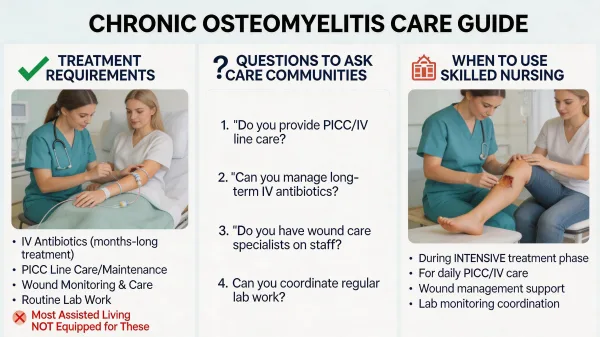
Questions to Ask Any Senior Living Community About Osteomyelitis Care
Families evaluating a care community for a parent with chronic osteomyelitis need specific answers, not vague assurances. The questions below target the operational details that determine whether your parent's treatment will actually be followed through to completion.
Start with staffing: Can the facility administer IV antibiotics, and which nursing license level handles it? How many RNs are on staff during each shift? Is there 24-hour nursing coverage, or are overnight hours covered by LPNs or aides? Who performs PICC line dressing changes and flushes, and what training have they received? What is the protocol if a PICC line becomes occluded or dislodged after hours?
Then move to coordination: Does the facility work with an infectious disease specialist or an OPAT program? Can they draw blood for lab work on-site, or does the resident need to be transported for every blood draw? How do they communicate lab results and wound status to the prescribing physician? What is their process for wound assessment documentation, and how often are wound evaluations done?
Finally, ask about continuity: What happens when the visible wound starts to look better but the antibiotic course isn't finished? How do they prevent protocol fatigue, where staff attention drops as the patient appears to improve? From my years working in clinical settings, I can tell you that protocol adherence in week six rarely matches week one unless someone is actively tracking it.
The Diabetic Foot Ulcer Scenario: A Common Path to Osteomyelitis
Consider a situation where your parent has diabetes and develops a foot ulcer that doesn't heal. Over several weeks, the ulcer deepens, and your parent's doctor orders imaging that confirms the infection has reached the bone. The diagnosis is osteomyelitis, and the treatment plan calls for six weeks of IV antibiotics through a PICC line, followed by months of oral antibiotics and regular wound monitoring.
Your parent is discharged from the hospital with the PICC line in place and a detailed medication schedule. Now you need a care setting that can administer the IV antibiotic (often twice daily), flush the PICC line on schedule, change the dressing weekly with proper sterile technique, monitor the foot wound for signs of worsening, draw blood for weekly lab work, and coordinate with the infectious disease specialist. This isn't optional care. Skip any of these steps, and the infection can return or the PICC line can develop complications that send your parent back to the hospital.
For many families, a skilled nursing facility becomes the temporary answer during the IV phase. The goal is completing the full antibiotic course without interruption, then reassessing the next step based on how the wound and infection are responding.
What Families Often Overlook About Osteomyelitis Care
The biggest gap in osteomyelitis care planning is underestimating the timeline. Families often hear "six weeks of IV antibiotics" and assume that's the total commitment. But six weeks of IV therapy is just the intensive phase. Add the oral antibiotic continuation, wound healing time, and the six-month monitoring period, and you're looking at close to a year of active medical management.
Another common blind spot is the financial structure. Skilled nursing stays for IV antibiotic therapy may be covered under Medicare Part A if the patient qualifies, typically requiring a prior three-day hospital stay and physician certification that skilled nursing care is necessary. Coverage extends up to 100 days per benefit period, with full coverage for the first 20 days and a daily copay after that. Once the IV phase ends and your parent transitions to oral antibiotics, the level of care may no longer meet the threshold for skilled nursing coverage.
When our family was dealing with the financial realities of long-term care, the sticker shock hit hard. The costs don't pause when the acute phase ends. With osteomyelitis, the expenses continue through the oral antibiotic phase, follow-up appointments, lab work, and wound care supplies for months afterward. Planning for the full timeline, not just the first six weeks, makes a real difference in how prepared you are.
Coordinating with Your Parent's Medical Team
Chronic osteomyelitis management requires an infectious disease specialist, and that physician should remain involved throughout the entire treatment course, not just during the hospital stay. Before your parent moves to any care setting, confirm that the infectious disease doctor has a clear communication channel with the receiving facility's nursing staff. Lab results need to be reviewed promptly, because antibiotic adjustments based on kidney function, blood counts, or inflammation markers can't wait until the next scheduled office visit.
Ask the care community how they handle after-hours concerns. If your parent develops a fever, new drainage from the wound, or swelling around the PICC site at 2 AM, there needs to be a protocol in place. PICC-related complications like catheter-associated bloodstream infections are serious and time-sensitive.
Conclusion: Treating Chronic Osteomyelitis Requires the Right Care Setting
Chronic osteomyelitis is a months-long medical commitment that demands consistent, skilled nursing attention from start to finish. The IV antibiotic phase is the most medically intensive period, but the weeks and months that follow require ongoing clinical oversight that shouldn't be left to chance.
Your parent's care setting needs to match the treatment demands at every phase, not just the beginning. A skilled nursing facility is usually the right choice during IV therapy, and the transition to a less intensive setting should only happen when the medical team confirms the infection is responding and the PICC line is no longer needed. Don't let the improvement in how the wound looks trick you into thinking the job is done. Bone infections operate on their own timeline.
You're already doing the right thing by researching this. The families who ask the hard questions before placement are the ones whose parents get the care they actually need.