
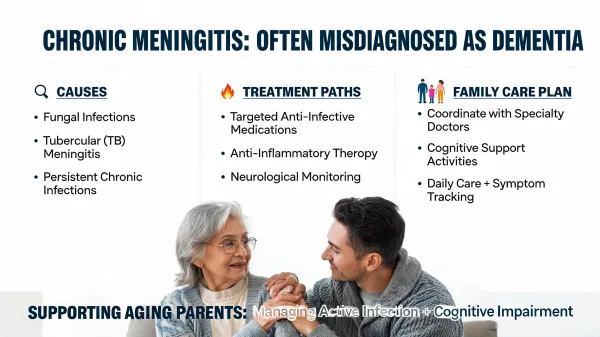
What if your parent's progressive confusion isn't dementia at all, but a slow-burning infection that's been damaging their brain for months? Chronic meningitis is one of the most underdiagnosed causes of cognitive decline in older adults, and by the time families start asking the right questions, the infection has often been at work for half a year or longer.
This is the territory where chronic meningitis memory care decisions get complicated. Your parent isn't just losing memory. They're fighting an active infection of the membranes around the brain, often while their immune system is already weakened by age, cancer treatment, autoimmune medications, or a transplant. The cognitive symptoms can mimic Alzheimer's so closely that families spend months pursuing a dementia workup before someone orders a lumbar puncture and finds the real cause.
Once the diagnosis comes, the picture changes overnight. You're suddenly coordinating between an infectious disease specialist, a neurologist, and possibly an oncologist, while also looking at a care setting that can handle long-term IV or oral antifungal therapy alongside cognitive support. Most families haven't planned for this kind of overlap. I've watched families absorb a diagnosis like this and go silent for a few minutes, because nothing in the standard memory care playbook quite fits.
This guide walks through the major causes of chronic meningitis in older adults, how each one affects cognition, and what care planning actually looks like when infection and cognitive decline arrive together.
What Chronic Meningitis Actually Means
Chronic meningitis is inflammation of the meninges, the membranes surrounding the brain and spinal cord, that persists for four weeks or longer. It's caused most often by fungal organisms, mycobacterial infections (tuberculosis), and certain cancers that seed the meninges. Symptoms develop gradually, sometimes over months, and frequently include headache, low-grade fever, cranial nerve problems, and progressive cognitive impairment.
The slow timeline is what sets it apart. Acute bacterial meningitis brings high fever, severe headache, and rapid deterioration, sending patients to the ER within hours or days. Chronic meningitis creeps. Your parent might mention recurring headaches for weeks. Their personality shifts a little. They get foggy. By the time someone connects the dots, the infection has already damaged brain tissue in ways that may not fully reverse, even with treatment. That's the central problem families are dealing with.
The category itself is broad. Doctors often divide chronic meningitis into infectious causes (fungal, mycobacterial, parasitic, certain bacterial) and non-infectious causes (cancer, autoimmune disease, sarcoidosis, certain medications). Each category requires a different workup and a different treatment path. The first job of the medical team is figuring out which category your parent falls into, because that determines everything that follows.
Why Chronic Meningitis Is So Often Missed
What most people don't realize until they're in it: chronic meningitis is rarely the first diagnosis anyone considers. The slow onset, the older patient, the vague complaints. They get attributed to migraines, stress, depression, early dementia, or just aging. A parent who shows up to urgent care with a headache and some confusion is far more likely to be sent home with a follow-up referral than to receive a lumbar puncture on the spot.
From the inside of a hospital, I've seen the pattern up close. An older patient with progressive cognitive symptoms gets a CT, maybe an MRI, often a basic metabolic panel. If those are unremarkable, the working diagnosis tilts toward dementia. Lumbar puncture is invasive, requires planning, and isn't ordered casually. Many patients see three or four providers before someone says the words "chronic meningitis." By then, weeks or months have passed.
The diagnostic delay matters enormously. Each week of untreated infection means more inflammation, more pressure inside the skull, and more damage to the brain tissue around the meninges. Families often discover, after the fact, that earlier symptoms they'd dismissed were the infection's first signs. The headaches that came and went. The forgetfulness that everyone blamed on stress. Looking back, the timeline is almost always longer than anyone initially realized.
How Chronic Meningitis Damages Cognition
The cognitive impairment in chronic meningitis comes from several mechanisms working at once. Inflammation around the meninges spreads to nearby brain tissue. Cerebrospinal fluid flow can get blocked, raising pressure inside the skull (hydrocephalus). Small blood vessels can become inflamed and clot, causing strokes in deep brain structures. Cranial nerves passing through the inflamed meninges can be damaged, leading to vision changes, hearing loss, and facial weakness.
The end result is a pattern of cognitive symptoms that doesn't look exactly like Alzheimer's. Memory loss is common, but families also see slowed thinking, confusion that fluctuates, executive function problems, and sometimes personality changes. Research on tuberculous meningitis has found that roughly half of patients show measurable cognitive impairment six months after diagnosis, with deficits across memory, attention, processing speed, and language. Cryptococcal meningitis survivors show similar patterns, with memory and processing speed often the slowest to recover.
What makes this especially difficult for families is the unpredictability. Two patients with the same type of chronic meningitis can have very different cognitive trajectories. One may recover most of their pre-illness function over six to twelve months. Another may experience permanent deficits even with successful treatment of the infection itself. The damage already done before treatment started often determines outcomes more than the treatment itself does. That's part of why early diagnosis matters so much.
Types of Chronic Meningitis and Their Cognitive Impact
Chronic meningitis isn't one disease. It's a category that covers several distinct infections and conditions, each with different treatment paths and different expected cognitive outcomes. Knowing which type your parent has shapes nearly every decision that follows.
Cryptococcal Meningitis
Cryptococcal meningitis is the most common form of fungal meningitis worldwide and the most common cause of non-viral meningitis in the United States. It's caused by Cryptococcus neoformans or Cryptococcus gattii, fungi found in soil and bird droppings. Most older adults who develop it have some form of immune suppression: long-term corticosteroids, organ transplant medications, biologic drugs for autoimmune disease, certain cancers, or untreated diabetes. Some previously healthy patients also develop it.
Treatment runs in three phases. Induction is usually two weeks of intravenous amphotericin B plus oral flucytosine, designed to clear the fungus from the cerebrospinal fluid quickly. Consolidation follows with eight weeks of oral fluconazole at higher doses. Maintenance therapy at lower fluconazole doses then continues for six to twelve months, sometimes longer if your parent remains immunocompromised. Even with full treatment, mortality and long-term morbidity remain high. Research suggests 30 to 50 percent of patients face significant long-term complications despite therapy, and immune reconstitution inflammatory syndrome (IRIS) can complicate recovery in some patients. Cognitive recovery varies considerably from patient to patient. Some regain most of their pre-illness function over the months following treatment. Others have lasting deficits in memory, attention, and processing speed that don't fully resolve. The early recognition window matters most. Patients diagnosed and treated within the first weeks of symptoms tend to recover more cognitive function than those whose diagnosis was delayed for months.
Tuberculous Meningitis (TB Meningitis)
TB meningitis is the deadliest form of tuberculosis. In older adults, it often reflects reactivation of a latent TB infection acquired decades earlier, sometimes during childhood. Symptoms develop over weeks: low-grade fever, headache, weight loss, personality changes, then confusion. Treatment is long, typically nine to twelve months of multi-drug therapy starting with isoniazid, rifampin, pyrazinamide, and ethambutol, often combined with corticosteroids to reduce inflammation. Studies have shown cognitive impairment in roughly half of TB meningitis survivors at six months, with deficits that may persist even after the infection is cured. The earlier treatment starts, the better the cognitive outcome.
Other Fungal Meningitis
Coccidioidal meningitis (from Valley Fever) and histoplasma meningitis are regional fungal infections. Coccidioidal meningitis is found mainly in the southwestern United States, while histoplasmosis is more common in the Ohio and Mississippi River valleys. Both can cause chronic meningitis with progressive cognitive decline, and both typically require lifelong antifungal therapy because the infection rarely clears completely. Fluconazole is the standard treatment for coccidioidal meningitis, with itraconazole used for some histoplasma cases.
Carcinomatous Meningitis (Leptomeningeal Disease)
Carcinomatous meningitis isn't infection at all. It's cancer cells that have spread to the meninges, most often from breast cancer, lung cancer, or melanoma. It causes meningitis-like symptoms because the cancer cells trigger inflammation and disrupt cerebrospinal fluid flow. Cognitive decline can be rapid, and prognosis is grave. Median survival is two to four months even with treatment. Care planning here looks very different from infectious meningitis, because the focus shifts toward symptom management and quality of life rather than long-term recovery.
Immunocompromised vs. Immunocompetent
Immune status changes everything. Patients with weakened immune systems get sicker faster, respond less well to treatment, and have higher rates of relapse. They also need longer maintenance therapy and closer monitoring. Immunocompetent patients sometimes recover more cognitive function, but they're also less likely to be diagnosed quickly because doctors don't immediately suspect chronic infection in someone without obvious risk factors.
Recognizing the Cognitive Symptoms
The cognitive symptoms of chronic meningitis don't match any single dementia pattern. That's actually a clue. Alzheimer's typically progresses slowly and steadily, with memory loss leading the way. Chronic meningitis tends to produce a more mixed picture, often with headache as a constant companion.
Families should pay close attention to symptoms that include progressive headaches that don't respond to typical treatment, low-grade fevers that come and go, personality changes that seem out of character, fluctuating confusion (worse some days, better others), problems with vision or hearing, weight loss without an obvious cause, and night sweats. When several of these appear together with cognitive decline, chronic meningitis belongs on the differential diagnosis list.
Imagine your father has been complaining about headaches for six weeks. He's been more forgetful, but you've chalked it up to stress. Then you notice he's lost ten pounds, and his sister mentions his personality seems different. The headaches plus the cognitive changes plus the systemic symptoms together are the pattern that should trigger a workup beyond a basic dementia evaluation. That cluster of symptoms isn't normal aging.
Diagnosis: Why It Takes So Long
Diagnosing chronic meningitis requires a lumbar puncture (spinal tap) to analyze cerebrospinal fluid. Brain imaging alone usually isn't enough. CT scans often look normal early in the disease. MRI may show subtle changes around the meninges, but those findings can be missed if the radiologist isn't specifically looking for them. The CSF analysis is what reveals the diagnosis: elevated protein, low glucose, lymphocyte-predominant white blood cells, and (with luck) the actual organism on culture or antigen testing.
Even then, diagnosis can take time. Fungal cultures grow slowly. Cryptococcal antigen tests are usually fast and reliable, but tests for coccidioidomycosis or histoplasmosis may require sending samples to specialized labs. TB testing on CSF is notoriously insensitive. Cytology for cancer cells often requires multiple lumbar punctures. The first tap has roughly a 50 percent yield for carcinomatous meningitis. By the third tap, the yield rises closer to 85 percent.
For families, this means the period between "something is wrong" and "here's what we're treating" can stretch weeks. That waiting period is one of the hardest parts.
When to Push for a Second Opinion
If your parent has progressive cognitive symptoms combined with persistent headaches, low-grade fever, or systemic illness, and the workup so far has been limited to brain imaging and basic labs, ask whether a lumbar puncture is appropriate. This is especially true if your parent has any condition or medication that suppresses the immune system. Common ones include long-term steroid use, biologic medications for rheumatoid arthritis or psoriasis, chemotherapy or recent cancer treatment, organ transplant medications, untreated or poorly controlled diabetes, and HIV.
You're not being difficult by asking. You're advocating for the level of workup that the symptoms actually warrant. A neurologist or infectious disease specialist consultation can also help when a primary care doctor or general hospitalist hasn't ordered the right tests. Many families look back later and wish they'd pushed harder, sooner.
From my hospital years, I've seen patients get re-evaluated after a family member finally insisted on a different specialist, and the lumbar puncture came back positive for an infection nobody had considered. The moral isn't that you should distrust your parent's doctors. The moral is that complex diagnoses sometimes need a fresh set of eyes, and asking for one is reasonable. Most physicians appreciate engaged families who are paying attention to changes the medical team might not see in a fifteen-minute appointment.
Care Planning When Infection and Cognitive Decline Overlap
Once chronic meningitis is diagnosed, your parent needs both ongoing infectious disease management and cognitive support, often for many months. This is where standard memory care planning gets complicated. Most assisted living and memory care communities are built for stable cognitive decline, not for residents who need IV antifungal infusions, frequent lumbar punctures, weekly lab draws, and coordination across three or four specialists.
Medication Adherence with Cognitive Impairment
Antifungal and anti-TB regimens are unforgiving. Missed doses can mean treatment failure, drug resistance, or relapse. A patient with cognitive impairment can't reliably manage a complex medication schedule. Families need to plan for medication management from day one. In a home setting, that often means a family caregiver dispensing every dose. In assisted living, medication management is typically a paid service that adds to the monthly cost. In skilled nursing, it's built into the level of care. The wrong setting for a patient with chronic meningitis is one where they'll be expected to self-manage their medications.
Infection Control in Residential Care
Most chronic meningitis isn't contagious through casual contact, which surprises some families. Cryptococcal, coccidioidal, and most fungal meningitis don't spread person-to-person. TB meningitis, however, requires careful evaluation. Pulmonary TB can be contagious, and a facility may want documentation that your parent isn't actively shedding the organism. Carcinomatous meningitis isn't infectious. Always confirm with the infectious disease team what specific precautions, if any, the care community needs to follow.
Coordinating Infectious Disease and Neurology
Your parent will likely have at least two specialist teams: infectious disease for the infection, neurology for the cognitive and neurological consequences. Sometimes oncology joins for carcinomatous meningitis. The handoffs between these teams matter. Ask early whether your parent's care team uses a shared electronic record, who's responsible for adjusting medications when side effects appear, and which physician you should call first when something changes. Without a clear point of contact, families end up acting as their own care coordinators, which is a heavy job to carry alongside everything else.
Watching a loved one cycle through hospital admissions for a chronic illness teaches you something that no clinical training quite captures. I spent five years caring for my first husband through cancer, and what I learned in those years is that the emotional weight isn't only in the crises. It's also in the long stretches between them, when you're managing medications, watching for the next sign that something is changing, and trying to hold a normal life together around an abnormal situation. Families dealing with chronic meningitis need sustainable support systems, not just acute care responses. The infection is going to be part of life for many months, and you have to plan accordingly.
Choosing the Right Care Setting
For active treatment, especially during the induction phase of cryptococcal meningitis, hospital-level or skilled nursing care is often the right setting. Once your parent transitions to oral consolidation or maintenance therapy, options open up. Assisted living with medication management and a strong nursing presence can work for some patients. Memory care can work if the cognitive decline is stable and the medication regimen is simple. Home care with skilled nursing visits can work for families who have the support to make it sustainable.
The Cost of Chronic Meningitis Care
Care for chronic meningitis can be expensive in ways families don't expect. The hospital admission and induction therapy are usually covered by Medicare or private insurance, but post-hospital care often involves significant out-of-pocket costs. Memory care averages around $6,200 to $8,000 per month nationally as of 2025, depending on location and level of care. Assisted living with medication management typically runs $5,000 to $7,500 per month. Skilled nursing facilities run higher, often $9,000 to $12,000 per month, but Medicare covers limited stays after a qualifying hospital admission, and Medicaid eventually covers long-term skilled nursing for those who qualify financially.
Add in specialist co-pays, lab work, and medications (some antifungals run thousands of dollars per month even with insurance), and annual costs can exceed $100,000 for the first year of care alone. I've watched families experience the financial shock of memory care costs from the inside, and chronic meningitis often makes that shock worse, because the timeline is uncertain and the medical needs are higher than in standard memory care.
Building a Sustainable Family Support Plan
Treatment for chronic meningitis often unfolds over a year or longer. The family caregiver who's running on adrenaline in week three won't be able to keep that pace through month nine. Sustainable support means dividing responsibilities now, not later. Identify who handles medical appointments, who handles medication management, who handles finances, and who provides primary emotional support. If those all default to one person, burnout isn't a risk. It's a certainty.
Respite care, whether through adult day programs, in-home care services, or short-term residential stays, is a tool many families don't use until they're already exhausted. Set it up early. Ask the infectious disease team's social worker about resources. Some hospitals have dedicated care coordinators for complex chronic conditions, and many states have aging services agencies that can connect families with caregiver support, financial counseling, and respite programs.
Document everything as you go. Keep a notebook or shared digital file with current medications, doses, side effects observed, lab results, and notes from each appointment. When your parent is treated by multiple specialists, the family record is sometimes the most complete picture of what's happening. It's also invaluable if your parent moves between care settings or sees a new physician who needs the full history quickly.
Decision Framework: Where Should Care Happen?
When you're weighing options, walk through these questions about your parent's specific situation:
- How much medical care does treatment require right now? IV therapy and frequent lab draws push toward skilled nursing or hospital-level care. Oral medications and stable monitoring open more options.
- How advanced is the cognitive impairment? Stable decline can be managed in memory care. Fluctuating confusion with active infection often needs more medical oversight.
- Is there a family caregiver who can sustain home care for many months? Honest answer, not aspirational. The marathon nature of chronic meningitis matters here.
- What's the projected duration of treatment? A nine-month TB regimen is different from indefinite maintenance therapy for coccidioidal meningitis.
- What's the prognosis for cognitive recovery? If significant recovery is expected, a setting that supports rehabilitation matters. If decline is likely to continue, the setting should be one that can handle progression without another move.
There's no single right answer. The right setting is the one that matches your parent's medical needs, your family's capacity, and the realistic trajectory of their condition.
What to Hold Onto
Chronic meningitis is one of the most complex situations a family can face, because it combines an active medical illness with cognitive decline at the same time. The diagnosis is often delayed. The treatment is long. The cognitive outcomes are uncertain. None of that is your fault, and none of it makes you a worse caregiver for not having seen it coming.
What helps most is getting the right specialists involved early, planning for sustainability rather than sprint, and being honest with yourself about what your family can carry. The families who do best aren't the ones who try to do everything themselves. They're the ones who build a team, ask hard questions, and stay flexible as the situation changes. You can do this. You don't have to do it alone.