
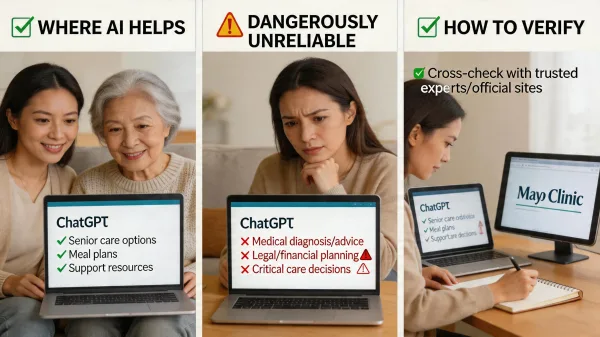
As of April 2026, you're probably already using ChatGPT, Claude, or Gemini to help research your parent's care. Most family caregivers are. The question isn't whether to use AI chatbots, it's how to tell when they're helping and when they're confidently wrong in ways that matter.
During the caregiving arc of my own life, what I would have given for a 24/7 knowledgeable friend to ask questions to at 2 AM when the medical world had shut down for the night. ChatGPT can feel like that friend. Sometimes it actually is. Sometimes it's not, and the gap between those two states is harder to spot than people realize.
Picture a family whose mother was just diagnosed with vascular dementia. The adult daughter has been using ChatGPT to research prognosis, treatment options, legal planning, and what to expect month by month. Some of what the chatbot tells her is accurate. Some is outdated. Some is subtly wrong in ways she can't detect without a clinical or legal background. That's the situation most caregivers are in right now, and it's the reason this guide exists.
From nearly 20 years inside hospitals and from my own family's experience watching dementia accelerate, here's a framework for ChatGPT for caregivers: the four categories where it actually helps, the three where it's dangerously unreliable, and the verification habits that separate effective AI use from blind trust.
The Four Categories Where ChatGPT for Caregivers Actually Helps
AI chatbots aren't uniformly good or bad. They're reliable for some types of questions and unreliable for others, and the dividing line is more predictable than most people assume.
1. General Explanations of Conditions and Medical Terms
This is where AI chatbots shine. Asking ChatGPT to explain what vascular dementia is, how it differs from Alzheimer's, what Lewy body dementia looks like in early stages, or what ARIA means in the context of lecanemab treatment will produce accurate, clearly written answers most of the time. These concepts are heavily represented in training data and the underlying definitions don't change quickly. The chatbot can also adjust the reading level, which matters when you're trying to explain a diagnosis to your siblings or to your parent.
2. Drafting Difficult Conversations
Some of the most useful caregiver work an AI chatbot does has nothing to do with medicine. Asking it to help you draft a conversation with your father about giving up driving, or to frame a sibling discussion about who's contributing financially, or to script how you'll explain memory care to a parent who doesn't think they need it, produces genuinely useful first drafts. You'll edit them. But the chatbot gives you a starting point you didn't have before, and that lowers the activation energy for conversations most families avoid for too long.
3. Organizing and Summarizing the Information Deluge
Caregiving generates a lot of paper. Discharge summaries, insurance documents, facility brochures, doctor's notes, advance directive forms. ChatGPT can summarize a 40-page Medicare Advantage policy into the points that matter for your specific situation. It can extract action items from a hospital discharge summary. It can convert clinical shorthand into language your parent understands. I've watched families come into the ER with a printout of ChatGPT-generated questions, and the visit went better because they weren't trying to remember everything in the moment.
4. Research Scaffolding
The chatbot is useful for generating the questions you don't yet know to ask. Ask it for a checklist of things to look for on a memory care facility tour, or for the questions a neurologist should be able to answer at your parent's next appointment, or for the considerations that should go into a long-term care decision. The output isn't a final answer. It's a scaffold that helps you walk into the next conversation prepared.
The Three Categories Where ChatGPT for Caregivers Is Dangerously Unreliable
This is the section that matters most. The categories below are where AI chatbots produce confidently stated answers that are wrong often enough to do real harm if you act on them without verification.
1. Current Clinical Guidelines and Treatment Protocols
AI training data has a cutoff. Medical guidelines change faster than that cutoff. ChatGPT will state what the standard of care for moderate Alzheimer's was a year or two ago with the same confidence it states what your last name is. It will tell you which medications are first-line for behavioral symptoms in dementia, what hospice eligibility criteria are, or what Medicare's coverage rules are for cognitive testing, and some of that information will be outdated. The chatbot doesn't flag this. It doesn't say "as of my training data, which may be behind current guidance." It just answers.
2. Specific Medication Decisions
This is the category that worries me most. The chatbot will produce probabilistically plausible answers about dosing, drug interactions, and substitutions. None of those answers account for your specific elderly parent: her kidney function, her other medications, her recent hospitalization, the fact that she's lost 15 pounds in three months. A pharmacist or her physician knows that context. The chatbot doesn't, and the answer it gives can sound right while being wrong for her.
The most haunting thing I saw repeatedly during my family member's dementia journey, and during nearly two decades in the hospital, wasn't dramatic medical errors. It was confident-sounding information that turned out to be wrong in ways the family couldn't detect until it cost them something. A care coordinator who said Medicaid worked one way when it didn't. A pamphlet that listed eligibility criteria three years out of date. A relative who'd read something online and built a plan around it. AI chatbots produce that same kind of authoritative-sounding wrongness, and they produce it faster and cheaper than any other source. The physicians I trust most are the ones who say "let me check" before they answer. The chatbot never says that, and the longer you use it, the easier that is to forget.
3. State-Specific Legal and Benefit Eligibility
Medicaid rules vary dramatically by state. Power of attorney requirements vary by state. Advance directive specifics vary by state. Long-term care insurance triggers vary by policy. ChatGPT defaults to generic, federal-level, or "most states" answers. Those answers are often wrong for your state, and the difference can be tens of thousands of dollars or a legal document that won't hold up when you need it to. Ask the chatbot a Medicaid question and you'll get an answer that's true somewhere in the country and false where your parent lives. The chatbot has no way to know which.
The Verification Framework Caregivers Should Use
For anything consequential, run AI output through a three-layer verification. The habit takes about ten minutes and it's the difference between AI helping you and AI quietly steering you wrong.
Layer One: Primary Source Check
Does the chatbot's answer match primary source documentation? For medical questions, the Alzheimer's Association, the National Institute on Aging, and Mayo Clinic publish current information at the level a family caregiver needs. For benefits questions, Medicare.gov and Medicaid.gov are the authoritative sources, plus your state's Medicaid agency for state-specific eligibility. For legal questions, your state's bar association website and the state office on aging both publish accurate materials. If the chatbot's answer doesn't match what these sources say, the chatbot is wrong, not the source.
Layer Two: Specialist Confirmation
For anything that will drive a decision, ask a qualified human to confirm or correct. Bring the AI output to your parent's physician and ask explicitly: "ChatGPT told me X about her medication. Is that right for her?" Bring the legal output to an elder law attorney and ask whether it applies in your state. Bring the benefits output to a social worker or to your Area Agency on Aging. The chatbot is not your specialist. It's the thing that helps you walk into the specialist's office prepared.
Layer Three: Source Citation Check
Ask the chatbot to cite the specific sources for its claims, then verify those sources actually say what it claimed. Modern AI chatbots will sometimes cite sources that don't exist, or cite real sources that don't contain the cited information. This is called hallucination, and it happens often enough that the citation itself isn't proof. The proof is opening the source and reading the relevant section. If the chatbot can't cite a source, or the source it cites doesn't say what it claimed, treat the answer as a guess.
None of this is paranoid. It's the same verification habit a careful clinician uses, and it's why the AI tools become useful instead of dangerous.
Prompts That Actually Work for Caregiving Research
How you ask matters. The same chatbot will produce mediocre output from a vague prompt and sharp, usable output from a structured one. Three patterns work consistently for caregiving research.
For Condition Research
"Explain [condition] at a level appropriate for a family caregiver who isn't a medical professional. Include what to expect in the first six months after diagnosis. Then list five questions I should ask the specialist at our next appointment, and tell me what red flags would warrant a call between appointments."
This prompt structure does three things. It sets the reading level, it specifies the timeframe, and it ends with action items you can actually use. The output you'll get is dramatically better than what "tell me about vascular dementia" produces.
For Difficult Conversations
"Help me draft a conversation with my 76-year-old father about [topic]. His values include [values]. He tends to [common reaction pattern]. The outcome I want is [specific goal]. Give me an opening line, a response for if he gets defensive, and a response for if he goes quiet."
The specificity is what makes this work. Generic conversation drafts read like generic conversation drafts. When you give the chatbot the values, the patterns, and the goal, the draft sounds like something a person who knows your father might write. You'll still rewrite it in your own voice, but you'll start from somewhere useful.
For Document Summarization
"Here is a 15-page document from our insurance company. Summarize it in plain language, focusing on [specific concern: coverage for memory care, out-of-pocket maximums, prior authorization requirements]. Then list what's unclear or missing, and tell me what I should follow up on with the company directly."
The "what's unclear" part is the trick. It forces the chatbot to flag its own uncertainty instead of papering over it, and it gives you a list of things to call the insurance company about rather than a false sense that you understand the policy.
What Not to Do With a Chatbot
The categories below aren't gray areas. They're the situations where AI output should never be the basis for action.
Don't let the chatbot replace your parent's primary care physician, a geriatric care manager, an elder law attorney, or a hospital social worker. These professionals carry liability and judgment the chatbot can't replicate. Don't make medication decisions based on its output, including OTC medication and supplement decisions for an elderly parent on multiple prescriptions. Don't rely on it for state-specific legal guidance you intend to act on without an attorney's review. Don't use it to draft legal documents that will actually be filed. Use it to generate the questions for the lawyer, not the document the lawyer would draft.
Don't use it to draft medical communications that will go to a provider without you reading every line. The chatbot will sometimes invent symptoms, dates, or medication names that sound plausible but didn't happen. Don't paste personal health information you wouldn't want stored on a company server, since chatbot conversations are typically retained and used for training unless you've configured them otherwise. And don't treat the absence of a hedge as confidence. The chatbot's tone is uniform whether it's confident or guessing. Your judgment is the part that has to fill that gap.
Using AI Without Outsourcing Your Judgment
ChatGPT for caregivers is a real tool, not a gimmick. It saves time, it lowers the cost of getting started on hard tasks, and it gives families access to information that used to require an appointment. The hazard isn't that it exists. The hazard is the confident tone it takes on topics where it's subtly wrong, and the way that confidence wears down your skepticism over time.
Use it for the four categories where it helps. Verify aggressively in the three categories where it doesn't. Build the three-layer verification habit before you need it. And remember that the chatbot is the thing that helps you walk into the doctor's office, the lawyer's office, and the facility tour prepared, not the thing that replaces them.
You're already doing the hardest part: showing up for a parent who needs you. The AI is just one more tool. Used well, it gives you back time and clarity. Used badly, it gives you confident wrongness that costs you both. The framework above is what separates the two.