
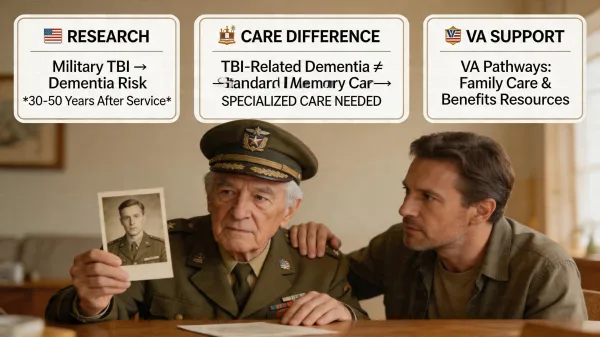
Could the head injury your dad got in the service 40 years ago be why he's declining now? It's the question families ask when they sit with a VA doctor and realize the story of their parent's cognitive decline didn't start six months ago. It started in a blast, a training accident, or a firefight decades earlier, and the link between military TBI and dementia is one that families rarely see coming.
Military TBI-to-dementia progression refers to the documented pattern where veterans who sustained traumatic brain injuries during service show elevated dementia risk 20 to 50 years later. The injury often appears to resolve, but underlying neurological damage raises the likelihood of cognitive decline in later life.
I've seen the acute side of TBI in the ER for nearly two decades, and what the research shows about what happens 30 years later is why this article exists. Adult children come in with a parent whose memory is slipping, and somewhere in the history intake, a son or daughter mentions that Dad "got knocked out pretty good" during Vietnam or Desert Storm. That's often the moment the picture starts to shift. This article walks through what the research actually establishes, how TBI-related dementia can differ from standard Alzheimer's in care needs, how to rebuild a service-era injury timeline, VA benefits that may apply, and the practical decisions families face when old injuries resurface.
The Research Connection: Why a TBI From 1969 Matters in 2026
The research link between military TBI and later dementia is one of the more established findings in veteran neurology, though important nuances still get lost when families hear about it secondhand. The landmark study came out of the San Francisco VA in 2018, published in JAMA Neurology, led by Dr. Deborah Barnes and Dr. Kristine Yaffe. They followed more than 178,000 veterans with documented TBI and compared them to a matched control group of veterans without TBI. The results showed a clear dose-response relationship: the more severe the TBI, the higher the later risk of dementia.
The adjusted hazard ratios tell the story clearly: veterans with mild TBI but no loss of consciousness showed about 2.4 times the risk of developing dementia compared to veterans without TBI, and mild TBI with loss of consciousness pushed the risk to roughly 2.5 times. Moderate-to-severe TBI, the category that would include penetrating head wounds, large blast exposures, and vehicle rollover injuries, nearly quadrupled the risk at 3.77 times baseline. An earlier Barnes study from 2014 focused on older veterans and found that 16% of those with TBI developed dementia during a 9-year follow-up, compared to 10% of those without TBI.
What the research actually says about latency
The latency period is what catches families off guard. The veteran recovered, went back to work, raised a family, and seemed fine for decades. Then, often in their 60s or 70s, cognitive symptoms begin. Research suggests that TBI may accelerate age-related neurodegeneration, and that even a single moderate injury can set off long-term changes in brain tissue that don't produce symptoms until aging, genetic vulnerability, or other factors compound the damage. This isn't a case where the dementia "comes from" the TBI in a simple cause-and-effect sense. It's that the TBI raises the baseline risk, and the dementia that eventually appears may be Alzheimer's, vascular dementia, or a mixed pathology.
Blast exposure and penetrating injuries
Blast injuries and penetrating wounds carry particular concern, and roughly 60% of military-related TBI from the Iraq and Afghanistan conflicts came from blast exposure, with VA research identifying distinct injury mechanisms from blast wind and pressure waves that differ from ordinary impact TBI. All penetrating brain injuries, including shrapnel wounds and gunshot wounds, are classified as severe TBI by VA criteria, regardless of how well the veteran appeared to recover afterward.
What the research doesn't yet establish
Chronic traumatic encephalopathy, or CTE, is a distinct tau-protein neurodegenerative disease most often associated with repetitive head impacts in contact sports. Research has identified CTE pathology in some blast-exposed veterans, and a Department of Defense brain tissue repository study published in the New England Journal of Medicine found CTE in a small proportion of military decedents with blast exposure. However, CTE is diagnosed post-mortem, and current evidence doesn't support diagnosing it in living veterans or equating it with the more common dementias that appear decades after TBI. The ongoing LIMBIC-CENC consortium, a VA and Department of Defense research partnership, continues to study these long-term effects, but families should understand that much of the detailed mechanism remains active research rather than settled science.
What is established is this. Your parent's TBI didn't cause a predictable disease in a predictable timeline. It raised the statistical odds that, as they aged, cognitive decline would arrive earlier or hit harder. That matters for understanding what's happening now and for navigating benefits your family may be entitled to.
How TBI-Related Dementia Differs in Care Needs
Standard memory care is largely designed around Alzheimer's disease: gradual short-term memory loss, progressive disorientation, and eventually physical decline. Veterans with TBI-related cognitive decline often present a different picture, and memory care facilities that have never worked with this population sometimes struggle to recognize what's happening.
Behavioral volatility is the first thing to understand. TBI damages specific brain regions, particularly the frontal and temporal lobes, in ways that can produce disinhibition, sudden anger, impulsivity, and emotional dysregulation well before classic memory symptoms fully develop. Your father may forget the conversation he had an hour ago, but the behavioral change families report first is often that he's "not himself," meaning shorter fuse, less filter, less emotional control. A facility staff member who reads that behavior as standard dementia agitation may respond in ways that escalate rather than de-escalate.
PTSD overlap is the second layer. Many veterans with TBI also have co-occurring PTSD from the same combat experiences that caused the brain injury. When dementia begins stripping away the coping mechanisms your parent built over 40 or 50 years, PTSD symptoms can resurface with intensity. Nightmares, hypervigilance, startle response, and flashbacks can all return in ways the family hasn't seen since your parent came home from the war. A memory care facility without staff trained in trauma-informed care may treat a startle response or nighttime agitation as behavioral management rather than trauma recurrence.
In the ER, I saw acute TBI patients present with the volatility and disorientation that textbook descriptions predict, and the treatment was stabilization and neuro consult. Years later, when I was doing mobile X-ray work inside senior care facilities, I saw residents with what looked like dementia but with behavioral profiles that didn't quite match. The staff were trained on Alzheimer's protocols, and when a resident acted out in ways those protocols didn't anticipate, the response was often medication rather than investigation. Looking back, I'm sure some of those residents were veterans whose TBI history nobody had connected to what was happening in the dayroom. That experience is why this article is blunt about asking facilities what they know before you sign an admission agreement.
When you tour facilities, ask specifically: How many of your current residents are veterans? What training does your staff have in trauma-informed care and TBI-related behavioral symptoms? How do you handle nighttime agitation that may be trauma-related? Do you have a relationship with the local VA medical center, and can you coordinate care with VA neurology? A facility that answers these questions with specifics is a different caliber of option than one that pivots to general marketing language.
Rebuilding Your Parent's Military TBI Timeline
Before the VA can evaluate service connection, and before a neurologist can put the current decline in context, you'll need to reconstruct what actually happened during service. Many veterans of earlier eras, particularly Vietnam, either don't remember the details clearly, never talked about them, or minimized the severity at the time. Blast exposures and mild TBIs weren't documented systematically in service medical records until relatively recently.
Start with the DD-214, which is the discharge document that confirms service dates, combat theaters, and awards. A Combat Infantryman Badge, Purple Heart, or combat action medal is often the thread that leads to identifying when and how an injury occurred. Request a complete copy of service treatment records from the National Personnel Records Center. Then sit down with your parent, if they're able, and ask about specific events. When my own family was piecing together what had been happening with a relative's cognitive decline, the conversations where siblings compared memories turned up details nobody had ever shared. Old letters, VFW friends, and fellow unit members are sometimes the only remaining source for what actually happened in 1969 or 1991.
Getting a Formal TBI and Dementia Evaluation Through the VA
The VA Polytrauma System of Care, established in 2005, is the specialty infrastructure for evaluating and treating service-related TBI. It has five Polytrauma Rehabilitation Centers located in Minneapolis, Palo Alto, Richmond, San Antonio, and Tampa, along with 23 Polytrauma Network Sites and 87 Polytrauma Support Clinic Teams distributed across VA medical centers nationwide.
For an aging veteran showing cognitive decline, the evaluation usually starts with a referral from your parent's primary VA provider to the local Polytrauma Point of Contact or Network Site. A Comprehensive TBI Evaluation by a specialty provider typically includes neuropsychological testing, imaging, and a structured clinical interview about injury history. These evaluations matter both for care planning, which guides what kind of memory care environment your parent will actually do well in, and for benefits, because the VA's determination of whether the current cognitive decline is connected to service influences what compensation and long-term care options become available.
VA Benefits for Veterans with TBI-Related Dementia
If the VA determines that your parent's dementia is secondary to service-connected TBI, disability compensation rates can change meaningfully. As of December 2025, reflecting the 2.8% cost-of-living adjustment that took effect for 2026, a 100% service-connected veteran receives $3,832.73 per month, with additional amounts for dependent spouses and children, and a veteran at 70% or higher also qualifies for additional VA long-term care programs. Aid and Attendance is the benefit most relevant to families facing memory care costs. It's an add-on to VA pension or disability compensation for veterans who need help with activities of daily living, are bedridden, or reside in a nursing facility. The wartime-service pension version of Aid and Attendance has separate income and asset thresholds, while the service-connected version falls under the Special Monthly Compensation framework, which includes Aid and Attendance tiers that can add substantial monthly amounts. A VA-accredited representative or Veterans Service Officer can calculate what applies to your parent's specific situation, since the combinations depend on disability rating, dependents, care setting, and whether the veteran served during a qualifying wartime period.
The Financial Picture for TBI Memory Care
Memory care costs hit families hard, and veterans' families aren't exempt from the sticker shock. Per the 2025 CareScout Cost of Care Survey, the national median for assisted living reached $6,200 per month, or $74,400 annually. Memory care typically runs $1,000 to $2,000 above assisted living, placing a realistic national range at roughly $7,200 to $8,500 per month, or $86,400 to $102,000 per year. Nursing home care in a private room runs $355 per day, or about $129,575 annually.
When I watched a family member's memory care costs start stacking up, the annual math was what really landed. The monthly number feels manageable in isolation. Multiplied by twelve, then projected across a potential five-to-eight-year care trajectory, it's a different conversation entirely. VA benefits can offset meaningful portions of that cost, but usually don't cover all of it. Families should model the full funding picture early, combining VA compensation, Aid and Attendance, Social Security, pensions, long-term care insurance if any, and personal assets against projected annual cost.
Support Resources for Families of Veterans with TBI
The VA Caregiver Support Program operates through two tiers of assistance. The Program of General Caregiver Support Services, or PGCSS, is available to caregivers of any enrolled veteran regardless of era, and offers peer mentoring, skills training, phone support, and resource referrals. The Program of Comprehensive Assistance for Family Caregivers, or PCAFC, requires a 70% or higher service-connected disability rating and provides a monthly stipend, CHAMPVA health insurance if the caregiver isn't otherwise insured, mental health counseling, at least 30 days of respite care per year, and legal and financial planning support.
The Caregiver Support Line at 1-855-260-3274 is the entry point for both programs. The Alzheimer's Association also maintains veteran-specific resources and can help families coordinate between VA services and community dementia support.
Family Decision Framework: Planning for TBI Memory Care
When you sit down to plan, a few practical questions will shape the path forward. Has your parent been formally evaluated by the VA Polytrauma System, or only by community providers? Do you have documentation of the service-era TBI, or do you need to reconstruct it? What's your parent's current VA disability rating, and when was it last updated? Is there a surviving spouse who would be affected by long-term care decisions and costs?
On the care side: What does your parent's daily behavior actually look like, not as a diagnostic label but as lived reality? Are facilities near you experienced with veterans and trauma-informed care? What's the realistic funding picture over the next five years, combining VA benefits with family resources?
Answering these questions concretely gives you something to work with. Vague answers lead to rushed decisions during crises. Specific answers give you a decision framework you can hold up against any facility, any VA pathway, and any financial model your family considers.
Closing Thoughts
The connection between a head injury from 40 years ago and the cognitive decline you're seeing now is real, but it doesn't mean the future is written. Research establishes that military TBI elevates dementia risk; it doesn't predict exactly how the disease will unfold for any single veteran. What your family can do is rebuild the timeline, engage the VA Polytrauma System for evaluation, pursue benefits your parent earned through service, choose a care setting with staff who understand veterans and trauma, and model the financial picture with real numbers.
None of this erases what your parent is going through, or what your family carries. But clarity about the why, and about the resources available, tends to change how the next year feels. You stop reacting to something mysterious and start managing something understood. That shift, from confusion to informed action, is often the most important thing a family can give a veteran parent in this stage. Your parent served. Now it's your turn to work through the system on their behalf, and you don't have to do it alone.