
When One Excision Becomes Seven: Living with Recurring Skin Cancer
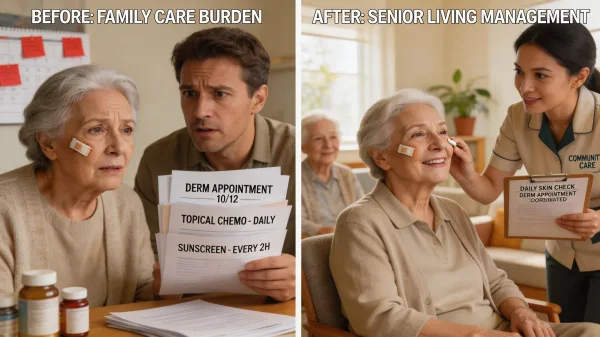
Your parent's dermatologist finds another suspicious spot during what was supposed to be a routine skin check. There's a brief exam, a biopsy, and a call a week later confirming another basal cell carcinoma, the seventh one in ten years. The procedure itself isn't the hard part anymore, because your family already knows the drill: schedule the excision, manage the wound care, wait for it to heal, go back for monitoring, and repeat. What catches most families off guard about recurring skin cancer isn't any single diagnosis, but the realization that this cycle of treatment and surveillance is now a permanent part of their parent's life. For families weighing senior living as a way to manage that ongoing burden, understanding what the cycle looks like and what kind of daily support it requires can help you evaluate your options with clarity.
Recurring skin cancer in seniors isn't a medical crisis in the traditional sense. Basal cell carcinoma, the most common type, rarely spreads beyond the skin and almost never threatens life. But the steady rhythm of dermatology visits, biopsies, Mohs surgeries, wound care, and topical chemotherapy treatments creates a care burden that builds quietly over years. For an older adult already managing other health concerns, this recurring cycle can turn into a full-time coordination job for the family, and a senior living community with the right staff and routines can absorb much of that weight.
I've spent years caring for people whose conditions required small, consistent daily actions rather than dramatic interventions, whether it was managing feeding schedules, medication timing, or wound care routines. Running a daycare for a decade taught me that reliable care isn't glamorous, but the people depending on you notice when it slips, even a little. That same principle applies to every chronic health condition I've encountered since, including the years I spent as a spousal caregiver managing daily medication and wound care. Skin cancer management in seniors works the same way: it's not about emergency responses, but about showing up every day with the right routine in place.
Why Skin Cancer Keeps Coming Back in Older Adults
Basal cell carcinoma accounts for roughly 80% of all non-melanoma skin cancers, and its incidence rises sharply with age. A global analysis published in JAMA Dermatology estimated approximately 2.8 million BCC cases among adults 65 and older worldwide in 2021, with rates continuing to climb as populations age. The reason is cumulative: decades of sun exposure create ongoing damage in the skin's DNA repair mechanisms, and aging skin becomes less efficient at correcting that damage on its own. For seniors who've already had one BCC, studies suggest a 30% to 50% chance of developing a new lesion within five years, not because the original cancer returned but because the skin itself has been primed by a lifetime of exposure.
That pattern is what shifts skin cancer from a one-time medical event into a chronic management condition, and families who understand this early tend to plan more effectively than those who treat each new diagnosis as a surprise.
The Recurring Cycle: What Ongoing Skin Cancer Management Looks Like
The typical cycle for a senior with recurring skin cancer follows a predictable pattern, though the timing varies person to person. It starts with surveillance: a full-body skin exam every three to six months, depending on the patient's history. The dermatologist examines existing scars, checks areas of prior treatment, and looks for new suspicious spots. For someone with a history of seven or more BCCs, these exams are thorough and can take 30 to 45 minutes.
When something suspicious appears, a punch or shave biopsy follows, usually the same day, with results returning within one to two weeks. If the biopsy confirms a BCC or squamous cell carcinoma, the next step depends on the lesion's location, size, and subtype. Low-risk lesions on the trunk or limbs might be treated with a standard surgical excision, while higher-risk lesions on the face, ears, nose, or scalp typically call for Mohs micrographic surgery. Mohs removes cancer layer by layer and examines each one under a microscope before proceeding, achieving cure rates near 99% for primary BCCs while preserving as much healthy tissue as possible.
After a Mohs procedure, the wound care phase begins, and this is where the daily management commitment becomes real. Post-Mohs wounds need consistent attention over several weeks. For the first 24 to 48 hours, the surgical site stays bandaged and dry. After that, the wound requires daily cleaning with gentle soap and water or a diluted peroxide solution, application of petroleum jelly or an antibiotic ointment like Polysporin, and fresh bandaging. Depending on wound size and location, this routine continues for four to six weeks, and scalp wounds or sites where the skin is thinner can take even longer. Older adults heal more slowly than younger patients because of reduced collagen turnover and decreased blood flow to the skin, so what might close in three weeks for a 50-year-old may take six weeks or more for someone in their late 70s or 80s.
For seniors also undergoing topical chemotherapy, the care layer adds another dimension entirely. Topical 5-fluorouracil (5-FU), one of the most commonly prescribed treatments for superficial BCCs and precancerous actinic keratoses, requires twice-daily application for three to six weeks. The treatment area becomes red, swollen, and scaly during the process, which is actually a sign the medication is working, but the treated skin is fragile and sun-sensitive during this period. For a parent being treated on the scalp, that means wearing a hat anytime they go outside, avoiding direct sun during peak hours, and keeping the treated area clean and free from irritation. Staff in a senior living community need to understand that the angry-looking skin on your parent's scalp isn't an allergic reaction or an untreated wound, but rather an expected phase of treatment that needs monitoring rather than intervention.
Then the cycle returns to surveillance, and the whole process begins again. For families managing this at home, the accumulated weight of scheduling appointments, driving to dermatology visits, overseeing wound care, ensuring sun protection compliance, and tracking treatment schedules creates a steady drumbeat of medical management that doesn't feel urgent on any given day but never actually stops. Communities that understand this cycle can absorb much of that burden.
What Daily Skin Cancer Management Looks Like in Senior Living
The practical reality of managing recurring skin cancer in a senior living community comes down to a few core tasks that need to happen reliably, and the challenge with all of them is consistency rather than medical complexity. Sun protection is the most basic and the most frequently overlooked. Your parent needs broad-spectrum SPF 30 or higher sunscreen applied to all exposed skin before going outdoors, reapplied every two hours during extended time outside. They need a wide-brimmed hat, UV-protective clothing when participating in outdoor activities, and someone paying attention to whether any of this is actually happening, because a senior with mild cognitive changes or simple forgetfulness may skip sunscreen entirely unless prompted.
Consider the scenario at the heart of this article: a parent who has had seven basal cell carcinomas removed over the past decade and is currently undergoing topical chemotherapy on their scalp. That parent needs a community where staff checks whether they've applied their 5-FU cream, monitors the treatment area for signs of infection during the weeks when the skin looks its worst, ensures they're wearing head protection outdoors, and keeps a calendar of upcoming dermatology appointments. A community with on-site nursing staff or a dedicated wellness coordinator can integrate these tasks into the daily routine without each one becoming a separate medical event.
Wound care after excisions is the other consistent need. Most post-Mohs wound care can be performed by trained nursing staff: cleaning the site, applying ointment, and rebandaging. The community should have basic wound care supplies available and staff who know the difference between normal healing and signs of infection like increased redness, warmth, unusual drainage, or a foul smell.
Evaluating a Community's Ability to Handle Skin Cancer Care
Not every senior living community handles chronic wound care and medication management equally well, so ask specific questions rather than accepting general assurances. Start with staffing: ask whether the community has licensed nursing staff on-site daily, not just on call. A licensed practical nurse or registered nurse should be able to manage post-surgical wound care, monitor topical chemotherapy application, and recognize when something needs a doctor's attention. Communities that rely entirely on unlicensed caregiving staff may be able to apply sunscreen and remind your parent about a hat, but they aren't equipped to evaluate a wound that looks different than it did yesterday.
Ask about their specific experience with dermatology-related care: how many current residents have ongoing dermatology needs, whether they coordinate transportation to specialist appointments, and whether they can follow wound care instructions from an outside surgeon. These aren't unusual questions, and a good community will have ready answers. I've seen facilities where the marketing materials promise personalized care but the reality inside is different. When I did mobile X-ray work in care facilities, I noticed the communities with the best outcomes weren't necessarily the fanciest ones, but the ones where staff actually followed through on daily tasks, and that follow-through matters more for chronic skin cancer management than any amenity on a brochure.
Sun Protection and Outdoor Activities: Getting the Balance Right
One concern families raise is whether their parent will be stuck indoors. Skin cancer patients don't need to avoid the outdoors entirely; they need to avoid unprotected sun exposure, which is a different thing. Good communities incorporate sun-safe practices into their activity programming, scheduling garden walks and outdoor social events before 10 a.m. or after 4 p.m. during summer months, providing shaded seating areas, keeping sunscreen available at outdoor stations, and prompting residents to wear hats and protective clothing. Ask whether the community can accommodate an individual sun protection plan noted in your parent's care file.
Costs and What Insurance Typically Covers
As of 2025, the national median cost for an assisted living community is $6,200 per month, or $74,400 annually, according to the CareScout Cost of Care Survey. Communities that offer higher levels of personal care or nursing services charge more. The dermatology care itself, including Mohs surgery, biopsies, and office visits, is generally covered by Medicare Part B after the deductible and 20% coinsurance, while topical prescriptions like 5-FU fall under Medicare Part D. The senior living community's base rate typically doesn't include the cost of medical procedures, but some communities bundle basic wound care and medication management into their care packages or charge a modest add-on fee.
The costs that catch families off guard tend to be indirect: transportation to dermatology appointments (especially when Mohs surgery involves multiple visits in a single day), over-the-counter wound care supplies, and SPF products. These aren't large individually, but they add up over years of recurring treatment. When my own family was researching care options during a relative's decline, I was surprised how quickly the "small" costs accumulated on top of the base rate. Ask prospective communities whether medical transportation is included or billed separately, and whether they supply basic wound care materials or expect the family to provide them.
When Home Care Isn't Enough Anymore
Many families manage their parent's recurring skin cancer at home for years before considering a senior living community. The tipping point usually isn't the skin cancer by itself, but the skin cancer combined with everything else. Maybe your parent has early cognitive changes that make them forget to apply their topical medication, or they've started skipping dermatology appointments because they don't want to bother anyone for a ride, or the wound care after the last Mohs procedure didn't go well because they removed the bandage overnight and the site got infected. Each of these situations is manageable in isolation, but together they signal that the daily management load has outgrown what part-time family involvement can reliably cover. Having spent most of my adult life in caregiving roles, I can tell you that recognizing this pattern is one of the hardest but most important things a family can do.
That realization isn't a failure on anyone's part. It's recognizing that the small, consistent actions your parent's skin cancer management requires aren't happening consistently anymore, and that a care community built around daily routine support is designed for exactly this kind of need.
Making the Transition Work for Your Parent
Your parent may resist the idea of senior living for something that feels, to them, like a minor inconvenience. Basal cell carcinoma doesn't make them feel sick, the surgeries are outpatient, and the wound care seems manageable from their perspective. The conversation works better when you frame it around what they gain. In a community, someone else tracks the appointments, applies the sunscreen, checks the wound, and makes sure the hat goes on before the garden walk. Your parent gets to stop managing their own medical calendar and just live their day, with the chronic care tasks folded into a routine handled by people whose job is to pay attention to those details.
From years of caring for others, I learned that the people who do best with chronic conditions are those who have steady, patient, daily support around them. A good senior living community provides exactly that. For a parent living with recurring skin cancer, that consistent presence can be the difference between a condition that quietly controls their schedule and one that simply runs in the background while they enjoy their life.