
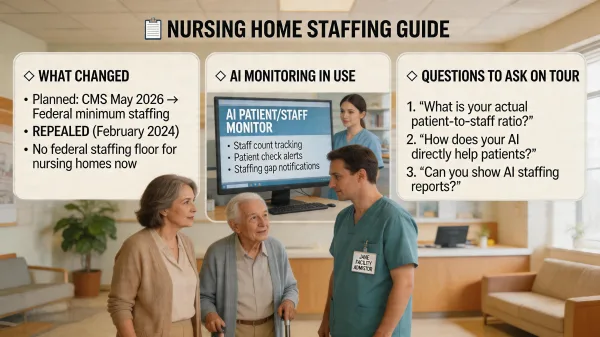
A family is touring three skilled nursing facilities for an 83-year-old father being discharged from the hospital after a stroke. The first facility mentions AI-powered monitoring on the tour. The second mentions it too. The third has a visibly lower staff-to-resident ratio than the others, but the admissions director smiles and says, "Our AI platform lets us provide more attention with fewer staff on the floor." The family writes it down and isn't sure what to do with it.
This is a 2026 problem, and it's a new one. As of April 2026, the federal floor that families thought was coming for nursing home staffing isn't there. The CMS staffing mandate that would have required minimum nursing hours per resident per day starting May 11, 2026 was repealed in December, and the repeal took effect February 2. AI monitoring systems are being installed in nursing facilities across the country, sometimes to help thinly stretched staff respond faster, sometimes to provide cover for operating with fewer staff than residents need. The two are not the same thing, and you can't tell from the marketing tour which one you're looking at.
I've spent close to 20 years as a Radiologic Technologist, and a meaningful chunk of that included mobile X-ray work inside nursing facilities. I've stood in those buildings at 2 PM on a Tuesday and seen what families on a 10 AM tour don't see. This article is my best attempt to give you the regulatory picture, the technology picture, and a concrete checklist for evaluating a facility when there's no longer a federal staffing floor underneath the decision.
What Happened to the CMS Staffing Mandate
In April 2024, CMS finalized the Minimum Staffing Standards for Long-Term Care Facilities rule. The rule set a national floor for nursing care: a total of 3.48 hours per resident day (HPRD), broken into a minimum of 0.55 HPRD of registered nurse care and 2.45 HPRD of nurse aide care, with the remaining 0.48 HPRD coverable by any combination of nursing staff. The rule also required a registered nurse onsite 24 hours a day, 7 days a week. Implementation was phased: non-rural facilities had until May 11, 2026 to meet the 3.48 HPRD and 24/7 RN requirements; rural facilities had until May 10, 2027.
The rule was estimated by University of Pennsylvania researchers to save approximately 13,000 nursing home residents' lives each year. It was also estimated to cost facilities significantly, and the industry pushed back hard. Two federal courts found portions of the rule invalid. Then on July 4, 2025, Public Law 119-21 was signed into law. Section 71111 of that law prohibited CMS from implementing, administering, or enforcing the minimum staffing standards until September 30, 2034.
That was a moratorium, not a repeal. The actual repeal came later. On December 2, 2025, CMS issued an interim final rule rescinding the 3.48 HPRD requirement and the 24/7 RN requirement entirely. The rescission took effect February 2, 2026. So as of right now, the federal staffing floor that the CMS staffing mandate would have established for nursing homes does not exist.
Here's the standard that's actually in effect: a registered nurse must be onsite for at least 8 consecutive hours per day, 7 days a week, and the facility must designate a full-time RN as director of nursing (with limited waiver options). That's the same standard that existed before the 2024 rule was finalized. It's the floor the United States has been operating with for decades, and it's what your parent's facility is required to meet right now.
What didn't get repealed is also worth knowing. The enhanced facility assessment requirements from the 2024 rule are still in place. Facilities still have to formally assess resident acuity and document the staffing they need to meet that acuity. They just don't have a hard HPRD number to meet anymore.
One more piece of context that didn't go away when the rule did. KFF analysis of pre-repeal staffing data found that only 19% of nursing facilities had staffing levels that would have met all three of the (now-repealed) minimums. Roughly 60% met the basic 3.48 HPRD threshold. The compliance gap was widest at for-profit facilities, where about 11% met all three requirements, compared to roughly 41% of non-profit facilities and 39% of government-run facilities. That data is still informative even though the rule is gone. It tells you, with reasonable specificity, what the staffing reality of American nursing homes looks like in 2026.
How AI Monitoring Is Being Deployed in Nursing Homes
The CMS staffing mandate may be gone, but the workforce shortage that prompted it isn't. The American Health Care Association reported that 90% of nursing home providers still find recruitment difficult, even after gaining 40,700 jobs in 2025 and reducing temporary agency use by 44% since 2022. The Bureau of Labor Statistics projects roughly 189,000 to 195,000 RN job openings annually through 2034. The national RN vacancy rate is around 9.6%. Skilled nursing facilities are hiring into a market that has been short on nurses for years and will be short on nurses for years to come.
That's the gap AI vendors are pitching into. The deployments you're most likely to encounter on a 2026 tour fall into a few categories. Ambient monitoring platforms (care.ai is the largest, currently deployed in over 1,500 healthcare settings; Teton is another, originally built in Denmark and now expanding into US care homes) place sensors and cameras in resident rooms and use computer vision to detect movement, falls, pre-fall postures (sitting on the edge of a bed, swinging legs over), and behavioral changes. Alerts are pushed to staff devices in real time. Virtual sitting is a closely related service: a remote operator monitors video feeds from multiple rooms and notifies onsite staff when intervention is needed. Virtual nursing is a step further, where a remote RN handles tasks like admission documentation, discharge education, and routine monitoring through in-room video, freeing onsite nurses for hands-on care.
Beyond monitoring, AI is showing up in scheduling tools that fill open shifts faster, in clinical documentation assistants that handle nursing notes through ambient voice capture, in medication management systems, and in predictive analytics that flag residents at elevated fall risk or early clinical deterioration. The legitimate value is real. A care team that catches a resident getting out of bed at 2 AM through a sensor alert can prevent a fall that an unstaffed hallway wouldn't. A virtual nurse handling admission paperwork frees a floor RN to actually be on the floor. Documentation tools that reduce charting time give bedside staff more bedside time.
The concerning reality is that some operators are positioning AI monitoring as a substitute for staffing rather than a supplement to it. The phrasing on tours is the tell: "AI lets us provide more attention with fewer staff" is a substitution claim. "AI helps our staff catch things faster" is a supplement claim. The first one is what should make you uneasy. Sensors don't deliver medications, don't reposition residents, don't change a brief, don't sit with someone who's afraid. They generate alerts. The alert is only useful if there's a person available to respond to it within a useful window. If the staffing isn't there to respond, the alert is documentation of an event the facility couldn't address, not prevention.
I'll tell you what I saw doing mobile X-ray work, because it's the part of my background that's most relevant here. The brightly lit lobby and the engaged staff on the morning tour are not what the facility looks like at 2 PM on a Tuesday or 3 AM on a Saturday. I've walked through hallways where call lights had been blinking for 20 minutes. I've seen residents who hadn't been repositioned, who were soaked, who were trying to get up alone because no one was answering. The gap between what the family was told and what was actually happening inside those walls is the reason I'm writing this article. AI changes what that gap looks like (now there's a sensor logging the call light, a dashboard somewhere showing response times) but it doesn't close it on its own. A platform that observes more without changing what humans can respond to creates a paper trail of unmet need.
How to Evaluate a Nursing Home Tour in 2026
The questions that matter most are the ones a sales-oriented admissions director least wants to answer. You're not being rude by asking them. You're protecting a parent. Most families feel uncomfortable pressing for specifics, and most facilities are counting on that discomfort. The way an admissions director responds to direct questions tells you almost as much as the answers themselves.
Ask for actual staffing numbers, not philosophy
"What is your current RN, LPN, and CNA hours-per-resident-day?" A facility that takes staffing seriously will know this number, or be able to pull it up. A facility that doesn't will tell you they "staff to acuity" and change the subject. Both answers are data. Then ask: "What was your average staff-to-resident ratio for the ward my parent would be on, over the past 30 days?" Same logic. They submit this data quarterly to CMS through the Payroll-Based Journal system. They have it.
Ask how AI alerts actually get handled
"If your monitoring system detects a fall or pre-fall behavior, who responds, and what's the average response time?" The answer should be specific: an onsite CNA, with a target response under a defined number of minutes, with documented compliance. If the answer is vague (something like "our team responds quickly"), that's not an answer. Then ask: "What happens overnight when monitoring detects a fall? Is there a nurse onsite? Is it a callback system? Does it trigger a hospital transfer?" Overnight protocols are where AI-as-substitute-for-staffing shows up most clearly.
Ask to see the schedule
"Can I see the actual posted staffing schedule for the unit my parent would be on?" Some facilities will show you. Some won't. The ones that won't aren't necessarily hiding anything, but the ones that will are signaling transparency. Either way, you can cross-check what they say against what shows up on their CMS Care Compare staffing page.
Ask about AI documentation and oversight
"How is AI-generated documentation reviewed for accuracy before it goes into the chart?" Ambient AI scribing tools are powerful, but they're not infallible. A facility that has a clear review process knows what it's doing. A facility that doesn't is either new to the technology or hoping you don't ask. "What training do staff receive on the AI systems?" follows naturally. Computer vision systems generate false positives. Staff need training on which alerts to act on immediately and which require contextual judgment.
What good answers sound like
Good answers are specific. They include numbers, time windows, named protocols, and named roles. The admissions director may not have every number at the top of their head, but they should be able to get them. Bad answers are abstractions: "exceptional care," "industry-leading technology," "a culture of attention." None of those phrases survive contact with a hallway at 2 PM. If everything you hear sounds like a brochure, the brochure is what they're selling. The care is a separate question.
Three Red Flags Worth Watching For
Most facilities aren't bad actors. Most are operating in a brutal labor market with thin margins, doing the best they can with imperfect tools. But there are three patterns that should concern you when you encounter them.
AI pitched as a replacement, not a supplement
Listen for the substitution narrative. Phrases like "our AI lets us provide more care with fewer staff" or "smart monitoring is the new staffing model" or "we're more efficient than facilities that haven't invested in this technology." These are operator-facing claims dressed up for families. The reasonable version of the same idea is: "Our AI helps our staff catch things faster, so we can intervene before situations escalate." The difference is whether the technology is described as adding to what staff can do or replacing what staff used to do.
Monitoring without clear response protocols
Sensors that detect events without clearly defined human response are a paper trail, not a safety system. If you ask "who responds" and get a vague answer, or if you ask about average response times and the facility doesn't track them, the monitoring isn't doing what you'd want it to do. Computer vision can identify a resident sitting on the edge of a bed in real time. It cannot get them safely back into bed. Someone has to walk into the room. The question is whether that person exists, on shift, with bandwidth to respond.
Heavy overnight reliance on virtual nursing
Virtual nursing, where a remote RN provides clinical oversight through in-room video, can extend RN coverage in ways that genuinely benefit residents. It's a problem when it's used to thin out physical RN presence overnight without adequate compensating onsite staff. A virtual RN can answer a question. She can't physically assess a resident, hand-deliver a medication, or transfer someone to the bathroom. If a facility's overnight model relies heavily on virtual RN coverage with skeleton onsite physical staffing, the math doesn't work for residents who need hands-on care, which is most residents in skilled nursing.
Use CMS Care Compare Before You Tour
Medicare's Care Compare tool at medicare.gov/care-compare lets you pull staffing hours, inspection history, and quality measures for any Medicare or Medicaid-certified nursing facility in the country. Use it before you walk through the door. The data has limitations (some of it is self-reported, and there's a lag between actual conditions and what's posted), but it's the best public starting point you have.
Read the staffing rating and the actual staffing hours, not just the overall five-star rating. The overall rating starts with the health inspection score, then adjusts up or down based on staffing and quality measures. A facility can have a four-star overall rating and a two-star staffing rating, and the staffing rating is often the more honest signal for day-to-day care. Pay attention to RN hours per resident day, total nurse hours per resident day, and the staff turnover measures CMS added in 2022. High turnover often correlates with care quality issues that take longer to show up in inspection deficiencies.
Check the inspection history. Look for the pattern, not just the most recent inspection. A facility with one bad inspection in a string of clean ones is a different situation from a facility with a multi-year pattern of staffing-related deficiencies. Special Focus Facilities are flagged on Care Compare with a special icon, and their overall rating is capped at 3 stars regardless of other data. If your shortlist includes one, that's worth knowing.
One caution about the star ratings. They're relative, not absolute. The top 10% of facilities in each state get 5 stars, the bottom 20% get 1 star, and the middle 70% get 2, 3, or 4 stars in equal thirds. A 4-star facility in a state with high overall standards may be operationally better than a 5-star facility in a state with lower standards. The raw HPRD numbers and inspection deficiency narratives carry more information than the star count alone.
What a Realistic Assessment Looks Like
This isn't an anti-AI piece. AI in skilled nursing has real benefits when it's deployed correctly. A care team that catches falls earlier, documents more efficiently, and gets predictive flags on residents at risk of clinical decline is a better care team than one without those tools. The goal isn't to find an AI-free facility, and you probably couldn't if you tried. The goal is to find a facility where the AI clearly supplements adequate staffing rather than masking inadequate staffing.
A reasonable mental model: walk in expecting that the facility is using some AI. Ask how they're using it. Listen for whether the answers center on staff (the AI helps our nurses do X) or center on operations (the AI lets us run leaner). The first framing is one you can work with. The second framing is one you should weigh carefully against everything else you observe.
And remember: with the federal staffing floor repealed, your evaluation is the floor. The hardest part of this isn't asking the questions. It's accepting that you have to. Families have been told for a long time that there are protections in place that ensure adequate staffing in nursing homes. Some of those protections were promised, then withdrawn. The promised CMS staffing mandate would have set a national HPRD minimum starting May 2026. It won't. The decision in front of you is, in a real way, your decision now in a way it wouldn't have been a year ago.
The Bottom Line for Families Touring in 2026
The CMS staffing mandate that was supposed to take effect this May was repealed three months ago. AI monitoring is being deployed across the skilled nursing industry, sometimes to help staff catch and prevent harm, sometimes to provide a more sophisticated kind of cover for operating with fewer caregivers than residents need. You can't tell which is which from a tour alone. You can tell by asking specific questions and listening for specific answers, by checking CMS Care Compare data before you walk in, and by paying attention to how the facility frames its technology when it doesn't think you're paying attention.
If you're touring three facilities for a parent right now, my best advice is this. Take the brochure. Take the coffee. Then ask for the unit's staffing schedule, the average AI alert response time, and the overnight nursing protocol. Watch how those questions are answered. The answers that come back, and the answers that don't, are the most useful thing you'll learn on the tour.
You're going to make this decision. Make it with the actual information.