
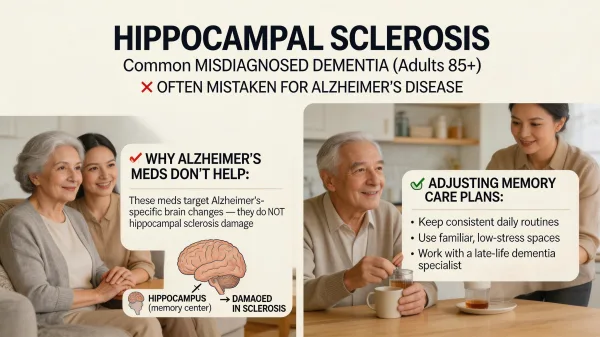
Picture this: you're sitting in a care conference at your mother's memory care community. She's 88. She's been there two years under an Alzheimer's diagnosis. The staff is reviewing her medications, and a new geriatrician says something that stops you cold. The Alzheimer's drugs you've been managing, refilling, and worrying about for the past two years probably aren't doing anything for her. The underlying cause of her dementia, he explains, may not be Alzheimer's at all. It may be something called hippocampal sclerosis.
For families who've spent years building their understanding of a parent's condition around an Alzheimer's diagnosis, hearing that the real cause might be something different is disorienting. You've read the books. You've joined the support groups. And now the ground shifts.
Hippocampal sclerosis is a condition marked by severe cell loss and scarring in the hippocampus, the brain region most responsible for forming and retrieving memories. It's one of the most common causes of dementia in adults over 85, and a frequent reason families in memory care find that their parent's decline doesn't match the Alzheimer's pattern they were told to expect.
Researchers estimate hippocampal sclerosis plays a role in roughly 20% of dementia cases among the oldest-old, yet most families have never heard of it. Its symptoms so closely mirror Alzheimer's disease that it's frequently misidentified, sometimes for years. When someone in my own family started declining in ways that didn't match what we'd been told to expect, we spent months assuming we just weren't understanding the disease well enough. It took a long time before anyone considered that the diagnosis itself might need revisiting. That experience is exactly why I want families to know this condition exists.
What Is Hippocampal Sclerosis?
The hippocampus is a small, curved structure deep in the brain that acts as the hub for memory processing. When hippocampal sclerosis develops, neurons in this region die off and are replaced by scar tissue, a process called gliosis. The result is a brain that progressively loses its ability to form new memories and gradually struggles to retrieve older ones. Autopsy studies suggest that hippocampal sclerosis is present in roughly 10 to 20% of people over age 85 and in as many as 26% of those who had documented dementia at the time of death. Those numbers make it one of the most common pathological findings in the oldest-old, yet it remains largely unknown to families and even to some clinicians.
In recent years, researchers have connected hippocampal sclerosis in older adults to a broader condition called LATE, which stands for Limbic-predominant Age-related TDP-43 Encephalopathy. LATE is caused by the buildup of a misfolded protein called TDP-43, which is different from the amyloid plaques and tau tangles that define Alzheimer's disease. According to the National Institute on Aging, autopsy studies of more than 6,000 people found TDP-43 deposits in about 40% of brains examined, with an average age at death of 88. The distinction matters because hippocampal sclerosis represents a fundamentally different disease process than Alzheimer's, even though the two can look almost identical from the outside.
Why Hippocampal Sclerosis Is Frequently Misdiagnosed as Alzheimer's
The symptoms overlap almost completely. Memory loss comes first. Daily tasks get harder. Conversations become repetitive. A physician seeing these signs in an 87-year-old patient will, understandably, reach for the most common explanation. And because there hasn't been a reliable way to test for hippocampal sclerosis or LATE in a living patient, Alzheimer's becomes the working diagnosis by default. Clinical criteria for identifying LATE during life were only published in 2025, and the tools to apply those criteria in routine practice are still catching up.
The overlap goes deeper than symptoms. On standard brain imaging, both conditions cause hippocampal shrinkage. Standard cognitive tests can't distinguish between them. Even specialists who suspect something other than Alzheimer's often lack the specific biomarkers needed to confirm it. For most families, the result is years spent building an entire care strategy around the wrong condition, following medication plans and progression timelines that were never designed for what their parent actually has.
I watched this play out with my own family. When our loved one's cognitive decline accelerated, we followed every piece of guidance we'd been given for Alzheimer's. We adjusted routines, managed medications, and prepared ourselves for a progression timeline that matched what the doctors had described. But the decline didn't follow that pattern. The medications didn't seem to change anything. The behavioral shifts didn't match the stage we were supposedly in. We spent months questioning ourselves, wondering what we were doing wrong, instead of questioning whether the diagnosis itself might be incomplete. Looking back, I can see how the diagnostic maze kept us focused on the wrong map for far too long. That confusion is something I don't want other families to go through without at least knowing that a different explanation exists.
How Hippocampal Sclerosis Differs From Alzheimer's in Daily Memory Care
In practice, this is where things break down. When a parent has been in memory care under an Alzheimer's diagnosis, every element of their care plan is shaped by assumptions about how Alzheimer's progresses: what medications to use, what behavioral changes to anticipate at each stage, and how quickly functional decline will happen. If the actual cause is hippocampal sclerosis, several of those assumptions don't hold.
Medications That Aren't Helping
The most commonly prescribed Alzheimer's medications are cholinesterase inhibitors, drugs like donepezil (Aricept), rivastigmine (Exelon), and galantamine (Razadyne). They work by boosting acetylcholine levels in the brain, targeting a specific chemical deficit that occurs in Alzheimer's disease. Hippocampal sclerosis and LATE involve a completely different protein pathway (TDP-43), and there is currently no evidence that cholinesterase inhibitors provide benefit for this type of dementia. According to the Alzheimer's Association, these medications are approved specifically for dementia due to Alzheimer's, and even among confirmed Alzheimer's patients, they help only an estimated 10 to 30 percent of those who take them. No treatment currently exists that targets the TDP-43 protein buildup responsible for hippocampal sclerosis and LATE, though research is active.
For families who've been carefully managing a medication regimen for years, learning that those drugs were likely never addressing the actual problem is a gut punch. I know from my own family's experience how much energy goes into medication schedules, pharmacy refills, and watching for side effects. When the medications aren't matched to the right condition, that effort doesn't translate into benefit. But the side effects (nausea, appetite loss, sleep disruption) are still very real. That's time and discomfort your parent didn't need to go through.
A Different Progression Pattern
Alzheimer's disease tends to follow a somewhat predictable trajectory through defined stages, moving from mild memory loss through moderate confusion and behavioral changes to severe functional decline. Hippocampal sclerosis, particularly when driven by LATE as the primary condition, often follows a slower, more gradual course. Researchers at the Mayo Clinic note that people with LATE may decline more slowly than those with Alzheimer's, though the trajectory speeds up significantly when both conditions are present in the same brain, something that happens in more than half of cases according to NIA autopsy data.
For families, this matters more than it might sound. If your parent has been in memory care for two years and hasn't declined as rapidly as you were told to expect, that could be a sign the underlying cause isn't purely Alzheimer's. Your parent might hold at a certain functional level longer than the staging charts predicted. They might lose memory function significantly while retaining personality, social skills, and physical ability in ways that don't fit the Alzheimer's narrative. Staff at a memory care community may be watching for behavioral patterns like aggression, wandering, or sundowning that are hallmarks of mid-stage Alzheimer's, while your parent's actual experience looks different. That gap between the expected pattern and the real one creates confusion on both sides. The care team wonders why your parent isn't following the typical course, and your family wonders whether the care plan is working at all.
What Care Staff Should Know
If your parent's diagnosis shifts to hippocampal sclerosis, or a physician raises it as a possibility, the memory care team needs to be informed. Most care staff are trained primarily around Alzheimer's progression models. That's not a criticism of the facility. It reflects the reality that Alzheimer's accounts for the majority of memory care residents. But when the underlying condition is different, the care approach benefits from adjustment: less focus on Alzheimer's-specific medication management, more attention to comfort-oriented support, and realistic expectations that the decline may not follow a familiar script.
The goal doesn't change. Good memory care still centers on dignity, safety, engagement, and quality of life regardless of the specific diagnosis driving the dementia.
What This Means for Your Parent's Memory Care Plan
A hippocampal sclerosis diagnosis, or even a strong suspicion of one, is a reason to revisit the care plan. Not to panic. The practical changes are manageable, but they require honest conversations with your parent's medical team and the memory care staff.
Start with medications. Ask the prescribing physician whether continuing cholinesterase inhibitors makes sense given the revised understanding. If your parent has been tolerating the medication without problems, some physicians may choose to continue it as a precaution, especially if there's any possibility of co-occurring Alzheimer's pathology. Others may recommend stopping it. That decision belongs to the physician and your family, not to the care facility.
Next, revisit the care plan with the facility's director of nursing or care coordinator. Share what the physician has explained. Ask how the team can adjust their approach to match a non-Alzheimer's progression model, and what behavioral or functional markers they'll track going forward. In my nearly 20 years working inside the healthcare system, I've seen how much better outcomes get when the family, the physician, and the care team are all operating from the same information instead of three different versions of the story.
When the Diagnosis Isn't Certain
Here's the hard truth: hippocampal sclerosis can only be definitively confirmed through autopsy. While the 2025 clinical criteria for LATE represent a major step forward, many community physicians and even some neurologists aren't yet applying them in everyday practice. Your parent's doctor may describe hippocampal sclerosis as "likely" or "possible" without being able to confirm it with certainty.
That uncertainty is uncomfortable. But it doesn't leave you stuck. A working diagnosis of probable hippocampal sclerosis is still clinically useful because it changes the conversation about medications, expected progression, and daily care planning. It gives your family a different framework for understanding what your parent is going through, even without a definitive lab result. Many families find that an imperfect answer that actually matches their parent's reality is more helpful than a confident diagnosis that never quite fit.
Focus on what you can control. Make sure your parent is comfortable. Make sure the care team knows the diagnosis is being reconsidered. And give yourself permission to let go of the Alzheimer's playbook if it hasn't been matching your parent's reality.
Questions to Bring to Your Parent's Care Team
If hippocampal sclerosis has been raised as a possible factor in your parent's dementia, these conversations with the medical team and the memory care staff can help your family move forward with better information.
For the physician: Has my parent been tested for amyloid biomarkers that would help confirm or rule out Alzheimer's? Given the revised diagnosis, should we continue the current medication regimen or consider changes? Are there symptoms we should watch for that would suggest a different trajectory than what Alzheimer's typically follows? What does the expected progression look like for hippocampal sclerosis at this age?
For the memory care community: How does your staff handle a diagnosis change like this? Can we update the care plan to reflect a non-Alzheimer's model? What cognitive or functional benchmarks will you track going forward, and how will you communicate changes to our family? Are there any adjustments to daily activities or engagement programming that would be appropriate?
You don't need all the answers today. These questions open the door to more accurate care.
When the Answers Change
Learning that your parent's dementia may not be Alzheimer's can feel like starting over. You've spent years absorbing information about a disease that might not be the one your parent has. That's a real loss, the loss of the framework you'd built to make sense of everything that was happening.
But a clearer picture, even an incomplete one, is still progress. It explains why the medications didn't seem to help. It explains why the decline didn't match the timeline. And it lets you refocus your energy on what matters most at this stage of your parent's life: comfort, connection, and the best quality of life for whatever time you have together.
Having walked through a version of this with my own family, I can tell you that the shift in understanding, even when it comes late, brings a kind of relief you don't expect. You stop fighting a battle that was never the right one. You stop blaming yourself for not seeing improvement that was never going to come from those medications. And you start making decisions based on what's actually happening, not what a textbook said should be happening.
Your parent's care team is there to help you through this transition. Lean on them. Ask your questions. And know that the best thing you can do right now is exactly what you're already doing: paying attention, showing up, and making sure your parent is cared for with dignity.