
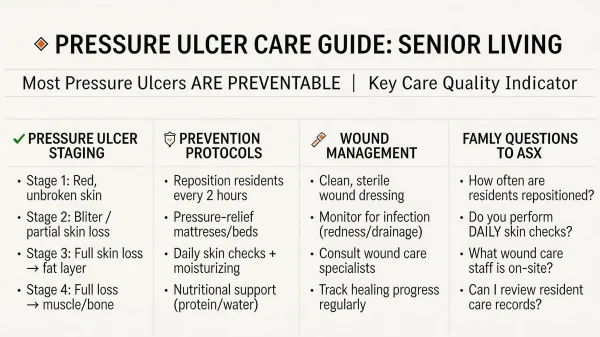
The National Pressure Injury Advisory Panel reached unanimous consensus on a fact that should change how every family evaluates senior living: most pressure ulcers are preventable. Not some, and not a slim majority. Most. When a resident develops a serious pressure wound in a care community, it usually points to a breakdown in basic care protocols, not an unavoidable medical event. For families evaluating senior living options or monitoring a parent who already lives in one, understanding pressure ulcers and how they develop is one of the most practical tools available for measuring whether a community delivers the care it promises.
I've walked through care facilities during my years doing mobile X-ray work, and the condition of residents' skin told me more about a building's care quality than any brochure or marketing tour ever could. Pressure ulcers don't appear out of nowhere. They develop over hours and days when someone isn't being repositioned, when skin isn't being checked, when nutrition falls short. They're a visible signal of what's happening (or not happening) behind the scenes.
Consider a situation where your parent moves into an assisted living community, and within two months, a deep wound appears on their tailbone. The community tells you it was unavoidable. But when you understand what causes pressure ulcers and what prevents them, you'll know exactly what questions to ask and what answers should concern you.
This article covers what pressure ulcers are, how they're staged, why their presence in a community is a direct quality indicator, what treatment looks like when one has already developed, and what families can do to protect their parent. If your loved one is in a senior living community or you're evaluating one, this is information worth having before you need it.
What Are Pressure Ulcers and Why Should Families Pay Attention
Pressure ulcers, also called pressure injuries or bedsores, are areas of damaged skin and tissue caused by sustained pressure that cuts off blood flow. They most commonly develop over bony areas of the body: the sacrum (tailbone), heels, hips, shoulder blades, and back of the head. When someone sits or lies in one position too long without being repositioned, the constant pressure compresses blood vessels, starves the tissue of oxygen, and causes cells to die. The result is a wound that can range from a reddened patch of skin to an open crater exposing muscle or bone.
Seniors in care communities are at higher risk because many have limited mobility and rely on staff to help them change positions. Residents with diabetes, poor circulation, incontinence, or low body weight face even greater risk. An estimated 2.5 million pressure injuries are treated each year in the United States, and the sacrum alone accounts for roughly 44% of all pressure injury locations. That makes it the single most common site for these wounds. What surprises many families is how quickly a pressure ulcer can develop. Tissue damage can begin within two hours of sustained pressure on vulnerable skin, which is why repositioning schedules are measured in hours, not days. A resident who isn't moved after a long stretch in bed or a wheelchair is already at risk by the time the next shift starts.
For families, the critical point is this: a pressure ulcer on your parent isn't just a wound. It's information. It tells you something specific about the care your parent is or isn't receiving on a daily basis. And the stakes are higher than most people realize. Advanced pressure ulcers increase the risk of serious infections like cellulitis and sepsis, can require hospitalization and surgery, and are associated with higher mortality rates in older adults. The Agency for Healthcare Research and Quality has estimated that roughly 60,000 people die each year from complications related to pressure ulcers.
Pressure Ulcers as a Quality Indicator: What Their Presence Really Tells You
Pressure ulcers don't develop because aging skin is fragile, though it is. They develop because the specific, well-documented steps required to prevent them aren't being followed consistently. Prevention isn't complicated. It requires attention, staffing, and follow-through on protocols that every accredited care community should have in place. When those protocols fail, residents pay the price with their skin, their comfort, and sometimes their lives.
The core prevention protocols are well established and have been for years. Repositioning is the foundation: residents at risk should be repositioned at least every two hours, and those in wheelchairs should shift weight every 15 minutes. This isn't optional or aspirational. It's the baseline standard of care. Pressure-relieving surfaces, including specialized mattresses and wheelchair cushions that distribute weight more evenly, should be in use for any resident with limited mobility. Skin assessments should happen at admission, with reassessments on a regular schedule and any time a resident's condition changes. Staff should be checking for early warning signs like reddened skin that doesn't blanch when pressed. Nutrition optimization matters more than most families realize. Adequate protein, calories, and hydration directly affect skin integrity and the body's ability to resist breakdown. Residents who are malnourished or dehydrated are far more vulnerable. Moisture management is the final piece: incontinence, perspiration, and wound drainage all soften and weaken skin, making it more susceptible to pressure damage. Facilities need protocols for keeping skin clean and dry without stripping it of natural oils.
When a community has a high rate of pressure ulcers, it rarely means they admitted sicker residents. It usually means one or more of these protocols isn't being followed. Maybe staffing levels are too low to reposition residents on schedule. Maybe the facility hasn't invested in appropriate support surfaces. Maybe nutritional screening isn't happening. Whatever the specific gap, the pressure ulcer rate is the visible outcome of an invisible staffing or systems problem. Research bears this out: one study found that when a single registered nurse voluntarily left an ICU, the pressure injury rate in that unit increased by nearly 20%. Comprehensive prevention programs, when actually implemented, have reduced pressure ulcer rates by as much as 90% in some facilities, at a fraction of the cost of treating the wounds after they develop. Prevention works. The problem is that it requires consistent effort and adequate staffing, both of which cost money that some communities choose not to spend.
Families can and should request a community's pressure ulcer data. The Centers for Medicare and Medicaid Services (CMS) tracks pressure ulcer rates as a quality measure for nursing homes, and this data is publicly available through Care Compare (formerly Nursing Home Compare). For assisted living communities that aren't Medicare-certified, the data may not be publicly reported, but you can still ask. Request the community's current pressure ulcer prevalence rate and their incidence rate for new pressure ulcers that developed after admission. A community that tracks this data and shares it openly is demonstrating both competence and confidence in their care. A community that can't provide these numbers, or won't, is telling you something important about their approach to quality monitoring.
I've seen the difference between facilities that take prevention seriously and those that treat it as paperwork. During my years doing mobile X-ray work, I walked into one facility where a resident had a pressure ulcer that had progressed to exposed bone, a wound that should never have gotten that far if basic repositioning protocols were being followed. The staff seemed overwhelmed, the equipment was outdated, and the residents were paying the price. In the facilities that got it right, I could see it in the staffing patterns, the equipment on the beds, and the condition of the residents. The quality of wound prevention in a building isn't invisible. It shows up on people's bodies, and once you've seen what neglect looks like, you can't unsee it.
When a Pressure Ulcer Already Exists: What Wound Management Requires
If your parent has already developed a pressure ulcer, understanding the staging system helps you grasp how serious the wound is and what treatment should look like. The National Pressure Injury Advisory Panel defines the stages based on the depth of tissue damage, and each stage requires a different level of care.
Stage 1 is the earliest sign: intact skin with a reddened area that doesn't turn white when you press on it. The skin may feel warmer or cooler than surrounding tissue, or firmer or softer. At this stage, the damage is still reversible with immediate pressure relief, repositioning, and skin care. Stage 2 involves a shallow open wound or blister where the top layers of skin have broken down. It looks like an abrasion or a shallow crater and is usually painful. Treatment includes keeping the wound clean, using appropriate dressings like hydrocolloid or foam, and eliminating the pressure source.
Stage 3 is where things get serious. The wound extends through all layers of skin into the fatty tissue beneath, creating a deep crater. You may see yellowish dead tissue (called slough) in the wound bed. This stage requires professional wound care, often from a certified wound care nurse, and may involve debridement to remove dead tissue, specialized dressings, and close monitoring for infection. Having worked in hospital settings for nearly two decades, I've seen patients come in from care facilities with Stage 3 wounds that clearly started as something much smaller and were missed or inadequately treated for weeks. Stage 4 is the most severe: the wound extends through skin and fat into muscle, tendon, or bone. Exposed bone or muscle may be visible in the wound. This is a medical emergency that often requires hospitalization, surgical debridement, and potentially reconstructive surgery with skin flaps or grafts. There are also unstageable wounds where dead tissue covers the wound bed so completely that the true depth can't be determined until the tissue is removed.
For Stage 3 and Stage 4 ulcers, wound care becomes a daily clinical task. A wound care nurse (typically a certified Wound, Ostomy, and Continence Nurse) should be directing the treatment plan. Daily care at this level involves cleaning the wound, applying medicated dressings, monitoring for signs of infection like increased redness, warmth, odor, or drainage, and documenting wound measurements to track whether the wound is getting smaller or larger. Dressing changes for advanced wounds can take 20 to 45 minutes per session and may need to happen once or twice daily depending on the wound's condition and the type of dressing used.
Negative pressure wound therapy, sometimes called a wound VAC, is commonly used for deeper wounds. This device applies controlled suction through a sealed dressing to draw fluid away from the wound, increase blood flow, and promote new tissue growth. The dressing is typically changed every 48 to 72 hours, and the patient wears the device continuously between changes. It's changed how many advanced wounds are managed, though families should know that research on its effectiveness specifically for pressure ulcers is still evolving. Not every wound is appropriate for negative pressure therapy, and the treating clinician should explain why it's being recommended and what the expected timeline for improvement looks like.
Nutrition becomes critical during wound healing. Protein requirements increase significantly, with clinical guidelines recommending 1.25 to 1.5 grams of protein per kilogram of body weight daily for residents with pressure injuries, and up to 2 grams per kilogram for Stage 3 and Stage 4 wounds. Caloric needs also rise, typically to 30 to 35 calories per kilogram of body weight. Adequate vitamin C, zinc, and hydration all support the healing process. If your parent's community isn't involving a dietitian in the care plan for a pressure ulcer, that's a gap worth raising.
Be honest about care levels here. Most assisted living communities aren't equipped to manage Stage 3 or Stage 4 pressure ulcers on their own. These wounds often require skilled nursing care, and a resident with an advanced pressure ulcer may need to transfer to a skilled nursing facility or hospital for treatment. Skilled nursing facilities typically have wound care nurses on staff or on contract and can manage daily dressing changes, negative pressure wound therapy, and the nutritional monitoring that advanced wound care demands. Assisted living communities generally don't have this level of clinical infrastructure. If a community tells you they can handle a deep wound without wound care nursing on site, ask very specific questions about who will be managing the dressing changes, how often the wound will be assessed, and what the escalation protocol looks like if the wound isn't improving. A vague answer here is a red flag.
The Question No One Thinks to Ask
There's a question that should be on every family's list when touring a senior living community, and almost no one asks it: What is your current pressure ulcer prevalence rate?
Most families ask about activities, meals, room sizes, and monthly costs. Those all matter. But the pressure ulcer rate tells you something none of those other details can: whether the daily, hands-on care in this building is actually happening the way it should. A community that knows its pressure ulcer rate and can share it without hesitation is one that's tracking its own quality. A community that seems surprised by the question, deflects, or says they don't track that data is one where you should dig deeper before signing anything.
For Medicare-certified skilled nursing facilities, you can look up pressure ulcer quality measures on the CMS Care Compare website before you ever walk through the door. For assisted living communities, the data isn't always public, which makes the direct question even more valuable. Ask for both the prevalence rate (how many current residents have a pressure ulcer) and the facility-acquired rate (how many developed one after moving in). The second number is the one that reflects the community's actual care quality. A low facility-acquired rate suggests strong prevention protocols. A facility that won't separate the two numbers may be blending in wounds that residents arrived with to dilute their own accountability.
What to Do If Your Parent Develops a Pressure Ulcer in a Community
Imagine you visit your parent and discover they've developed a Stage 3 pressure ulcer on their sacrum after just two months in an assisted living community. The wound is deep, painful, and the community says it was unavoidable. Your instinct that something went wrong is probably right.
Start by requesting a copy of the care plan and all wound care documentation. You want to see repositioning logs, skin assessment records, and nutritional screening results. If the community can't produce these records, that absence itself is significant. Ask when the wound was first identified and at what stage. A pressure ulcer that's first documented at Stage 3 likely wasn't caught early enough, or wasn't documented at the earlier stages when intervention could have prevented progression.
Request an immediate wound care assessment from a qualified professional if one hasn't already occurred. Your parent may need to see a wound care specialist or transfer to a skilled nursing setting for proper treatment. Contact the state's long-term care ombudsman program, which advocates for residents in care facilities and can investigate concerns about care quality. If the wound is severe and you believe it resulted from neglect, you can also file a complaint with your state's health department or licensing agency. Every state has a process for reporting concerns about care facility quality, and your report becomes part of the facility's inspection record.
Having spent years inside the healthcare system, I can tell you that documentation is your strongest tool in these situations. Write down what you see, when you see it, and who you speak with. Take photos of the wound with a timestamp if the care team permits. These records matter if you need to escalate the situation later.
Don't accept "it was unavoidable" without evidence. While not every pressure ulcer is preventable, particularly in patients at the end of life or with severe circulatory conditions, a pressure ulcer that develops in a care setting after two months in an otherwise stable resident should trigger a root cause analysis by the facility. The family should be part of that conversation.
How Pressure Ulcer Prevention Should Look in Daily Care
When a community takes pressure ulcer prevention seriously, you can see it in their daily routines. Here are the specific steps that should be part of every at-risk resident's care:
1. Comprehensive skin assessment within 24 hours of admission, with a standardized risk assessment tool like the Braden Scale to identify residents at higher risk.
2. A written repositioning schedule for every at-risk resident, with documentation that it's being followed. For bed-bound residents, repositioning should happen at least every two hours.
3. Pressure-relieving surfaces on the beds and wheelchairs of at-risk residents, including specialized foam, air, or gel mattresses rather than standard hospital mattresses.
4. Nutritional screening and ongoing monitoring, with dietitian involvement for residents identified as malnourished or at risk of malnutrition.
5. Moisture management protocols for residents with incontinence, including prompt cleaning, barrier creams, and absorbent products that keep skin dry.
6. Regular staff training on pressure ulcer identification, prevention techniques, and proper repositioning methods, including the use of lift sheets to avoid dragging residents across bed surfaces.
7. Heel-specific prevention for bed-bound residents, such as heel suspension devices or pillows placed under the calves to keep heels completely off the mattress. Heels are the second most common pressure ulcer site after the sacrum, and they're easy to overlook.
During tours or family meetings, ask the community to walk you through how each of these elements works in practice. General assurances aren't enough. You want specifics about staffing ratios, equipment, and documentation.
The Cost of Pressure Ulcer Treatment
Treating a pressure ulcer is expensive, and the costs climb rapidly with severity. As of 2025, estimates place the national cost of pressure ulcer treatment at $9 to $11 billion per year in the United States. Individual treatment costs depend heavily on the stage of the wound. A Stage 1 or Stage 2 ulcer caught early may require only basic wound care supplies and nursing time, and can heal within days to weeks with proper intervention. But a Stage 3 pressure ulcer can take months of daily professional wound care to heal, and a Stage 4 pressure ulcer requiring hospitalization, surgical debridement, negative pressure wound therapy, and potentially reconstructive surgery can cost over $100,000 per episode of care. Recovery from surgical repair of a Stage 4 wound can require four to six weeks of bed rest followed by a gradual return to sitting, with frequent monitoring of the surgical site throughout.
When I was going through the financial shock of a family member's care needs, I remember thinking that none of the costs I'd planned for included complications like wound care. Most families budget for the monthly room and board cost of senior living and don't factor in the possibility of additional medical expenses if care quality falls short. This is one more reason prevention matters so much: a pressure ulcer doesn't just cause physical suffering. It creates a financial burden that compounds an already expensive care situation.
Medicare covers medically necessary wound care treatment, including physician visits, wound care supplies, and negative pressure wound therapy when specific criteria are met. But coverage can be complicated, and families often face unexpected out-of-pocket costs for extended treatment. Ask the community and your parent's insurance provider what would be covered if a pressure wound were to develop.
Protecting Your Parent: What Families Can Do Starting Today
You don't need a medical background to be an effective advocate for your parent's skin health. Visit regularly, and vary the times of your visits so you see different shifts and different staff. Check your parent's skin gently, especially the sacrum, heels, and hips, for any redness that doesn't go away within 30 minutes of repositioning. Ask your parent if they're being helped to change positions throughout the day, and pay attention to whether they're eating and drinking enough.
If your parent is at higher risk due to limited mobility, diabetes, or incontinence, make sure the care plan specifically addresses pressure ulcer prevention. Ask the community what equipment they're using, how often repositioning is documented, and who reviews the prevention plan if your parent's condition changes. If anything about your parent's skin looks different from your last visit, bring it up immediately. Early intervention is the difference between a reversible Stage 1 injury and a months-long battle with an advanced wound.
Prevention is the standard that every quality community should meet. A pressure ulcer in a care setting isn't just a medical problem. It's a care quality problem. Families who understand that distinction, who ask the uncomfortable questions and look past the marketing materials, are in the strongest position to protect the people they love. Your parent deserves care that prevents harm, not just treats it after the damage is done.