
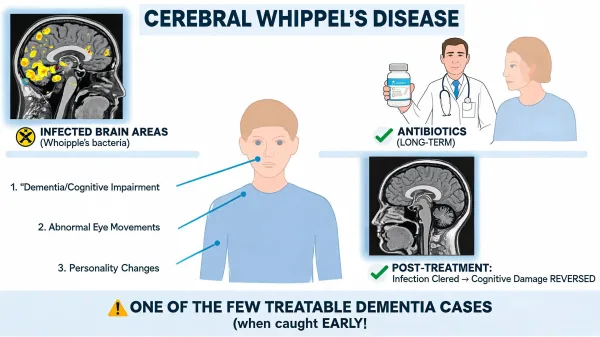
Cerebral Whipple's disease has an incidence of fewer than 1 case per million people each year, which puts it among the rarest causes of dementia a doctor will ever see. That rarity is exactly why it gets missed. Most neurologists will go an entire career without seeing a single confirmed case. The symptoms can resemble Alzheimer's, frontotemporal dementia, or even Creutzfeldt-Jakob disease closely enough that families often spend months or years moving from specialist to specialist before anyone considers an infection.
Here's the part that matters most. Cerebral Whipple's disease is one of a small handful of dementias that can actually be reversed. It's a chronic bacterial infection. With the right antibiotics, taken for the right length of time, much of the cognitive damage can heal. Some people recover completely. Others are left with residual memory problems, sleep disturbances, or eye movement issues that still call for memory care planning. Either way, the families who push for a complete diagnostic workup are the ones who get the answer.
I've been a caregiver in some form for most of my life, and one thing I've learned is that no one should stop asking questions until every treatable cause has been ruled out.
The pages ahead cover what cerebral Whipple's disease is, why diagnosis takes so long, how doctors confirm it, and what treatment and recovery actually look like. The treatable-dementia message is the centerpiece, because for the small group of families who hear this diagnosis, it changes everything.
What Cerebral Whipple's Disease Is
Cerebral Whipple's disease is a rare bacterial infection of the brain caused by Tropheryma whipplei, the same organism that causes the gastrointestinal form of Whipple's disease. It can produce dementia, eye movement abnormalities, personality changes, and other neurological symptoms. Long-term antibiotics can stop the infection and reverse much of the cognitive damage when treatment begins early enough.
Whipple's disease itself is rare, with fewer than 1 case per million people diagnosed each year. The brain becomes involved in roughly 10 to 40 percent of all cases. In a smaller subset, the brain is the only organ affected, with no gut symptoms at all. The bacteria can hide in the body for years before symptoms surface, which is part of what makes the diagnosis so easy to miss.
The infection most often affects men between 40 and 70. Women can develop Whipple's, but the gender ratio runs roughly 8 to 1 in favor of men. That demographic pattern matters because Whipple's may not be the first thing a doctor considers when an older adult shows memory problems. The presentation doesn't fit the typical dementia profile, and in a busy clinic, rare causes get pushed down the differential list.
The Symptoms That Set Cerebral Whipple's Apart
The cognitive piece looks like other dementias at first. Memory loss, confusion, attention problems, and personality changes are the most common neurological complaints. Roughly a quarter of patients with neurological involvement show clear memory impairment, and almost a third develop changes that meet criteria for dementia. Psychiatric symptoms like depression, apathy, and anxiety often appear early.
What sets cerebral Whipple's apart is the combination of symptoms. Eye movement problems are common, especially difficulty with vertical gaze. A small but striking number of patients develop a rhythmic jerking of the eye and jaw muscles called oculomasticatory myorhythmia. That sign is considered specific to Whipple's. If a neurologist sees it, the diagnosis is highly likely pending biopsy confirmation.
Other clues include unexplained weight loss, joint pain, hypersomnia (sleeping much more than normal), and chronic GI symptoms like diarrhea or abdominal pain. When memory problems show up alongside any of these, the picture starts to fit Whipple's rather than Alzheimer's. The right specialist needs to see the whole pattern at once, which doesn't always happen when different doctors handle different symptoms.
Why Diagnosis Often Takes Years
Most cases of cerebral Whipple's get missed at first because the disease doesn't make most diagnostic short lists. A neurologist working through memory loss thinks about Alzheimer's, vascular dementia, frontotemporal dementia, Lewy body dementia, and a long list of structural and metabolic causes. An obscure bacterial infection rarely makes the cut, especially without obvious gut symptoms.
This is where my own caregiving history shapes how I think about every dementia diagnosis. A lifetime spent caring for others, from running an in-home daycare for ten years to walking through a family member's dementia journey, built a deep conviction that no one should stop looking for answers until every treatable cause has been ruled out. Treatable causes such as thyroid problems, vitamin B12 deficiency, normal pressure hydrocephalus, autoimmune encephalitis, and rare infections like Whipple's sometimes hide behind a presumed Alzheimer's diagnosis. Families who keep asking questions are the ones who occasionally find them. Whipple's is the extreme example, but the broader lesson holds across many cases. A thorough workup is worth pushing for, even when the odds of finding something reversible feel low. The reward, when it comes, is the kind of answer that changes everything, and even when it doesn't come, knowing every avenue has been checked is its own form of peace for the families left to plan around the diagnosis they have.
Consider a parent who has been losing weight, complaining of joint pain, and struggling with attention and short-term memory over the past 18 months. Multiple neurologists run cognitive testing and brain MRIs and raise the possibility of Alzheimer's or frontotemporal dementia. Then a gastroenterologist orders a small-bowel biopsy for unrelated GI complaints, and the pathologist reports PAS-positive macrophages. The diagnosis pivots overnight, and the family hears that the dementia might be reversible.
How Cerebral Whipple's Disease Is Diagnosed
Diagnosis usually starts with a small-bowel biopsy, even when the dominant symptoms are neurological. Pathologists stain the tissue with periodic acid-Schiff (PAS), which lights up macrophages full of T. whipplei bacteria. PCR testing on the same tissue confirms the bacterial DNA. About 94 percent of classic cases produce a positive intestinal biopsy.
When the brain is the only site of infection, the intestinal biopsy can come back clean. In those cases, doctors look at cerebrospinal fluid through a lumbar puncture and run PCR on the CSF. A brain biopsy is rarely needed, but it remains an option when imaging suggests a focal lesion. MRI findings can include T2 or FLAIR hyperintensities in the medial temporal lobes, hypothalamus, midbrain, or basal ganglia, though imaging alone can't confirm the diagnosis.
The whole process can take weeks. Once a clinician suspects Whipple's, the workup moves quickly, but suspecting it is the bottleneck. That's why the eye movement findings matter so much. They can shortcut months of guessing and push the workup straight toward the right tests.
Treatment and Recovery: What Families Can Expect
Treatment for cerebral Whipple's disease is long, structured, and not negotiable. Cutting it short is the most common reason the disease comes back, sometimes years later. Relapses involving the brain tend to be harder to treat than the original infection, which makes commitment to the full course one of the most important parts of the plan. Most patients won't feel sick by the time their oral antibiotics are scheduled to end, and that's exactly when the temptation to stop is strongest.
The standard regimen begins with an intravenous antibiotic that crosses the blood-brain barrier. Most centers use ceftriaxone, given once or twice daily for two to four weeks. Some use intravenous penicillin G or meropenem instead. This phase typically happens in or near a hospital because of the IV access and monitoring involved. Symptoms often start to improve within the first one to two weeks of antibiotics, which is one of the most striking features of treatable infectious dementias.
After the IV phase, treatment shifts to long-term oral antibiotics. The most common choice is trimethoprim-sulfamethoxazole, often sold as Bactrim or Septra, taken twice daily for one to two years. People who can't take sulfa drugs may receive doxycycline plus hydroxychloroquine for a similar duration. Recent expert reviews suggest at least 18 months of oral therapy when the brain is involved. Cognitive recovery can be remarkable. Some families see clear improvement in memory, attention, and personality within a few months. Eye movement abnormalities and gait problems often improve more slowly, sometimes over a year or more. In one published series of 18 patients with neurological involvement, 14 showed clinical improvement after a full course of treatment, though some were left with residual cognitive impairment, sleep disorders, or eye movement issues that continued past treatment.
Monitoring is its own commitment. Doctors typically repeat duodenal biopsies, CSF PCR, or both during and after treatment to confirm the bacteria have cleared. Even after a successful course, late relapses have been reported decades later, with some published cases occurring 30 years after initial treatment ended. From my years working hospital floors, I've watched how often patients drop their specialist follow-up once they feel better. With Whipple's, that gap can be costly. Families should plan on long-term follow-up with both an infectious disease specialist and a neurologist.
When Memory Care Is Still Needed Despite Treatment
Treatment doesn't always restore full cognitive function. Some people who survive cerebral Whipple's are left with permanent memory deficits, gait problems, sleep cycle disturbances, or eye movement abnormalities that affect daily life. The longer the brain was infected before treatment started, the more likely some residual damage will remain.
For families in that situation, memory care planning still matters. A parent with stable but lasting cognitive impairment may need help with medication management, safety supervision, daily structure, and orientation cues. Some people do well with in-home support and family caregivers. Others benefit from an assisted living community with memory care services, especially when behavioral changes or sleep cycle issues make home care difficult.
The trajectory is different from progressive dementias like Alzheimer's. With Whipple's, once the infection is treated, the cognitive picture usually stabilizes rather than worsening. That's a meaningful difference for care planning. Families can plan around a fixed level of support rather than preparing for relentless decline. Watching a family member move through dementia myself, I can say that knowing what to expect, even an imperfect picture, is its own kind of relief.
The Bottom Line for Families
Cerebral Whipple's disease is rare. Most families researching memory care will never encounter it. But the small group who do hear this diagnosis stand on the other side of one of the most striking realities in modern neurology, a dementia that can often be reversed with antibiotics. That fact alone makes the question worth asking.
If your parent's symptoms include the unusual combination of cognitive decline, eye movement problems, weight loss, and joint pain, ask whether Whipple's has been considered. If the answer is no and the standard workup hasn't found anything, that's a fair conversation to push. Comprehensive workups matter, and the rare cases caught early are the ones with the best outcomes.
The broader takeaway is simpler than the specific diagnosis. Don't accept "this is just Alzheimer's" too quickly. Ask about reversible causes. Ask for a thorough workup. Whipple's is the extreme example, but the question itself, the question no one thinks to ask, is sometimes the one that finds the answer.