
What happens when cataracts can't be surgically removed? For most families, that question never even comes up. Cataracts are so common in older adults, and cataract surgery is so routine, that most people assume their parent's cloudy vision is a temporary problem with a simple fix. The National Eye Institute estimates that cataracts affect roughly 24.4 million Americans age 40 and older, and about half of all Americans over 75 have had cataracts or cataract surgery. It's one of the most frequently performed procedures in the country.
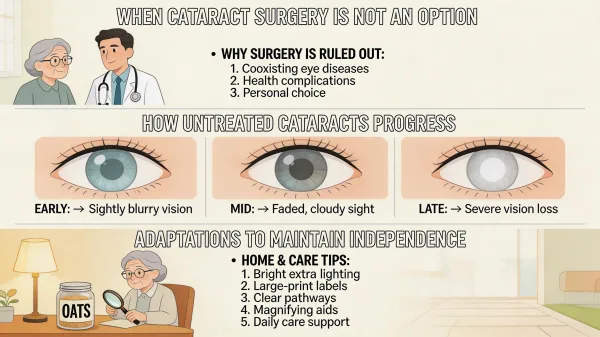
But surgery isn't always an option, and when it's ruled out, families face a very different kind of planning. Some seniors have coexisting eye diseases, like advanced macular degeneration or severe glaucoma, that make surgery unlikely to improve vision or too risky to attempt. Others have systemic health conditions that complicate the procedure, or they may decline surgery for personal reasons. When a family learns that their parent's cataracts can't be removed, the conversation shifts from "when do we schedule the surgery" to "how do we plan for vision that's only going to get worse."
That shift catches people off guard. I've spent years adapting environments and routines for people with different abilities, from my decade running an in-home daycare to years of caregiving, and one thing I've learned is that when the standard solution isn't available, the care plan has to change. It becomes about creativity, patience, and making the most of what's still possible. This article covers why cataract surgery sometimes isn't recommended, what progressive vision loss looks like without intervention, and the practical adaptations that help seniors maintain as much independence as they can.
What Cataracts Are and Why Families Expect a Quick Fix
A cataract is a clouding of the eye's natural lens, the part of the eye that focuses light onto the retina. As proteins in the lens break down with age, they clump together and form opaque patches that scatter or block light. The result is blurry vision, increased glare sensitivity, faded colors, and difficulty seeing in low-light conditions. Most cataracts develop slowly over years, often beginning in a person's 40s or 50s but not causing significant vision problems until their 60s or later.
The reason families assume surgery will solve everything is that, for most people, it does. Cataract surgery replaces the clouded lens with a clear artificial one, and it works well for the vast majority of patients. The American Academy of Ophthalmology notes that cataract surgery is safe even for patients in their late 80s and 90s, with more than 90% achieving good visual outcomes. The procedure typically takes about 15 minutes, recovery is fast, and complications are rare. So when families hear "cataracts," they hear "fixable." That's a reasonable assumption in most cases, but it's not universal, and the exceptions can blindside families who haven't considered them.
The problem is that cataracts rarely exist in isolation in older adults. By the time your parent is old enough for cataracts to seriously affect their vision, they may also have macular degeneration, glaucoma, diabetic eye disease, or some combination. These conditions affect different parts of the eye, and they interact with each other in ways that can make cataract surgery less effective or inadvisable. Families who only know the "cataracts are fixable" narrative aren't prepared for the conversation where the doctor says otherwise.
When Surgery Isn't an Option: Living With Progressive Cataracts
Why Some Seniors Can't Have Cataract Surgery
The most common reason cataract surgery isn't recommended is the presence of another serious eye condition that limits how much the surgery can help. Advanced age-related macular degeneration is the one families encounter most often. AMD damages the central vision area of the retina, and if that damage is severe, removing the cataract won't restore the vision the retina can no longer process. Consider a situation where your parent's retinal specialist says cataracts have progressed significantly, but advanced macular degeneration makes the procedure too risky. The family assumed surgery would restore their vision, and now they're facing worsening clouding with no surgical path forward. That scenario plays out more often than most people realize.
Severe glaucoma, diabetic retinopathy, and corneal disease can also limit what surgery achieves. Some seniors face a different barrier: conditions like advanced Parkinson's disease, severe cardiac issues, or cognitive impairment that make it difficult to cooperate during the procedure or manage recovery. And some seniors simply refuse surgery, a decision families may struggle with but must respect.
How Cataracts Progress Without Surgery
Without removal, cataracts don't stay the same, and they continue to worsen over time. The lens becomes progressively cloudier, and over months to years, vision deteriorates in predictable ways. Early on, your parent might notice increased glare from headlights or overhead lights, and colors may appear washed out or yellowed. Stronger eyeglass prescriptions can compensate for a while, but eventually no prescription is strong enough. As the cataract matures, contrast sensitivity drops and reading becomes difficult even with magnification. In advanced stages, a hypermature cataract can reduce vision to where the person perceives only light and shadow. Without intervention, cataracts only get worse.
Adaptations That Maximize Remaining Vision
When surgery isn't coming, the focus shifts to low-vision adaptations and environmental modifications. From my years running a daycare and caring for my late husband during his illness, I've seen firsthand how much difference thoughtful environmental changes can make when someone's abilities shift. You redesign the space around the person's actual capabilities rather than the capabilities you wish they still had. That mindset, the willingness to stop waiting for a fix and start adapting, is what turns a difficult situation into a manageable one.
Lighting is the single most impactful change. Bright, even, glare-free lighting throughout the home helps a person with cataracts use their remaining vision more effectively. Task lighting at reading areas, countertops, and workspaces makes a measurable difference. Motion-sensor nightlights in hallways, bedrooms, and bathrooms reduce fall risk during nighttime trips. High-contrast modifications come next: brightly colored tape on stair edges, contrasting colors between countertops and floors, large-print labels on medications and kitchen items, and light switch plates that stand out from the wall. Voice-activated devices, talking clocks, and large-button phones also help bridge the gap as vision declines.
How Inoperable Cataracts Affect Daily Life and Safety
Progressive vision loss from cataracts touches nearly every part of daily life, and driving is usually the first major loss. Even moderate cataracts increase glare and reduce contrast, making night driving dangerous, and as the condition advances, daytime driving becomes unsafe too. The loss of driving independence is often what pushes families to reevaluate a parent's living situation entirely.
Falls represent the biggest safety concern, and the data backs that up. The CDC reports that falls are the leading cause of injury among adults 65 and older, and poor vision is a well-documented contributor. I've worked with elderly patients in the ER who came in after falls, and impaired vision is a factor more often than families realize. A senior with progressing cataracts may miss a step, misjudge the edge of a curb, or trip over objects they can't see clearly. Medication management becomes harder when labels are unreadable or when pill colors blend together. Cooking carries burn and cut risks when a person can't distinguish stove settings or clearly see a knife's edge.
Social isolation follows too, and it often gets overlooked in the conversation about cataracts and senior living. When your parent can't read, can't follow a television show, struggles to recognize familiar faces, and feels unsafe leaving the house, they stop doing those things. That withdrawal isn't just inconvenient. Research consistently links vision loss in older adults to higher rates of depression, anxiety, and faster cognitive decline. The vision problem compounds into a broader quality-of-life problem that affects physical and mental health at the same time.
Families often underestimate how many daily tasks depend on clear vision until they start watching their parent struggle. Something as simple as reading a thermostat, checking whether food has expired, or identifying which bills need to be paid becomes a challenge. These aren't dramatic moments, but they're quiet, daily frustrations that add up, and they're the kinds of things that signal it's time to reassess your parent's support system.
The Question No One Thinks to Ask
Most families walk into an eye appointment assuming cataract surgery is a given. The question they don't think to ask is whether anyone has actually confirmed that surgery is possible for their parent, or whether they're just assuming it is. Getting a definitive surgical assessment early changes the entire care planning conversation.
If your parent has been told they have cataracts and also has another eye condition, ask the ophthalmologist directly: "If we removed the cataract, how much improvement would we realistically expect?" That answer tells you whether you're planning for a surgical recovery or planning for progressive vision loss. Those are two very different paths, and families who don't ask that question early often spend months waiting for a surgery that was never realistic. I've seen this in my own family. The time we spent assuming a fix was coming was time that could have been spent making practical changes. Don't make the same mistake.
If surgery is ruled out, ask what comes next. Request a referral for low-vision rehabilitation and ask whether your parent's other eye conditions have their own treatment options that could stabilize some of the remaining vision. Get clear answers about how quickly the cataracts are expected to progress. The more specific information you leave the appointment with, the better your planning will be.
Senior Living Options When Vision Loss Progresses
When a parent's cataracts can't be corrected and vision continues to decline, the living situation may need to change. Aging in place is possible for many seniors with low vision, especially with the environmental modifications described above and support from in-home care aides who can help with tasks that require clear sight. Medication sorting, meal preparation, transportation to appointments, and help managing correspondence are common areas where an aide fills in what your parent's eyes no longer can. A low-vision occupational therapist can assess the home and recommend specific changes tailored to your parent's remaining vision and daily routine. That referral is worth requesting from your parent's eye doctor, and many insurance plans cover at least some occupational therapy visits when prescribed for functional vision loss.
Assisted living communities are another option, particularly those experienced in supporting residents with visual impairments. During my mobile X-ray work, I visited enough care facilities to know that some are far better prepared for residents with vision challenges than others, and the differences show up in the details. Look for communities that emphasize consistent furniture layouts so residents can memorize their surroundings, bright and even lighting without the harsh glare that worsens cataract symptoms, high-contrast design elements on stair edges, hallway walls, and door frames, and staff trained in guiding techniques for visually impaired residents. Ask whether the community has experience with low-vision residents and what specific accommodations they provide. If your parent's vision loss is combined with other care needs, a community that offers graduated care levels provides flexibility as their needs evolve over time.
The cost of additional support, whether in-home aides or an assisted living community, is a factor families need to plan for early. Vision loss from inoperable cataracts is progressive, which means the level of help your parent needs today won't be the level they need in two years. Building some financial flexibility into the plan gives you room to adjust as things change.
Planning Ahead for Progressive Vision Loss
If your parent's cataracts aren't operable, the most important thing you can do is plan proactively instead of reacting to each new limitation as it appears. The first step is a low-vision rehabilitation referral. These specialists help seniors learn adaptive techniques, from eccentric viewing methods that work around central vision loss to daily-living skills that reduce dependence on sight for routine tasks. They can also recommend assistive devices tailored to your parent's specific vision level, ranging from handheld magnifiers to electronic readers with adjustable text size. Connect with your state's commission for the blind or visually impaired, which often provides free or low-cost services including home assessments, mobility training, and assistive technology. Many families don't know these resources exist until a doctor or social worker mentions them, so ask early.
Build a support network before you need one. Talk with your parent about what help they'll need as their vision changes, and identify who in the family or community can provide it. Have honest conversations about driving, home safety, and what adjustments need to happen. These conversations aren't easy, but they're far less stressful when they happen before a crisis, like a fall or a missed medication, forces the issue.
Your parent deserves a plan that protects their safety and preserves as much independence as possible for as long as possible. Inoperable cataracts aren't the outcome anyone hopes for, but with the right adaptations, the right support, and a willingness to plan ahead rather than react, your parent can still live well. Start now. The cataracts won't wait, and neither should the plan.