
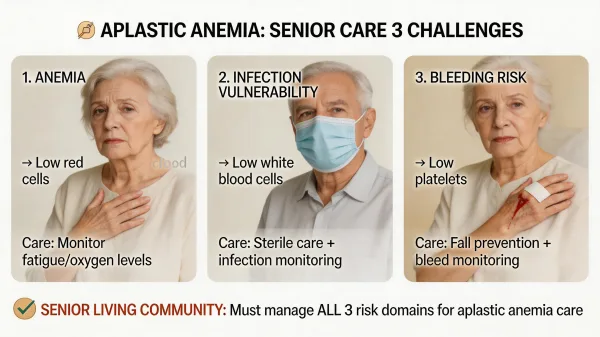
Only 600 to 900 people are diagnosed with aplastic anemia in the United States each year. That rarity means the senior living community your parent moves into has almost certainly never managed this condition before. Unlike common forms of anemia that respond to iron supplements or dietary changes, aplastic anemia is a bone marrow failure disorder that causes the body to stop producing enough red blood cells, white blood cells, and platelets all at once. Your parent isn't dealing with one problem. They're dealing with three simultaneous deficiencies, each with its own risks, symptoms, and care requirements. That triple threat is what makes finding the right aplastic anemia senior living environment so difficult and so important.
I've spent nearly 20 years working in hospital settings where patients with complex blood disorders come through the ER and radiology departments regularly. What I've learned is that managing conditions like aplastic anemia requires a specific kind of clinical awareness, not just general attentiveness. The staff caring for your parent needs to understand why a low-grade fever in someone with a normal immune system is a minor inconvenience, but in someone with aplastic anemia, it can be a medical emergency.
This article answers the most common questions families ask when a parent with aplastic anemia needs structured daily care. We'll cover what makes this condition uniquely challenging for care communities, what to look for during your search, how transfusion logistics work outside of a hospital, and what the realistic costs look like.
What Is Aplastic Anemia and Why Is It Different from Regular Anemia?
Regular anemia means your body doesn't have enough red blood cells. Aplastic anemia means your bone marrow has partially or fully stopped producing all three major types of blood cells: red blood cells that carry oxygen, white blood cells that fight infection, and platelets that control bleeding. The medical term for this triple deficiency is pancytopenia, and it changes everything about how your parent's daily care needs to work.
Aplastic anemia affects roughly 2 in every million people per year in the United States and Europe, with a second peak in incidence appearing in adults over 60. In older adults, the condition tends to present with more severe platelet deficiencies at diagnosis, and response rates to first-line treatment are lower than in younger patients. Research from a 2024 international study found that only 47% of patients over 60 responded to initial therapy, compared to 65% of younger patients. That gap matters because it means your parent may be managing this condition long-term rather than recovering quickly.
Three Risks at Once: Anemia, Infection, and Bleeding
Where this gets confusing for families is that aplastic anemia isn't one problem with one set of symptoms to watch. It creates three simultaneous risk domains, each demanding its own monitoring, its own response protocols, and its own set of daily precautions. Most senior living communities are experienced with residents who have a single chronic condition. Managing all three of these at once is a different level of care entirely.
Low Red Blood Cells (Anemia)
When your parent's bone marrow can't produce enough red blood cells, oxygen delivery to every organ drops. The visible signs include persistent fatigue that goes well beyond normal aging, shortness of breath after walking short distances, pale skin (especially in the nail beds and inner eyelids), dizziness when standing, and a rapid heartbeat. Care staff need to track energy levels daily, not just during scheduled check-ins. A resident who was walking to the dining room yesterday but can't make it down the hallway today may need an urgent hemoglobin check, not just rest. Red blood cell transfusions are the primary management tool, and the frequency depends entirely on your parent's blood counts. Some patients need transfusions every one to two weeks. Others can go longer. The hematology team sets threshold levels, typically a hemoglobin below 7 or 8 g/dL, at which a transfusion gets scheduled. Over time, repeated transfusions cause iron to accumulate in the body, which can damage the liver, heart, and other organs. Iron chelation therapy becomes part of the long-term management plan for many patients.
Low White Blood Cells (Infection Risk)
This is the most dangerous of the three deficiencies. Low neutrophil counts, the specific white blood cells that fight bacterial and fungal infections, leave your parent vulnerable to infections that a healthy immune system would handle without trouble. A small skin break, a mild respiratory exposure, or even bacteria from food can become life-threatening. Research consistently identifies infection as the leading cause of death in aplastic anemia patients. Fever in someone with an absolute neutrophil count below 500 per microliter is a medical emergency requiring immediate evaluation and broad-spectrum antibiotics. Care staff must check temperature at least twice daily, monitor for subtle signs like increased confusion or reduced appetite (which may signal infection before a fever appears), enforce strict hand hygiene protocols for everyone entering the resident's space, and understand that waiting to "see if it gets worse" is not an option. Many patients also take prophylactic antibiotics, antifungals, and antivirals to reduce infection risk, which adds to the medication management burden.
Low Platelets (Bleeding Risk)
Platelets are what allow blood to clot. When platelet counts drop below safe levels, your parent bruises from the lightest contact, bleeds longer from small cuts, and faces the risk of internal bleeding that may not be immediately visible. The hematology team typically sets platelet transfusion thresholds at 10,000 per microliter for patients without active bleeding, or 20,000 if fever or infection is present. Care staff need to watch for petechiae (tiny red dots on the skin that indicate micro-bleeding), blood in urine or stool, nosebleeds that won't stop, and excessive bruising. Fall prevention becomes critical. A fall that might cause a bruise in a healthy resident could cause dangerous internal bleeding in someone with severe thrombocytopenia. The care environment itself matters: sharp edges on furniture, hard flooring without rugs, and even aggressive blood pressure cuff inflation all become risk factors.
I've seen patients in the hospital whose families had no idea that all three of these systems were failing simultaneously. The clinical team manages it behind the scenes, but once your parent is living in a community setting, the frontline staff becomes the early warning system. That's a competency, not something any caregiver can improvise on the spot. The staff need specific training on what to look for, what counts as urgent, and when to call the hematologist rather than just noting it in a chart.
Why Do Most Senior Living Communities Struggle with Aplastic Anemia?
The core issue is familiarity. Assisted living and senior living communities manage diabetes, heart failure, COPD, and dementia every day. Those conditions have well-established care protocols that staff learn during standard training. Aplastic anemia falls outside that experience base. A community might go years or even decades without ever having a resident with this diagnosis. That doesn't mean they can't learn, but it does mean you'll need to verify their willingness to build new protocols rather than assuming existing ones will cover your parent's needs.
The three-risk structure of aplastic anemia also creates an unusual staffing demand. Monitoring infection signs, tracking bleeding indicators, and watching for anemia symptoms are three different skill sets that all need to be active at the same time. Most communities assign one aide per several residents. That ratio may not be sufficient for someone whose condition can shift from stable to critical based on a single blood count change.
What Should You Look for in a Senior Living Community?
Start with the community's relationship with outside specialists. Your parent's hematologist will remain the primary decision-maker for their aplastic anemia management. The senior living community needs to be willing and able to coordinate closely with that specialist, including sharing lab results, adjusting care plans based on blood count changes, and getting your parent to transfusion appointments reliably. Ask specifically whether the community has managed residents with blood disorders or immunocompromised conditions before.
Infection control practices should be visible, not just written in a policy binder. Look at hand hygiene stations, ask about sick-staff policies (whether employees with respiratory symptoms are required to stay home), and find out how quickly the community can arrange transport for urgent medical evaluation. During my time doing mobile X-ray work inside care facilities, I saw how different the reality of infection control could be from what the brochures promised. Ask to see it in action, not just on paper.
You'll also want to ask about the community's capacity to handle emergency situations specific to blood disorders. If your parent develops a fever of 100.4 or higher, what's the protocol? Is there a nurse on-site around the clock, or only during business hours? How quickly can they reach the on-call hematologist? These aren't hypothetical concerns. For someone with aplastic anemia, the gap between a prompt response and a delayed one can mean the difference between outpatient antibiotics and an ICU admission. Write these questions down before your tour and don't leave without clear answers.
How Do Transfusion Schedules Work in a Senior Living Setting?
Most transfusions happen at an outpatient infusion center or hematology clinic, not inside the senior living community itself. A red blood cell transfusion typically takes two to four hours, and a platelet transfusion takes about 30 to 60 minutes. Your parent may need these every one to three weeks depending on their blood counts and how well they respond to other treatments. That means regular transportation to and from a medical facility, which becomes a logistical issue worth discussing with any community you're evaluating. Some patients also experience reactions during or after transfusions, including fevers, chills, or allergic responses, so the community should know what to watch for when your parent returns.
Some communities include medical transport in their fee structure. Others charge separately or rely on families to arrange rides. Transfusion days are physically exhausting, so your parent will likely need rest time afterward and shouldn't be expected to participate in normal activities. Make sure the community understands this rhythm and can accommodate it without treating it as an inconvenience.
What Does Aplastic Anemia Care Cost in Senior Living?
The base cost of assisted living in the United States reached a national median of $6,200 per month, or $74,400 per year, according to the 2025 CareScout Cost of Care Survey. That figure covers room, meals, and standard personal care assistance. It does not cover the specialized monitoring, medication management, and care coordination that aplastic anemia requires.
Families should expect additional costs in several categories. Higher care-tier pricing at communities that use tiered fee structures can add $500 to $2,000 or more per month depending on the level of monitoring and assistance needed. Medical transportation for transfusion appointments, if not included, typically runs $50 to $200 per round trip. The medications themselves, particularly immunosuppressive drugs like cyclosporine and newer agents like eltrombopag, can carry significant out-of-pocket costs even with insurance. When you add it all up, total monthly costs for a parent with aplastic anemia in an assisted living setting can realistically range from $8,000 to $12,000 or more. That's $96,000 to $144,000 annually. Plan for the higher end if your parent's condition is severe.
How Do Immunosuppressive Medications Affect Daily Care?
Many older adults with aplastic anemia take immunosuppressive medications like cyclosporine as a long-term treatment. These drugs work by calming the immune system to stop it from attacking the bone marrow, but they also make your parent even more susceptible to infections than the low white cell counts alone would. The care community needs to understand this compounding effect. It isn't just the disease suppressing the immune system. The treatment does too. From my years working with immunocompromised patients in the hospital, I can tell you that this double layer of immune suppression changes the urgency of every fever, every cough, every small wound that doesn't heal on schedule.
Medication timing matters. Cyclosporine levels need to stay within a therapeutic window, and missed doses or incorrect timing can cause the drug to become either ineffective or toxic. The community's medication management system should be able to handle this precision. Ask whether they administer medications at specific times or within broad windows, because broad windows aren't good enough for immunosuppressive therapy. Regular blood draws to monitor drug levels and kidney function are also part of the routine, which adds to the coordination demands between the community and the hematology team.
When Is Senior Living the Right Choice Over Home Care?
Home care can work well for some aplastic anemia patients, particularly those with non-severe disease whose blood counts remain relatively stable. But when your parent needs frequent monitoring, has a history of infections or bleeding episodes, or lives alone without a reliable caregiver present most of the day, structured care becomes the safer option. The question isn't whether your parent prefers to stay home. Most do. The question is whether the level of monitoring they need can realistically happen at home without gaps.
Consider a situation where your parent bruises from the slightest bump, gets winded climbing three stairs, and was recently hospitalized for a skin infection that wouldn't clear. Those three events aren't separate problems. They're all manifestations of the same bone marrow failure, and together they signal that your parent needs an environment where trained staff can watch for changes across all three risk areas every day. That's hard to replicate with a home health aide who visits for a few hours.
Families sometimes try to split the difference by hiring round-the-clock home care, but the cost of 24-hour in-home care often exceeds what assisted living charges, and you still lack the on-site infrastructure for emergency response, medication oversight by licensed staff, and coordinated communication with the hematology team. If your parent's condition is severe or unstable, the structured environment of a senior living community typically provides better safety margins.
Preparing for the Search
Finding the right senior living community for a parent with aplastic anemia takes more research than most families expect. You'll likely need to educate the community about the condition, bring detailed care protocols from the hematology team, and ask pointed questions about infection control, staffing ratios, and medication management. That's a lot of work on top of everything else you're already handling.
Before you start touring communities, ask your parent's hematologist to put together a written care summary. This should include current blood count ranges and transfusion thresholds, all medications with dosing schedules and monitoring requirements, specific infection prevention protocols, and emergency response instructions. Hand that document to every community you visit and watch how they respond. A community that reads it carefully and asks follow-up questions is already showing you something about how they'll manage your parent's care.
Your parent deserves a care environment that understands the specific risks they face and has the systems in place to respond quickly when something changes. When I think about families going through this, I think about how fast things can shift with blood disorders, and how much peace of mind comes from knowing that the people around your loved one are prepared. Take the time to find the right fit. That preparation is one of the most important things you can do for your parent right now.