
This article is for educational purposes only. It isn't legal advice, financial advice, or a substitute for consulting an elder-law attorney, certified financial planner, or other qualified professional. Laws governing power of attorney, conservatorship, and Adult Protective Services reporting vary by state, and every family's situation is different. Before acting on the legal or financial decisions described here, including establishing a power of attorney, petitioning for conservatorship, or reporting suspected exploitation, please consult a qualified professional licensed in your state.
As of April 2026, an 80-year-old father has moved $12,000 to a contractor for repairs that never happened and another $3,500 to a romance contact he's never met in person. His adult children find out three weeks after the second transfer, when they're going through his bank statements during a visit. Now they're asking what protective tools exist at his bank, at his brokerage, and in apps that might catch the next incident before it escalates.
This is where most families end up: looking back at damage and asking what could have been caught earlier. The honest answer in 2026 is that AI detection of elder financial exploitation has gotten better than most families realize. Several of these tools are already running on your parent's accounts whether you've activated anything or not. Banks have deployed pattern-recognition systems for older account holders. Brokerages use a federal rule that lets them put a hold on suspicious disbursements. Consumer apps now monitor across institutions and alert designated family members. Most of these protections require a small action by the account holder or family to fully activate, and most families have never been told what those actions are.
Watching a family member's cognitive decline taught me that judgment and money sense can erode before anyone notices memory changes. AI is finally catching some of what family members can't.
The Scale of Elder Financial Exploitation, and Why It's So Hard to Catch
The numbers are staggering and getting worse. The FBI's Internet Crime Complaint Center logged 147,127 elder fraud complaints in 2024 reporting nearly $4.9 billion in losses, a 43% jump over 2023. The average loss for victims aged 60 and older exceeded $83,000, and more than 7,500 people lost over $100,000. AARP-cited research estimates total annual losses to U.S. older adults at roughly $28.3 billion, accounting for unreported cases that never reach federal data. FinCEN, the Treasury Department's financial crimes unit, counted 155,415 elder financial exploitation reports filed by financial institutions over a single 12-month period, tied to about $27 billion in suspicious activity.
The patterns themselves explain why traditional bank oversight misses so much. Investment scams led losses in 2024, followed by tech support fraud, government impersonation, romance schemes, and grandparent scams that have grown more convincing with AI voice cloning. FinCEN's analysis found that roughly 80% of elder financial exploitation reports involve scams by strangers, while about 20% involve theft by a trusted person, often a family member. The trusted-person cases are the hardest to catch. A daughter named on a checking account moving money to her own account isn't a red flag to a transaction-monitoring system unless something else is off.
Cognitive decline creates a specific vulnerability that scammers know how to work. Decision-making and impulse control can soften before short-term memory does, which is part of why early signs of dementia are so easy for families to miss. A parent might still pay bills on time and remember names while losing the ability to evaluate whether a "Microsoft technician" on the phone is real. Loneliness compounds it. Romance scammers and pig-butchering crypto schemes both rely on long emotional grooming periods that look, from the outside, like a parent has simply found a new friend who calls a lot. Tech-support scammers exploit a different angle, using fake pop-ups and urgent phone calls that pressure a parent to grant remote access to their computer or wire money to "secure" their accounts. The transactions arrive in pieces. By the time a family adds them up, the loss is already six figures, and the recovery rate even when the activity is reported is lower than most families expect.
What AI Detection at Banks Actually Catches
Major banks have spent the past several years deploying machine-learning systems specifically tuned to elder fraud patterns. JPMorgan Chase, Wells Fargo, Bank of America, and Citi all run real-time transaction monitoring that scores each transaction against the account holder's historical behavior. American Banker's 2026 Predictions report found that 53% of banking professionals identified fraud detection and mitigation as the top use case for AI in their institutions, ahead of every other category. The systems catch what humans miss because the volume is too high to review manually.
What the AI flags varies by bank, but the categories are consistent. Unusual wire transfer amounts or new payees receiving repeated payments. Rapid sequences of large withdrawals, or daily ATM maximums on accounts that don't normally see that activity. Login patterns suggesting a third party has remote access, including new devices or IP addresses. Sudden shifts in spending categories, like cryptocurrency purchases on an account that's never bought crypto. Changes in mailing address or beneficiary designations that come right before unusual activity. FinCEN's 2022 advisory listed 24 specific behavioral and financial red flags that supervised institutions are now expected to incorporate.
Watching my own family member's cognitive decline taught me something I didn't expect. The bank statements were telling a story we hadn't been reading. We were watching for forgotten names and missed appointments, not for unusual transactions. The bank's AI was probably the only set of eyes that could have caught what was happening sooner, and we'd never asked them to talk to us about it. That's the gap most families don't see until they're inside it.
When a flag triggers, the response depends on the bank, the dollar amount, and what state the account holder lives in. Sometimes the bank places a hold and calls the customer to verify. Sometimes a fraud team contacts a designated trusted contact if one exists on the account, which is one of the most underused safeguards in U.S. banking and the reason it deserves its own section below. Sometimes the bank files a Suspicious Activity Report (SAR) with FinCEN, which goes into a federal database that law enforcement can mine. In some states, the bank is required to report suspected exploitation to Adult Protective Services. The interagency statement issued in December 2024 by the Federal Reserve, CFPB, FDIC, FinCEN, NCUA, OCC, and state regulators laid out clear expectations for how supervised institutions should detect, prevent, and respond, and many large banks have visibly upgraded their internal procedures since.
The limits matter as much as the capabilities. Banks can't share account information across institutions because of privacy law. Your parent's bank can flag activity inside its own walls, but it can't see the same scammer pulling from a brokerage account at a different firm. Banks also can't act on a hunch from a family member. They need their own internal review and reasonable belief before placing a hold. Federal law also prohibits a bank from telling anyone, including the account holder, that a Suspicious Activity Report has been filed. So a family might never know the bank caught something, only that a transaction was held up.
Trusted Contact Programs and Why Every Family Should Activate One
FINRA Rule 4512 requires brokerages to make a reasonable effort to obtain a trusted contact for every non-institutional account, and FINRA Rule 2165 lets the brokerage place a temporary hold of up to 15 business days on disbursements or securities transactions when there's reasonable belief of elder financial exploitation. The hold can be extended to 30 business days under certain conditions. The trusted contact gets notified, the brokerage runs an internal review, and in many cases the hold prevents a loss before funds leave the account. Banks now offer similar trusted contact designations, and the December 2024 interagency statement explicitly endorsed the practice.
Here's what the trusted contact does and doesn't do. The contact gives the institution a person to call if something looks wrong, if the account holder can't be reached, or if the institution suspects diminished capacity. The contact isn't granted authority to transact on the account. They can't move money, change beneficiaries, or see balances unless separately authorized. They aren't a power of attorney, and they don't replace one. Their role is to be reachable when the institution needs to verify whether something looks normal for the family.
Most parents have never been asked to designate one. That's the gap. Brokerages are required to ask but not required to obtain, and many account-opening conversations from years ago happened before the rule existed in 2018. Banks aren't federally required to offer the option, though many large institutions now do. The fix takes 10 minutes. A parent calls their bank or brokerage, asks to add a trusted contact, and provides the family member's name, phone, email, and relationship. Most can do it online.
From watching this play out both in my own family's dementia journey and in the families of patients I've cared for, the conversation about adding a trusted contact is harder than the action itself. Parents often hear it as "you don't trust me with my own money." It helps to frame it the way the brokerages do: this is a backup contact, like an emergency contact at a doctor's office. It doesn't change who controls the account. It just gives the institution a phone number to call if something doesn't add up. Frame it that way and most parents agree.
Consumer Apps That Monitor Across Accounts for Elder Financial Exploitation
Bank-level AI watches activity inside one institution. Consumer-facing apps watch across institutions and alert family members directly. Three names come up most often in 2026.
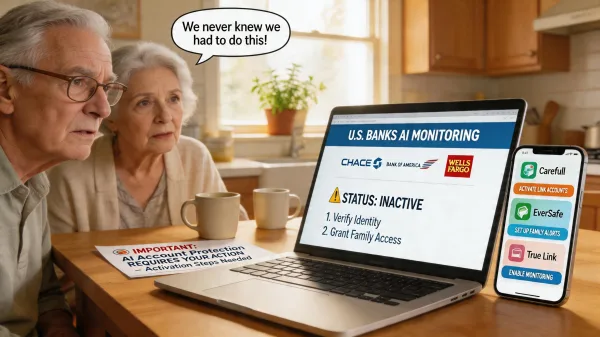
Carefull is a financial safety platform built for older adults and their caregivers. The company announced its proprietary AI engine, GreyMatter, at the Money20/20 conference in October 2025. It monitors connected accounts for more than 60 behavioral and risk patterns including forgetfulness, decline in judgment, and exploitation by trusted persons, and alerts designated family members. Direct-to-consumer pricing has historically been around $12.99 per month or $119.99 annually, though Carefull is increasingly offered free through bank and credit union partnerships. EverSafe takes a similar approach with three subscription tiers ranging from roughly $7.49 to $24.99 monthly depending on features. Their Trusted Advocate access lets family members receive alerts on a read-only basis without seeing balances or moving funds.
True Link Financial takes a different angle. Their Visa prepaid card, around $12 per month, lets a card administrator load funds, set spending rules across more than 50 categories, block specific merchants, and disable cash withdrawals entirely. The cardholder spends within the rules. The administrator gets real-time alerts on every transaction. It works well for parents in middle-stage dementia who still want the dignity of paying for their own coffee but shouldn't have access to a primary checking account.
None of these apps replace bank-level monitoring or a trusted contact designation. They layer on top of it. From the mobile X-ray work I did inside care facilities, what struck me was how often the family member visiting most often had no real-time visibility into what was happening with money at home. These apps are built for that gap. They earn their cost in households where a parent has shown signs of cognitive change, where multiple accounts span institutions, or where a family member lives far enough away that quick visual review of statements isn't realistic.
Legal Tools Families Should Understand Before They're Needed
Two legal frameworks tend to get conflated in family conversations: power of attorney and conservatorship, sometimes called guardianship. They aren't interchangeable. A durable financial power of attorney is a private document the parent signs while still legally competent, naming an agent to manage their finances if they become incapacitated. It's the standard estate-planning tool, it's relatively inexpensive, and it preserves the parent's autonomy because they choose the agent and define the powers. Most elder-law attorneys recommend establishing one well before any signs of decline.
Conservatorship is what families end up with when there's no power of attorney in place and the parent has lost capacity. It's a court process. A judge evaluates capacity, appoints a conservator, and from that point forward the conservator must file annual accountings with the court. It's expensive, it's public, and it strips the parent's autonomy in ways that a power of attorney doesn't. Conservatorship is also the right tool when an existing power-of-attorney agent is the one doing the exploitation, because it lets a court revoke the predatory document and freeze the accounts.
Adult Protective Services is the state-level investigative arm for suspected elder abuse, neglect, or exploitation. APS workers can interview the senior privately, review financial records, develop a safety plan, and refer cases to law enforcement or petition for emergency court intervention. The CFPB's elder financial abuse reporting guide directs families to call local APS first when they suspect exploitation, and to call 911 if there's urgent risk of harm. APS agencies are typically underfunded and overwhelmed, so families with means often work in parallel with a private elder-law attorney.
What I've watched, both in my own family and across patients and families I've worked with, is that most people wait too long. They notice changes, hope they're temporary, watch some money disappear, and only seek legal advice when the loss is large enough to force the conversation. By that point, options narrow. The cheaper, less invasive tools only help if they're activated before the crisis. Conservatorship and litigation are what's left after, and the costs add up on top of any losses already incurred and any memory care costs the family is now planning around.
What to Do This Week
The action list is short and specific. Call your parent's bank and ask whether they offer a trusted contact program, and if so, help your parent designate one. Do the same with every brokerage and retirement account. Confirm contact information is current at every institution, including phone, email, and mailing address. Address changes are themselves a red flag the bank's AI watches for. If your parent has shown any sign of cognitive change, look at Carefull, EverSafe, or True Link and decide whether one earns its monthly cost in your situation. Talk with an elder-law attorney about a durable financial power of attorney if there isn't one in place.
If exploitation is already happening, the steps are different. Contact your local APS office, which you can find through the Eldercare Locator at eldercare.acl.gov or by calling 1-800-677-1116. Call your parent's bank and ask whether a trusted contact can be added that day, and whether the bank can place a hold on pending transfers while the family investigates. Document what you've already observed: dates, amounts, recipients. The DOJ's National Elder Fraud Hotline at 1-833-372-8311 can also help connect families to the right reporting channels. None of this is comfortable. The technology is finally on the family's side in ways it wasn't five years ago, and most of it sits there waiting for someone to ask.