
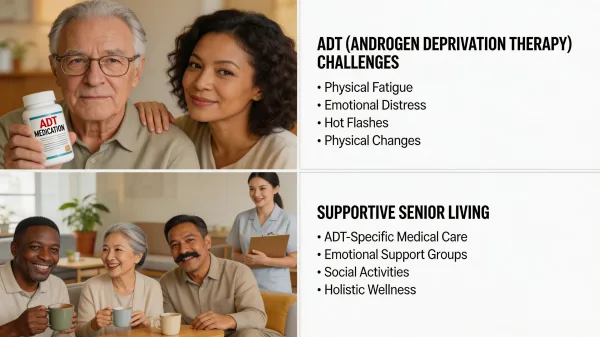
Your father built the deck, fixed the furnace, and carried the groceries in one trip every single time. He was the person in the family who never sat down, never complained, never asked anyone for help. So the first time you watched him struggle to get out of a chair, gripping the armrest with both hands while his legs shook underneath him, you felt something shift. Not just worry, but something closer to grief for a version of him you could feel slipping away. Because the man sitting in that chair didn't look like the father you knew, and the effort it cost him to stand was written all over his face.
Advanced prostate cancer changes a man's daily life in ways that go far beyond the diagnosis itself, and it's one of the reasons families start researching prostate cancer senior living options earlier than they ever expected to. The treatments designed to slow the cancer, particularly androgen deprivation therapy (ADT), can quietly dismantle the physical strength, emotional stability, and personal dignity that defined who he was. For families watching this happen, the hardest part often isn't the cancer itself. It's seeing your father become someone he doesn't recognize, and not knowing how to help him hold onto the parts of himself that treatment is quietly taking.
This article is written for adult children trying to figure out what comes next. If your father is dealing with advanced prostate cancer and the side effects of treatment are making it harder for him to live safely and comfortably at home, a supportive prostate cancer senior living community may be worth considering. Here's what you need to know about how treatment affects daily function, what kind of care actually helps, and how to find a community that treats your father like the whole person he still is.
What Advanced Prostate Cancer Looks Like in Daily Life
Prostate cancer is the most common cancer among men in the United States. About six in ten cases are diagnosed in men who are 65 or older, with the average age at diagnosis around 67 (American Cancer Society, 2025). An estimated 3.5 million men in the U.S. are currently living with a prostate cancer history, which is more than four times higher than for any other cancer in men (SEER, NCI). The five-year survival rate is 98% overall, which means many men live with this disease, and its treatments, for years or even decades.
That long survivorship period is both good news and a complication. For men with advanced prostate cancer, treatment isn't a short chapter that ends with a clear recovery date. It's an ongoing reality that reshapes what every day looks like. Hormonal therapy suppresses testosterone production to starve the cancer of fuel. Radiation causes fatigue and bladder irritation that can persist for months. Chemotherapy brings nausea, immune suppression, and deeper exhaustion. Each treatment layer adds a new limitation, and together they can turn a previously independent man into someone who needs help with basic tasks he used to handle without a second thought. The shift usually happens gradually, which is part of why families often don't recognize how much ground has been lost until the gap between who he was and who he is now has become impossible to ignore.
Beyond the Cancer: The Toll of Androgen Deprivation Therapy
If your father is on ADT, the side effects of the treatment may actually be more disabling day to day than the cancer itself. That's a hard thing to hear, but it's something families need to understand because it changes what kind of care your father needs and where he can realistically get it.
ADT works by suppressing testosterone production, which starves prostate cancer cells of the hormone that fuels their growth. The problem is that testosterone also maintains muscle mass, bone density, energy levels, mood regulation, cognitive sharpness, and sexual function. When you remove it, everything downstream is affected. Research in European Urology has documented that ADT's adverse effects include decreased bone mineral density, weight gain, muscle loss, increased insulin resistance, hot flashes, fatigue, and anemia. The risk of bone fracture alone increases by roughly 39% in men receiving ADT compared to those who aren't (Bourke et al., 2014).
The physical changes accumulate in ways that reshape daily life. Your father may gain weight around his midsection while losing muscle in his arms and legs, changing how he moves and how he sees himself. He may develop breast tissue (gynecomastia) that many men find deeply embarrassing and avoid discussing. Hot flashes can hit multiple times a day, soaking his shirt and disrupting sleep. The fatigue from ADT isn't the kind that rest can fix. It's a bone-deep exhaustion that makes even a short walk to the mailbox feel like a major effort, and because ADT weakens bones steadily over time, a fall that once would have been nothing can now mean a fracture and weeks of recovery.
I watched someone I loved go through treatment that changed who they were on the outside while the person I knew was still somewhere inside. My first husband fought cancer for five years, and what I learned during that time is that the psychological toll of treatment deserves the same attention as the physical symptoms. It rarely gets that attention, and families pay the price. With ADT specifically, the emotional and identity changes can be devastating for men who built their sense of self around physical capability and emotional control. Research from Donovan and colleagues (2015) found that men on ADT commonly report increased emotional lability, tearfulness, irritability, and a measurable loss of perceived masculinity. A separate study in the RADAR trial found that depression and anxiety were actually the strongest predictors of whether a man felt he had lost his masculinity, more so than the physical side effects themselves (Sharpley et al., 2014).
When your father suddenly cries during a commercial or snaps at you over nothing, that isn't weakness or a personality flaw. That's his brain chemistry responding to the absence of a hormone it has depended on for seven or eight decades. Those emotional changes are care needs, not footnotes in a treatment side-effect pamphlet.
In practice, this is where things break down for families. The oncologist manages the cancer, but nobody is managing the daily functional impact of treatment: the fatigue, the falls, the mood swings driving people away, the withdrawal from everything he used to enjoy. ADT side effects are frequently treated as acceptable collateral damage rather than care needs in their own right. Recognizing that gap is the first step toward filling it.
Managing Incontinence with Dignity
Incontinence is one of the most common and most distressing side effects of prostate cancer treatment, whether from surgery, radiation, or a combination of both. Elderly prostate cancer survivors have a two- to five-fold greater prevalence of urinary incontinence compared to their peers without cancer (Sanda et al., PMC, 2013). For many men, this single symptom is what drives them to stop going out, stop seeing friends, and stop participating in activities that once kept them connected to life outside their home.
The shame factor is powerful and often invisible to family members. Many men won't tell their own children they're wearing incontinence pads throughout the day. They cancel plans because they're worried about an accident in public, and they stop exercising because physical activity triggers leakage. I've seen this pattern play out many times in my years working inside hospitals, where men who were active and social before treatment slowly retreat into isolation because they feel like their bodies have turned against them. A well-run senior living community handles incontinence as a routine part of care, not as something that requires embarrassment or repeated explanation. Staff who are trained in discreet incontinence support, combined with easy access to supplies and private laundry services, can make a real difference between a man who stays engaged with the world around him and one who stops leaving his room.
Fatigue, Bone Loss, and the Risk of Falls
ADT-related fatigue isn't a motivation problem, and families shouldn't interpret it that way. It's a measurable physiological response to the suppression of testosterone that affects energy, drive, and the ability to complete everyday activities. Your father may sleep for ten hours and still feel completely spent before noon. That kind of exhaustion makes it difficult to prepare meals, keep up with medications, or even get to a doctor's appointment on time.
Combine that persistent fatigue with the bone density loss that ADT causes over months and years, and you have a serious fall risk that shouldn't be underestimated. I've worked with elderly patients in the ER who came in after falls that seemed minor but resulted in fractures because their bones had been weakened by long-term medication use. A senior living community with proper fall prevention protocols, including grab bars, non-slip flooring, good lighting, and staff who check in on residents regularly, can reduce that risk in ways that a home environment often can't match. Some communities also offer on-site physical therapy programs, which research has shown can help men on ADT maintain muscle mass and improve their balance over time.
Why Prostate Cancer Senior Living Communities Can Help
The gap between what a man with advanced prostate cancer needs and what he can realistically manage at home often widens so gradually that families don't see it until a crisis forces the issue. One month he's doing fine with a weekly visit from a home health aide. Three months later, he's fallen twice, lost eight pounds because he's too tired to cook, and stopped answering the phone because he doesn't want anyone to hear how he sounds.
Assisted living and other senior living communities aren't cancer treatment facilities, and they don't replace oncology care. What they provide is the daily support structure that treatment side effects demand but that few homes can offer around the clock: help with bathing and dressing on the days when fatigue makes those tasks feel impossible, medication management for complex drug regimens, meals that account for weight changes and dietary needs, and transportation to oncology appointments. Just as critically, they offer regular social contact that helps counter the isolation ADT-related depression can cause. For a man whose cancer treatment is eroding his ability to live independently, that structured support can be the difference between declining alone and maintaining the best quality of life his circumstances allow.
What to Look for in a Supportive Community
Not every senior living community is equipped to support a resident going through active cancer treatment. When evaluating options, ask specific questions. Does the community have experience with residents on ADT or chemotherapy? Can care staff coordinate with outside oncology teams? Is there a registered nurse on-site who understands the side effect profile of hormonal therapy?
I've visited enough care facilities through my work doing mobile X-ray to know that the marketing version of a community and the daily reality on the floor aren't always the same picture. Ask to visit during a regular mealtime, not just during a polished scheduled tour. Talk to families of current residents and ask how responsive staff are when care needs change. Watch how staff interact with residents who need hands-on help, not just the ones walking around independently. Look for communities that offer physical therapy access, mental health support or counseling referrals, and flexible care plans that can scale up as your father's needs evolve over the course of treatment.
Understanding the Costs
Assisted living in the United States carries a national median cost of $6,200 per month, or $74,400 per year, according to the CareScout 2025 Cost of Care Survey. That's the baseline for a standard one-bedroom unit with basic services. Your father's actual cost will likely run higher because the care demands of advanced cancer treatment typically push residents into elevated care tiers. Medication management, incontinence support, and increased staff assistance all add to the monthly total. Depending on the community, you could be looking at $7,000 to $9,000 per month once those charges are factored in, which translates to $84,000 to $108,000 annually.
Medicare doesn't cover assisted living room and board, though it does cover the oncology treatment itself, including doctor visits, chemotherapy, and radiation. Medicaid coverage for assisted living varies significantly by state, and eligibility requirements can be strict. Veterans with qualifying service may be eligible for Aid and Attendance benefits that help offset senior living costs. Long-term care insurance, if your father purchased a policy years ago, may cover a portion of the monthly charges. Start the financial planning conversation as early as possible, because these costs accumulate quickly and waiting until a crisis leaves fewer options on the table.
Talking to Your Father About Prostate Cancer Senior Living
This is the conversation nobody wants to have, and it's even harder when the person you're talking to spent his entire adult life being the strong one in the family. Expect resistance, and expect some anger. Those reactions don't mean you're wrong to bring the subject up.
Frame the conversation around what senior living gives him rather than focusing on what it takes away. Access to physical therapy that helps him stay stronger for longer. Staff who can help on bad days so he doesn't have to depend on you for everything. Regular social connection with other people, including other men who understand what living with a serious health condition feels like. From my own years as a caregiver, I know that the people who are hardest to help are the ones who spent their whole lives helping everyone else. Approach the discussion as a way to protect his independence and his dignity, not to end either one. If your father's emotional volatility from ADT is making these conversations more difficult, acknowledge that directly rather than working around it. Tell him you understand the treatment is affecting more than just his body, and that you're bringing this up because you want him to have the best possible quality of life during a difficult chapter.
When Home Care Isn't Enough
There isn't a clean threshold that tells you exactly when it's time, but there are signals you can watch for. If your father has fallen more than once in recent months, if he's losing weight because he's too exhausted to prepare meals, if he's missing oncology appointments because he can't drive himself and won't ask for a ride, or if incontinence concerns are keeping him from leaving the house at all, those are signs that home-based care has reached its practical limits.
The decision to move a parent into senior living is never easy, and a cancer diagnosis makes it harder because the situation feels both urgent and uncertain. But waiting until a crisis forces the decision usually means fewer options and less time to choose well. Starting the research now, even if a move is months away, gives your family breathing room to find the right fit instead of settling for whatever is available in an emergency.
Supporting Your Father Through What Comes Next
Advanced prostate cancer doesn't just happen to your father. It reshapes your whole family's daily reality. The treatment side effects, the personality changes from ADT, the slow erosion of the independence he valued more than almost anything, all of it lands on the shoulders of the people closest to him.
You can't fix the cancer, and you can't undo what ADT does to his body and his mood. But you can make sure the daily reality of his life is supported by people who understand what he's going through and who treat him with the respect he has always deserved. The right prostate cancer senior living community won't just manage his physical care needs. It will help him hold onto the parts of himself that the disease and its treatment haven't touched, and that is something worth every hour you spend looking for it.