
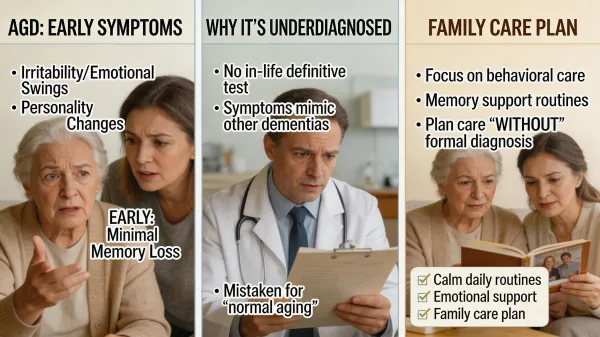
Argyrophilic grain disease (AGD) is a neurodegenerative brain condition that causes tiny tau protein deposits to accumulate in the limbic system, the region controlling emotion and memory. It accounts for roughly 5% of dementia cases found at autopsy and can only be confirmed after death.
Some dementias don't come with a clear diagnosis while your parent is still alive. For families watching behavioral changes that don't match the typical Alzheimer's pattern, the absence of a definitive answer can feel almost as overwhelming as the symptoms themselves.
Argyrophilic grain disease is one of those conditions. It's rarely discussed outside of neuropathology research, and most families won't hear the term unless a specialist raises it. AGD can't be confirmed through any test available during life. But it's more common than people realize, and the symptoms it produces, particularly irritability, paranoia, and sudden personality shifts, can upend a household long before anyone connects them to dementia.
When my own family member's decline started, what we saw didn't match the pamphlets. The behaviors came before the memory loss, the progression felt wrong, and we spent months questioning ourselves before anyone used the word dementia. That gap between what you expect cognitive decline to look like and what actually plays out at home is exactly why conditions like AGD leave families feeling lost.
This article covers what argyrophilic grain disease is, what the behavioral pattern looks like in daily life, why diagnosis is so difficult, and how to approach memory care planning when your parent's condition doesn't come with a clear label.
What Is Argyrophilic Grain Disease?
AGD belongs to a family of brain diseases called tauopathies, conditions caused by the abnormal buildup of tau protein. In a healthy brain, tau helps stabilize nerve cell structure. In AGD, a specific form of tau accumulates as small spindle-shaped deposits in the limbic region, the area that handles emotional regulation, memory processing, and behavioral responses.
The name comes from how the disease is identified at autopsy. When brain tissue is treated with a silver-based dye, the tau deposits appear as tiny grain-like shapes under the microscope, giving the condition its name: "argyrophilic" means silver-loving.
First described in 1987, AGD has only recently been recognized as a distinct condition. Autopsy studies consistently find argyrophilic grains in 5% to 9% of older adults' brains, with prevalence climbing sharply after age 80. One study of centenarians found grains in over 30% of brains examined. Despite those numbers, AGD remains nearly invisible to the clinical community because no scan, blood test, or cognitive assessment can detect it during life.
AGD frequently co-exists with Alzheimer's disease pathology. Many people whose brains show argyrophilic grains also have Alzheimer's-related changes present, which makes separating one condition from the other in a living patient extremely difficult.
The Behavioral Profile of AGD and What It Means for Memory Care
The hallmark of argyrophilic grain disease isn't memory loss. It's behavioral change. Research on autopsy-confirmed cases consistently shows that irritability, agitation, personality shifts, and emotional volatility appear before significant cognitive decline. In confirmed cases, irritability was the most common symptom throughout the illness, followed by paranoid delusions, low mood, and apathy. Because AGD targets the limbic system, the earliest damage shows up as changes in how a person feels and reacts, not in what they remember.
Consider a parent who was once patient and easygoing gradually becoming suspicious of family members, hostile toward offers of help, and prone to angry outbursts with little warning. They accuse a sibling of stealing from them. They insist someone has been through their belongings. The family chalks it up to depression, stress, or just aging. Months later, a neuropsychological evaluation reveals a dementia pattern that doesn't fit Alzheimer's, and the neurologist mentions argyrophilic grain disease as a possible explanation.
This behavioral profile creates real challenges in memory care settings. Most programs center on the Alzheimer's model, where confusion, wandering, and progressive memory loss drive the care plan. A resident with AGD may score reasonably on cognitive screenings but become combative during personal care, refuse meals out of suspicion, or lash out at staff without obvious triggers. Standard redirection techniques designed for confused Alzheimer's residents often don't work with AGD-type behaviors because the resident isn't confused in the typical sense. They're emotionally dysregulated. Care teams need training that goes beyond Alzheimer's-focused protocols: predictable routines that reduce agitation triggers, calm responses that avoid confrontation, smaller group environments, and close monitoring of paranoid thinking before it escalates. The goal isn't to eliminate every episode but to reduce the frequency and intensity enough for the resident to maintain safety and quality of life. When evaluating argyrophilic grain disease memory care options, ask how staff handles residents whose primary symptoms are behavioral rather than cognitive. That answer tells you more than any brochure.
I watched this disconnect firsthand with my own family member. The behavioral changes came first: the irritability, the suspicion, the personality shifts that arrived without warning. None of it matched what we'd read about dementia or what the doctors had told us to expect. We spent weeks wondering if it was depression or a medication side effect before anyone suggested this might be cognitive decline presenting in a way we never expected. That experience shapes how I write about rare dementias, and it's why I believe families deserve honest information when the pattern doesn't follow the textbook.
How AGD Differs from Alzheimer's Disease
The clearest way to understand AGD is to compare it to what most families already know about Alzheimer's. In Alzheimer's, the earliest and most prominent symptom is usually memory loss: forgetting recent conversations, repeating questions, losing track of dates and names. Personality changes can develop over time, but they typically follow cognitive decline rather than lead it.
AGD often works in the other direction. Emotional and personality changes come first, sometimes years before obvious memory problems. Your parent may become paranoid, easily angered, or emotionally flat in ways that feel sudden and out of character. Cognitive testing might show only mild impairment, which delays a formal diagnosis because the numbers don't match the severity of what the family is dealing with at home. AGD also tends to progress more slowly than Alzheimer's, with a typical course of 4 to 8 years depending on what other pathology is present. I remember being told to watch for forgetfulness, and when the first real signs were behavioral instead, it took us much longer to connect the dots.
The two conditions also frequently overlap. Many older adults with AGD carry some degree of Alzheimer's pathology as well, which makes the clinical picture even murkier. In practice, families often receive an Alzheimer's diagnosis that doesn't fully explain the behaviors they're living with every day.
Why Argyrophilic Grain Disease Is Rarely Diagnosed
The uncomfortable reality is that AGD can only be confirmed through examination of brain tissue after death. There's no blood test, no imaging study, and no cognitive screening tool that identifies argyrophilic grains in a living person. During life, what doctors observe is a behavioral pattern, and behavioral patterns can point in a dozen different directions.
This diagnostic gap is compounded by the fact that AGD rarely occurs in isolation. Most people with argyrophilic grains also have other forms of dementia pathology present, especially Alzheimer's-related changes. When a doctor identifies dementia symptoms and sees memory decline alongside behavioral issues, the diagnosis typically defaults to Alzheimer's or an unspecified neurodegenerative condition. AGD isn't on most clinicians' radar, and no available test would put it there.
For families, this means you may never get a definitive name for what your parent is going through. That's a hard thing to sit with, especially when you're making major care decisions. But the absence of a specific diagnosis doesn't have to stop you from getting the right care. The behavioral pattern itself is often a more practical guide for memory care planning than any diagnostic label would be.
Argyrophilic Grain Disease Memory Care: Focusing on Behavior, Not the Label
You don't need a confirmed AGD diagnosis to build an effective care plan. What matters is understanding your parent's behavioral profile and finding a memory care community equipped to respond to it.
When evaluating options, ask practical questions. Does this community have experience managing residents whose primary symptoms are behavioral rather than memory-related? How does staff respond when a resident becomes agitated or combative? What's the staff-to-resident ratio during late afternoon and evening, when behavioral episodes tend to peak? Is there flexibility for residents who don't respond well to structured group activities?
If your parent is already in memory care and the current approach isn't working, request a care plan review focused on behavioral triggers. A change in routine, medication adjustment, or room assignment can sometimes reduce difficult episodes. Push for individualized approaches rather than a standard protocol.
Talk openly with the care team about what you've observed at home. Describe the specific patterns: the irritability, the paranoia, the emotional swings. A general dementia label won't tell the whole story, and the more detail you share, the better staff can prepare and respond. In my experience, the families who adjust fastest are the ones who stop waiting for a perfect diagnosis and start building care around the symptoms that are actually present. The label matters less than the response.
What This Means for Your Family
Argyrophilic grain disease is unlikely to appear on your parent's medical chart. It's a condition most families won't hear about and most doctors won't mention. But if your parent is showing a pattern of behavioral and emotional changes that don't fit the typical Alzheimer's profile, knowing that AGD exists can help explain why the experience feels different from what you expected.
The most practical takeaway is this: you don't need a confirmed diagnosis to take action. Memory care decisions should be driven by what your parent needs right now, not by waiting for a label that may never arrive. Look for communities that understand behavioral presentations of dementia, ask direct questions about staff training and flexibility, and trust what you're observing with your own eyes.
Your parent's dementia may not match the standard narrative. That's OK. You're not imagining the changes. You're not overreacting. And the fact that you're researching something as specific as argyrophilic grain disease tells me your parent is fortunate to have someone paying this close attention.