
Why Does Your Parent Keep Getting the Same Skin Infection?
Your parent's leg turns red, swollen, and hot to the touch. You take them to the ER. They get IV antibiotics, maybe spend a few days in the hospital, and eventually the infection clears. Then, two months later, it happens again. And again.
If this cycle sounds familiar, your parent is likely dealing with recurrent cellulitis, a bacterial skin infection that keeps coming back because the underlying conditions causing it haven't been addressed. Cellulitis is one of the most common reasons older adults end up in the hospital. Across the United States, it accounts for roughly 650,000 hospitalizations each year, with the lower legs being the most frequently affected area. Each hospital stay averages close to five days, and the costs add up quickly when your parent is going through this multiple times a year.
What most people don't realize until they're in it: recurrent cellulitis is usually preventable. Each episode damages the lymphatic system a little more, which makes the swelling worse, which makes the next infection more likely. It's a cycle that feeds itself. But breaking it requires consistent daily prevention, the kind of routine care that's hard to maintain at home when your parent lives alone or when family caregivers are stretched thin.
I've seen this pattern play out too many times in the ER. A patient comes in with a leg that's red from knee to ankle, running a fever, clearly in pain. And when you look closely, the infection started from a tiny crack in the skin that nobody noticed. A small break that could have been caught with a daily skin check became a serious infection requiring IV antibiotics and days in the hospital. That preventable-to-serious escalation is exactly why recurrent cellulitis deserves more attention than it typically gets.
This article covers what's driving your parent's repeat infections, how to break the cycle, and when a senior living community might offer the consistent care environment your parent needs.
What Is Recurrent Cellulitis?
Cellulitis is a bacterial infection of the skin and the tissue just beneath it. It typically shows up as a spreading area of redness, warmth, swelling, and tenderness, most often on the lower legs. The bacteria responsible are usually group A streptococcus or staphylococcus aureus, and they enter through breaks in the skin that can be so small they're almost invisible to the eye.
When cellulitis keeps coming back, two or more episodes within a year, it's considered recurrent. Research shows that 35% to 50% of people hospitalized for cellulitis have had at least one previous episode. That's not a small number. And each recurrence does a little more damage to the lymphatic vessels in the affected area, creating a worsening cycle that becomes harder to interrupt over time.
For older adults, the risk factors stack up. Aging skin is thinner, drier, and more prone to cracking. Chronic conditions like diabetes, venous insufficiency, and lymphedema are common. Reduced mobility means more time sitting with legs down, which worsens swelling. Weakened immune systems make it harder to fight off bacteria. All of these factors converge in the elderly population, which is why seniors experience cellulitis at disproportionately high rates.
The Vicious Cycle: Why Each Episode Makes the Next One More Likely
Here's the part that catches most families off guard. Cellulitis isn't just an infection that comes and goes cleanly. Every episode inflicts damage on the lymphatic system, the network of tiny vessels responsible for draining fluid from tissues and mounting local immune responses. When cellulitis causes inflammation and tissue swelling, it physically damages these delicate lymphatic channels. The damaged channels can't drain fluid as efficiently, which leads to chronic edema (persistent swelling). That swelling stretches the skin, creates a moist environment bacteria love, and impairs the local immune response. The result? Another infection.
Researchers have documented this cycle extensively. A study of nearly 1,850 patients with lymphedema found that over 37% had experienced at least one episode of cellulitis, and nearly a quarter had recurrent episodes. Patients with more advanced lymphedema had dramatically higher cellulitis rates, with the most severe cases showing over nine times the risk compared to mild cases. The longer the swelling persists without treatment, the worse the cycle becomes.
This is why treating each individual episode with antibiotics, while necessary, isn't enough. Without addressing the underlying swelling and skin vulnerability, you're just waiting for the next round.
Breaking the Cellulitis Cycle: Prevention That Works
Breaking the recurrent cellulitis cycle comes down to addressing every factor that gives bacteria an opportunity to enter the skin and thrive. This isn't about any single intervention. It's about a daily routine that covers skin integrity, swelling management, and early detection. When these prevention measures are applied consistently, the results can be dramatic.
Daily Skin Inspection
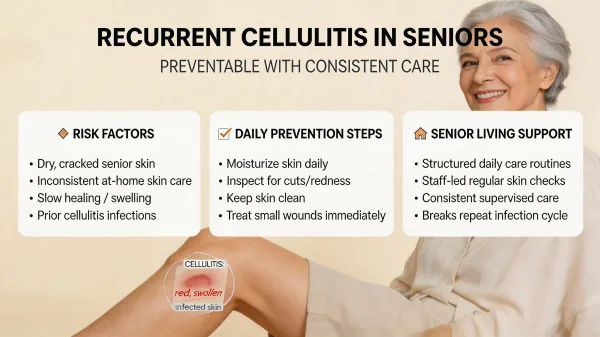
The single most important prevention step is checking the legs every day. Bacteria need an entry point, and in seniors with fragile skin, that entry point can be a tiny crack between the toes from athlete's foot, a scratch from bumping a walker against the shin, dry skin that has split open, or a small wound from ill-fitting shoes. These are easy to miss if nobody is looking. In my years working in the hospital, the patients who kept coming back with cellulitis almost always had the same story: a small skin break that went unnoticed for days. By the time someone noticed the redness and swelling, the infection had already taken hold. A daily visual inspection of both legs, including between the toes, the shins, and the ankles, can catch these problems before bacteria get a foothold. In a senior living community, this kind of inspection happens as part of the daily care routine. A trained caregiver checking the legs each morning during dressing or bathing can spot a small wound, a patch of cracked skin, or early redness that signals trouble.
Moisturizing Routines That Prevent Skin Cracking
Dry, cracked skin is one of the most common entry points for bacteria, and aging skin loses moisture faster than younger skin. A consistent moisturizing routine is a surprisingly effective prevention measure. The goal is simple: keep the skin on the legs supple and intact. A fragrance-free, medical-grade emollient applied after bathing and at least once more during the day can significantly reduce the tiny cracks and fissures that bacteria exploit. The key word is consistent. Moisturizing once in a while doesn't cut it. This needs to happen every single day, ideally twice.
Compression Therapy to Reduce Edema
If your parent has chronic leg swelling from lymphedema or venous insufficiency, compression therapy is one of the most effective tools available. A 2020 randomized controlled trial published in the New England Journal of Medicine found that compression therapy reduced cellulitis recurrence to 15%, compared to 40% in the group that received education alone. The trial was stopped early because the benefit was so clear. That's a number needed to treat of just four, meaning for every four patients who wear compression garments, one avoids a recurrence. Compression garments work by helping push fluid out of the legs and back into circulation, reducing the swelling that creates a hospitable environment for bacteria. Most patients in the study wore knee-high stockings providing 23 to 32 mmHg of pressure. However, compliance can be a challenge. Only about a third of patients with a history of cellulitis report being willing to wear compression stockings on their own. They can be difficult to put on, especially for seniors with limited hand strength or mobility. In a care setting, staff can assist with applying and removing compression garments daily, which dramatically improves adherence.
Treating Underlying Skin Conditions
Athlete's foot (tinea pedis) and toenail fungus are frequently overlooked contributors to recurrent cellulitis. The fungal infection creates cracks and openings in the skin between the toes, giving bacteria a direct path in. Treating these conditions with antifungal medications, and keeping the feet clean and dry, removes that entry point. Similarly, managing eczema, venous stasis dermatitis, and any other condition that compromises skin integrity is part of the prevention equation.
Prophylactic Antibiotics in Select Cases
For patients with two or more episodes of cellulitis in a year, their doctor may recommend low-dose prophylactic antibiotics to reduce recurrence. The PATCH I trial, a large randomized controlled study published in the New England Journal of Medicine, found that 12 months of low-dose penicillin V reduced recurrence from 37% to 22% during the treatment period. A Cochrane analysis of multiple trials found that prophylactic antibiotics reduced recurrence by about 69% overall. There's an important caveat: the protective effect fades after the antibiotics are stopped. Prophylactic antibiotics work best as a bridge while other prevention measures like compression, skin care, and lifestyle changes are being put into place. They aren't a permanent fix on their own, but they can buy valuable time to get the rest of the prevention plan working.
Why Consistent Care Breaks the Cycle
All of these measures share one requirement. They have to happen every day, without gaps. That's where the challenge lies for families managing a parent's care at home. Daily skin inspections, moisturizing twice a day, putting on and removing compression stockings, applying antifungal treatments, and managing medication schedules add up. When a parent lives alone, or when an adult child is juggling caregiving with work and their own family, things get missed. A senior living community provides that consistency. The care staff is there every day, and skin care protocols can become part of the standard daily routine, not something that depends on whether someone remembered to check.
When Home Care Isn't Enough
Consider a situation where your parent has developed cellulitis for the fourth time this year. Each episode has meant a trip to the ER, IV antibiotics, and a hospital stay. The infections keep starting in the same leg, the one with chronic swelling that your parent can barely reach to inspect. Between episodes, your parent is supposed to be moisturizing daily, wearing compression stockings, and keeping an eye on any skin changes. But they live alone, their mobility is limited, and the stockings are nearly impossible for them to put on without help.
This scenario is common, and it's a clear signal that the level of care required has outpaced what can be delivered at home. Each hospitalization takes a toll. Older adults lose muscle mass and function during hospital stays, which further reduces their mobility and makes the swelling worse. The cycle accelerates.
Moving to an assisted living community doesn't mean giving up independence. It means putting a support structure in place that addresses the daily prevention needs your parent can't reliably manage alone. The difference between a fourth ER visit and breaking the cycle is often just having someone check the legs every morning.
What to Look for in a Senior Living Community
Not every facility is equipped to manage a condition like recurrent cellulitis effectively. When you're evaluating communities for a parent with this issue, ask specific questions about their skin care protocols. Do they perform daily skin assessments for residents with known skin conditions? Can staff assist with compression garment application and removal? Is there a process for documenting and tracking skin changes over time? How quickly do they respond to early signs of infection?
You'll also want to understand the community's relationship with outside medical providers. Your parent will still need a physician managing their cellulitis prevention plan, potentially including prophylactic antibiotics, compression prescriptions, and specialist referrals. The community should be able to coordinate with those providers and carry out the care plan consistently. Having visited care facilities during my years doing mobile X-ray, I can tell you that the quality of daily routine care varies enormously from one place to the next. The communities that take skin care seriously have documented protocols, trained staff, and systems for flagging early changes before they become emergencies.
The Financial Case for Prevention
Recurrent cellulitis is expensive. A single hospitalization for lower extremity cellulitis carries a median cost of around $7,300, with an average stay close to five days. If your parent is hospitalized four times a year, that's nearly $30,000 in hospital costs alone, not counting follow-up visits, medications, and time away from normal life.
Compare that to the cost of prevention. Compression stockings run between $30 and $180 depending on the type. Moisturizer is a few dollars a month. Prophylactic penicillin is one of the least expensive antibiotics available. Even the cost of senior living, when weighed against repeated hospitalizations and the progressive decline in function that comes with each episode, often makes financial sense for families dealing with this cycle.
The real cost isn't just financial, though. Each hospitalization carries risks for older adults: hospital-acquired infections, delirium, falls, loss of muscle mass and mobility. Prevention isn't just cheaper. It's safer.
Having the Conversation with Your Parent
Talking to your parent about moving to a senior living community is never simple, and framing it around a medical condition like recurrent cellulitis can actually help. This isn't about taking away their independence. It's about solving a specific, recurring medical problem that has clear consequences if it continues unchecked.
Frame the conversation around what your parent is losing to these infections: time in the hospital, energy from fighting the infection, mobility from prolonged bed rest, and quality of life from the pain and disruption. Then frame what they'd be gaining: daily support that catches problems early, help with the stockings and skin care they struggle to manage alone, and fewer trips to the ER.
I've watched families go through this decision from both sides of the hospital bed. The guilt, the worry about whether you're making the right call. But I've also seen the difference that consistent daily care can make for a condition like this. When someone is checking the skin every day, catching the small problems before they become big ones, the repeat hospitalizations often stop.
What Comes Next
Recurrent cellulitis in an aging parent can feel like an endless loop of ER visits and antibiotics. But it doesn't have to stay that way. The infection cycle has identifiable drivers, and each one can be addressed with the right daily care routine.
If your parent keeps getting cellulitis and the current care plan isn't preventing recurrences, it may be time to evaluate whether a senior living community can provide the level of daily support they need. The prevention tools exist: skin inspections, moisturizing, compression therapy, treating fungal infections, and prophylactic antibiotics when appropriate. The missing piece for many families is simply having someone there to do them consistently, day after day.
You're not failing your parent by recognizing that their care needs have grown beyond what home can provide. You're doing what good families do: finding the solution that keeps them safer and healthier for the long run.