
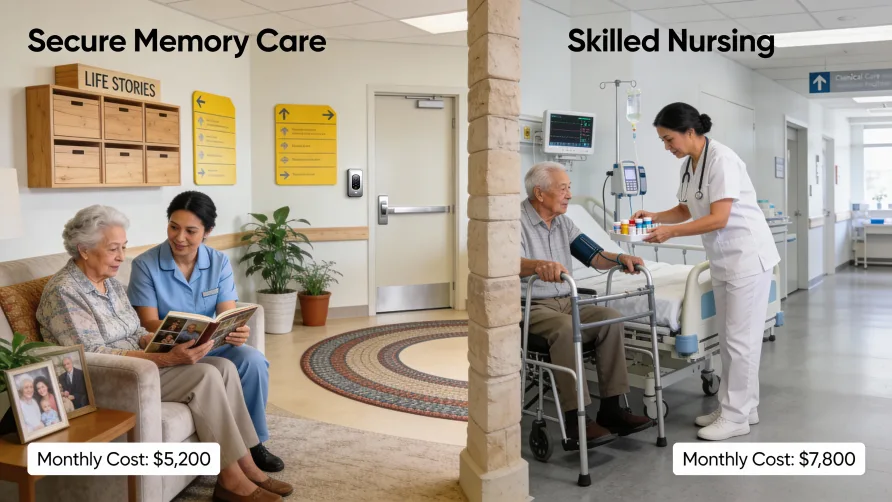
These aren't interchangeable, and choosing wrong is expensive. Send your parent with moderate dementia and stable health to a nursing home, and you'll pay $3,000 more monthly for medical services they don't need. Place your parent who needs daily wound care and IV antibiotics in memory care, and they'll be transferred to a nursing home within weeks when the facility can't meet their medical needs.
Understanding the difference between memory care and nursing homes isn't about finding "better" care. It's about matching your parent's specific needs to the right level of service. This guide breaks down the distinctions using direct comparisons, cost data, and clear criteria for who belongs where.
Quick Definitions
Memory Care: Specialized residential care for people with Alzheimer's disease, dementia, or other cognitive impairments who need supervision and structured environments but don't require skilled nursing services.
Nursing Home: Medical facilities providing 24-hour skilled nursing care, medical supervision, rehabilitation services, and complex health management for people who can't be safely cared for at home or in less medical settings.
Cost Comparison 2025
| Care Type | Semi-Private Room | Private Room | Annual Cost Range |
|---|---|---|---|
| Memory Care | $6,450 - $7,900/month | $6,450 - $7,900/month | $77,400 - $94,800 |
| Nursing Home | $9,277/month | $10,646/month | $111,324 - $127,752 |
| Cost Difference | +$2,827/month (+44%) | +$2,746/month (+35%) | +$33,924 - $32,952 annually |
Source: 2025 industry cost surveys
Primary Care Focus
| Feature | Memory Care | Nursing Home |
|---|---|---|
| Main Purpose | Dementia/cognitive support | Medical care + rehabilitation |
| Staff Focus | Behavioral management, safety, engagement | Medical treatment, skilled nursing |
| Environment Design | Secure, wandering-proof, cognitively supportive | Clinical, medically equipped |
| Medical Capability | Limited medical services | Full skilled nursing services |
Detailed Comparison Table
| Category | Memory Care | Nursing Home |
|---|---|---|
| Staffing | Dementia-trained caregivers, activity coordinators, some nurses | Registered nurses, licensed practical nurses, certified nursing assistants, physicians on call |
| Staff-to-Resident Ratio | Typically 1:6 to 1:8 during day | Varies; federally mandated minimums apply |
| Medical Services | Medication reminders, basic health monitoring | IV medications, wound care, tube feeding, injections, catheter care, oxygen therapy |
| Rehabilitation | Light exercise, cognitive activities | Physical therapy, occupational therapy, speech therapy |
| Security | Secured exits, alarmed doors, enclosed outdoor spaces | Standard facility security, some units secured |
| Activities | Memory-specific: reminiscence therapy, music therapy, sensory stimulation | General: bingo, movies, occasional outings (health-dependent) |
| Room Setup | Studio or one-bedroom apartments | Hospital-style semi-private or private rooms |
| Dining | Restaurant-style or family dining | Cafeteria-style or in-room trays |
| Move-In Process | Assessment, trial period common | Medical evaluation, care plan required |
| Discharge Policies | Remains until medical needs exceed capacity | Remains until stable enough for lower level of care |
Medical Care Level Breakdown
| Service | Memory Care | Nursing Home |
|---|---|---|
| Medication management | ? Reminders and administration | ? Complex medication administration |
| Vital signs monitoring | ? Basic (BP, temperature) | ? Comprehensive (including O2, detailed charting) |
| Wound care | ? Simple bandaging only | ? Advanced wound care, dressing changes |
| IV medications | ? Not provided | ? Full IV therapy capability |
| Feeding tubes | ? Not supported | ? G-tube, NG-tube management |
| Catheters | ? Limited or none | ? Catheter care and management |
| Oxygen therapy | ? Basic oxygen only | ? All levels of oxygen support |
| Post-surgical care | ? Not equipped | ? Post-op monitoring and care |
| Physical therapy | ? Maintenance exercises | ? Skilled PT with licensed therapists |
| 24/7 RN availability | ? LPN or on-call only | ? RN on-site around the clock |
? = Provided | ? = Not provided | ? = Limited capability
Who Belongs Where: Decision Framework
This is where families get it right or waste thousands. Here's how to determine which setting your parent needs.
Choose Memory Care When:
Primary Need: Cognitive Support
Your parent needs memory care if their main challenge is dementia-related and they meet these criteria:
- Diagnosed cognitive impairment: Alzheimer's disease, vascular dementia, Lewy body dementia, or other forms of dementia requiring specialized support.
- Safety risks from memory loss: Wandering, getting lost, leaving stove on, forgetting to eat, unable to recognize danger.
- Behavioral challenges: Agitation, sundowning, confusion, repetitive questions, resistance to care from family members.
- Medically stable: No active medical crises. Chronic conditions like diabetes, hypertension, or arthritis are managed with oral medications and basic monitoring.
- Can perform some ADLs with prompting: May need reminders or partial assistance but doesn't require two-person transfers or complete care for all activities of daily living.
Example scenarios for memory care:
- Mom has moderate Alzheimer's. She wanders and gets lost in her neighborhood. She's physically healthy, takes medications for blood pressure and cholesterol, walks independently, and eats well with supervision.
- Dad has Lewy body dementia with hallucinations and confusion. He's physically strong, no major health issues, but becomes aggressive when family tries to help with bathing. He needs specialized dementia care but not skilled nursing.
- Your parent has early-to-moderate dementia, is mobile, has no wounds or complex medical needs, but can't safely live alone due to poor judgment and memory deficits.
Choose Nursing Home When:
Primary Need: Medical Care
Your parent needs a nursing home if their medical complexity exceeds what memory care can safely provide:
- Requires skilled nursing: Daily wound care, IV medications, tube feeding, catheter management, complex medication regimens requiring nursing judgment.
- Post-hospitalization: Recovering from stroke, hip fracture, major surgery, or serious illness requiring rehabilitation and medical monitoring.
- Multiple complex conditions: Heart failure requiring daily monitoring, COPD with oxygen needs, diabetes with frequent blood sugar swings, advanced kidney disease.
- Significant physical limitations: Needs two-person transfers, is bedbound, requires hoyer lift, has pressure ulcers requiring skilled wound care.
- End-stage conditions: Advanced cancer, end-stage dementia with swallowing difficulties, hospice-level care needs.
Example scenarios for nursing homes:
- Dad fell and broke his hip. After surgery, he needs daily physical therapy, wound care at the surgical site, pain management, and help regaining mobility. He also has dementia, but the immediate need is medical rehabilitation.
- Mom has advanced dementia plus congestive heart failure. She's bedbound, needs catheter care, receives IV medications, and requires skilled nursing to manage fluid retention and breathing problems.
- Your parent had a severe stroke. They need physical therapy five days weekly, speech therapy to address swallowing problems, extensive help with all activities of daily living, and medical monitoring for blood pressure and stroke complications.
The Gray Area: Memory Care Wings in Nursing Homes
Some nursing homes have dedicated memory care units that bridge both needs:
Best for: People with dementia who also need skilled nursing services. These units provide dementia-specific programming and security within a medical setting.
Costs: Typically align with nursing home pricing ($9,000-$11,000 monthly) rather than standalone memory care pricing.
Example scenario: Mom has advanced Alzheimer's plus diabetes requiring insulin management and wound care for a diabetic foot ulcer. She needs both memory care structure and skilled nursing services.
Common Mistakes Families Make
Mistake 1: Assuming dementia = automatic nursing home placement
Reality: Many people with dementia don't need nursing home-level medical care. Memory care provides appropriate support at lower cost.
Mistake 2: Keeping parent in memory care when medical needs escalate
Reality: When wounds develop, complex medical issues arise, or skilled nursing becomes necessary, memory care facilities will require transfer to higher level of care.
Mistake 3: Choosing based on availability rather than needs
Reality: A nursing home bed opening first doesn't mean it's the right placement. Wait for appropriate level of care if possible.
Mistake 4: Not reassessing as conditions change
Reality: Someone appropriate for memory care initially may later need nursing home care, or vice versa. Needs change; placement should too.
Medicare Coverage: Where This Gets Confusing
Medicare coverage differences between memory care and nursing homes create massive confusion and costly mistakes.
What Medicare Covers in Nursing Homes:
- Up to 100 days of skilled nursing facility care following a qualifying three-day inpatient hospital stay
- Must need daily skilled services (wound care, IV therapy, rehabilitation)
- Days 1-20: Medicare covers 100% (after Part A deductible of $1,676 in 2025)
- Days 21-100: Daily coinsurance of $209.50 (2025 rate)
- After 100 days: No coverage
What Medicare Covers in Memory Care:
- Nothing for long-term residential costs
- Memory care is considered custodial care, not skilled care
- Medicare doesn't pay monthly memory care fees, room and board, or personal care services
The Confusion:
Families hear "Medicare pays for nursing home" and assume it covers memory care. It doesn't. The critical distinction: Medicare pays for skilled nursing facility care following hospitalization, not for custodial dementia care.
Even in nursing homes, Medicare only pays when skilled services are medically necessary. Once rehabilitation is complete and only custodial care remains, Medicare coverage ends. Many families experience this: Medicare covers Dad's post-stroke nursing home stay for 60 days of rehab, then coverage stops even though Dad still has dementia and can't go home. The remaining stay becomes private pay.
Medicaid Coverage Comparison
| Coverage | Memory Care | Nursing Home |
|---|---|---|
| Federal Requirement | None | Must cover for eligible individuals |
| Availability | State-dependent HCBS waivers | Available in all states for eligible individuals |
| Room and Board | Not covered (services only) | Fully covered |
| Waiting Lists | Common | Less common but vary by state |
| Asset Limits | $2,000 (varies by state) | $2,000 (varies by state) |
| Coverage Scope | Personal care services, programming | Complete care including medical services |
Staffing Comparison
| Staff Type | Memory Care | Nursing Home (Per Federal Requirements) |
|---|---|---|
| Registered Nurses | 1-2 per facility, not 24/7 | At least one RN on-site 8 hours daily, available 24/7 |
| Licensed Nurses (LPN/LVN) | Typically on day shift | Multiple shifts, 24-hour coverage |
| Certified Nursing Assistants | Majority of hands-on care | Majority of hands-on care |
| Special Training | Dementia care, behavioral management | Medical procedures, skilled nursing tasks |
| Medical Director | May have consulting physician | Required on-site medical director |
Activities and Environment
| Aspect | Memory Care | Nursing Home |
|---|---|---|
| Activity Focus | Cognitive stimulation, sensory engagement, life skills | General recreation, crafts, entertainment |
| Program Intensity | Structured daily schedule designed for dementia | Varied; depends on residents' health |
| Outdoor Access | Secure enclosed areas for safe wandering | Limited; often requires supervision |
| Social Atmosphere | Small groups, familiar routines | Larger groups, more institutional feel |
| Environmental Cues | Color-coded hallways, memory boxes, clear signage | Standard institutional markers |
Length of Stay
| Type | Average Stay | Typical Discharge Reason |
|---|---|---|
| Memory Care | 2-3 years | Medical needs exceed capacity, hospice, or death |
| Nursing Home | Varies widely (months to years) | Rehabilitation complete, medical stability, death |
Questions to Ask Facilities
For Memory Care:
- "What level of medical care can you provide?"
- "Under what circumstances would my parent need to transfer to a nursing home?"
- "Do you have nursing staff 24/7 or on-call only?"
- "Can you manage my parent's current medications and health conditions?"
For Nursing Homes:
5. "Do you have a specialized memory care unit or dementia-trained staff?"
6. "What activities are available for residents with dementia?"
7. "How do you handle behavioral issues related to dementia?"
8. "Is the unit secured to prevent wandering?"
The Bottom Line
| Decision Factor | Memory Care | Nursing Home |
|---|---|---|
| Best For | Dementia + stable health | Complex medical needs + possible dementia |
| Cost | $6,500-$7,900/month | $9,300-$10,600/month |
| Medicare Coverage | None for residential costs | Up to 100 days post-hospitalization |
| Medicaid Coverage | State-dependent, limited | Comprehensive in all states |
| Medical Capability | Basic health monitoring | Full skilled nursing services |
| Environment | Home-like, secure | Clinical, medical equipment present |
| Staff Expertise | Dementia care specialists | Skilled nursing, medical treatment |
Choose memory care when cognitive support is the primary need and health is relatively stable. Choose nursing home when medical care requirements exceed basic health maintenance.
Placement decisions should match current needs, not anticipated future needs. Someone appropriate for memory care now may need nursing home care later. Regular reassessment ensures your parent receives the right level of care as their situation evolves.