
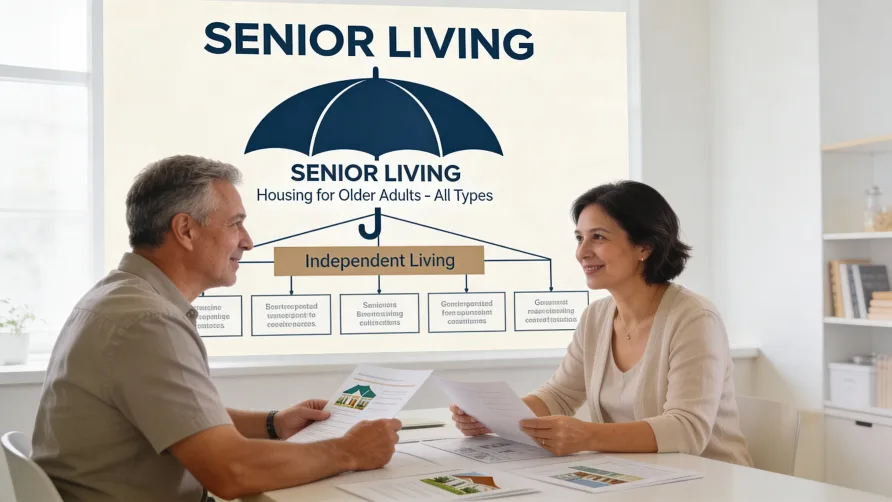
The terms are confusing, but the choice is straightforward. Here's what's happening: "senior living" is the industry's catch-all term for any housing designed for older adults. "Independent living" is one specific type within that category. Comparing "independent living vs senior living" is like comparing "apartments vs housing." One is a subset of the other.
This terminology confusion makes your research harder than it needs to be. When you search "independent living vs senior living," you're probably trying to understand which type of community your parent needs. Does your mother need a place with dining and activities but no personal care? That's independent living. Does she need help with bathing and medications? That's assisted living (which is also senior living, just a different care level).
This article clarifies what each term actually means, shows you the real differences between care levels, explains the misconceptions families commonly have, and gives you a framework for choosing the right option. No marketing language. Just practical information you can use to make the decision.
Quick Definitions
Independent Living
Independent living communities are housing designed for active adults typically 55 and older who can manage all personal care independently but want to eliminate home maintenance responsibilities. Residents live in private apartments, condos, or cottages. The community provides amenities like dining options, housekeeping, social activities, transportation, fitness centers, and 24/7 emergency response systems. What independent living doesn't provide is personal care assistance. You handle your own bathing, dressing, medication management, and toileting. Staff won't help you shower or remind you to take your pills. Independent living is about convenience and community, not caregiving. Monthly costs typically range from $2,500 to $4,500 depending on location and amenities. You're paying for maintenance-free lifestyle, not care services.
Senior Living
Senior living is the umbrella term for all housing options designed for older adults. It includes independent living, assisted living, memory care, and skilled nursing facilities. When someone says "senior living," they're not describing a specific care level or service package. They're simply indicating housing built for seniors. A "senior living community" could offer independent living only, assisted living only, or multiple care levels on one campus. The term itself tells you nothing about whether residents receive help with daily activities. Senior living encompasses everything from active retirement communities where residents need zero assistance to nursing homes providing 24/7 medical care. It's an industry category, not a specific type of housing.
The Actual Comparison: What's Included
Since "senior living" includes independent living, the real comparison is between independent living and other types of senior living (assisted living, memory care, skilled nursing). Here's what separates them:
Independent Living:
- Private apartments or homes
- Dining services (optional or included)
- Housekeeping and laundry
- Transportation for shopping, appointments, activities
- Social programming and activities
- Fitness centers, pools, common areas
- Emergency call systems
- NO help with bathing, dressing, or personal care
- NO medication management
- NO 24/7 care staff (only emergency response)
Assisted Living (a type of senior living):
- Everything independent living offers, plus:
- Help with bathing and showering
- Assistance with dressing and grooming
- Medication management (reminders or administration)
- Help with mobility and transfers
- Assistance with toileting
- 24/7 trained care staff
- Individualized care plans
Memory Care (a type of senior living):
- Everything assisted living offers, plus:
- Secure environment to prevent wandering
- Staff trained specifically in dementia care
- Specialized programming for cognitive impairment
- Higher staff-to-resident ratios
- Modified environment (reduced stimulation, clear signage)
Skilled Nursing (a type of senior living):
- 24/7 medical care from licensed nurses
- Rehabilitation services (physical, occupational, speech therapy)
- Complex wound care and medical treatments
- Short-term recovery or long-term care
- Appropriate for serious medical conditions
The difference isn't independent living versus senior living. It's independent living versus higher care levels within the senior living category.
Common Misconceptions About Senior Living and Independence
Families consistently misunderstand what different care levels provide and when transitions become necessary. These misconceptions delay appropriate moves and create unsafe situations. Here's what families often underestimate about how independence levels vary dramatically across senior living options.
Misconception 1: "My parent is independent, so senior living isn't appropriate."
This assumes all senior living means giving up independence. Independent living communities are specifically designed for people who are independent. Your father who still drives, manages his own finances, takes his medications correctly, and handles all personal care doesn't need assisted living. He might benefit enormously from independent living.
What families often underestimate is the burden of home maintenance. Your parent may be physically and cognitively independent but exhausted from yard work, home repairs, cooking every meal, and the isolation of living alone. Independent living removes those burdens while preserving complete autonomy over personal care and daily routines.
The misconception comes from lumping all "senior living" together. If your parent is truly independent, they belong in independent living, not assisted living. They're different options serving different needs.
Misconception 2: "Independent living is just an apartment building for old people."
This dramatically underestimates what independent living communities provide beyond housing. Yes, you get a private apartment. But you also get:
Dining services that eliminate grocery shopping, meal planning, and cooking. Most communities offer one or two meals daily included in rent, with additional meals available. This addresses nutrition concerns without requiring assistance with eating.
Social programming that combats isolation. Daily activities, exercise classes, educational programs, social events, and excursions keep residents engaged. Loneliness and isolation significantly impact health outcomes for older adults. Independent living directly addresses this.
Transportation services for medical appointments, shopping, and social outings. Your parent doesn't need to drive or arrange rides. The community handles it.
Housekeeping and maintenance that eliminates the physical demands of home upkeep. No more climbing ladders to change light bulbs, no more worrying about plumbing problems or HVAC repairs.
Emergency response systems and staff presence 24/7. If your parent falls or has a medical emergency, help is immediately available even though daily care isn't provided.
These services support independent living. They don't replace it with dependence on care staff.
Misconception 3: "If my mother moves to independent living, she can't transition to more care later."
Many families avoid independent living because they worry about needing to move again when care needs increase. This misconception assumes you're choosing once and living with that decision permanently.
In reality, many senior living communities offer multiple care levels on one campus. These are called Continuing Care Retirement Communities (CCRCs) or Life Plan Communities. Residents start in independent living and transition to assisted living, memory care, or skilled nursing as needs change, all within the same community.
Your mother keeps her community connections, familiar surroundings, and established relationships with staff and neighbors. She doesn't have to leave and start over in an entirely new place. The transition happens in place.
Even communities offering only one care level typically have relationships with nearby communities providing higher care. The transition may involve a physical move, but it's planned rather than crisis-driven.
What families often underestimate is the value of making the move to independent living before it becomes urgent. Moving while your parent is healthy and independent allows them to establish their new home, build friendships, and integrate into the community from a position of strength rather than crisis.
Misconception 4: "Senior living costs are always higher than staying home."
This depends entirely on what you're comparing. If your parent owns their home outright and needs zero services, staying home costs less than independent living. But that's rarely the actual situation.
Add up actual monthly costs of staying home:
- Mortgage or rent
- Property taxes
- Homeowners insurance
- Utilities (electric, gas, water, trash)
- Home maintenance and repairs
- Yard maintenance (lawn service, snow removal)
- Housekeeping services
- Transportation costs (car payment, insurance, gas, maintenance, or ride services)
- Grocery shopping and cooking (or meal delivery services)
Now add the costs families don't initially count:
- Family members' time providing transportation, yard work, home repairs, or companionship (your time has value even if you're not charging for it)
- Emergency expenses when something breaks
- The risk of falls or medical emergencies when your parent is home alone
Independent living consolidates many of these expenses into one predictable monthly payment. For many families, the total cost of staying home (including all the hidden expenses and family time) rivals or exceeds independent living costs.
What families often underestimate is how much they're already supplementing home living with services that independent living includes in the base rate.
Misconception 5: "My father can handle everything, he just needs help with a few things."
This is the most dangerous misconception. "A few things" usually means your father needs help with activities of daily living (ADLs) like bathing, dressing, or medications. That's not independent living. That's assisted living.
Independent living communities don't provide personal care assistance. If your father needs someone to help him shower safely, remind him to take medications, or assist with dressing, independent living staff won't do that. The community isn't licensed to provide those services at the independent living care level.
Families choose independent living thinking "Dad can manage, and we'll hire a home health aide to come help with showers a few times a week." You're now paying independent living rent plus home health aide costs. That's more expensive than assisted living, which includes all personal care assistance.
What families often underestimate is that needing help with "just" one or two ADLs means you need assisted living, not independent living. There's no shame in that. It's simply a different care level designed for people who need that support.
Misconception 6: "Senior living means giving up your home and belongings."
Families picture nursing home rooms with a bed and a chair, not the reality of modern senior living apartments. Independent living apartments are one-bedroom or two-bedroom units with full kitchens (or at minimum kitchenettes), living rooms, bathrooms, and often balconies or patios.
Residents furnish apartments with their own furniture, artwork, and belongings. Your mother brings her favorite chair, family photos, television, and personal items. The apartment is hers. It's her home, just without the maintenance burden of the house she left.
What families often underestimate is how downsizing can be liberating rather than limiting. Moving from a 2,000-square-foot house to an 800-square-foot apartment requires getting rid of decades of accumulated possessions. That sounds overwhelming, but many seniors find it freeing to shed belongings they no longer use or need.
Misconception 7: "Once you're in senior living, you can't leave."
This is completely false. Senior living is rental housing. Residents can leave anytime, though there may be notice requirements (typically 30 to 90 days) specified in the lease agreement.
If your parent tries independent living and hates it, they can move back home or to a different community. If they try independent living and realize they actually need assisted living, they can transition (either within the same community if available, or to a different community providing that care level).
What families often underestimate is that trying independent living isn't a permanent commitment. The fear of making an irreversible decision prevents families from making any decision, leaving aging parents in increasingly unsafe home situations.
How to Determine What You Actually Need
Stop focusing on terminology and assess your parent's actual daily situation. Here's the framework:
Your parent needs independent living if:
- They manage all personal care independently (bathing, dressing, toileting, medications)
- They're physically and cognitively healthy
- Home maintenance has become burdensome or concerning
- They're lonely, isolated, or worried about living alone
- They want social activities and community without needing care services
Your parent needs assisted living (a type of senior living) if:
- They need help with one or more activities of daily living
- Medication management is becoming unsafe
- They've fallen multiple times or have significant fall risk
- Personal hygiene is declining
- They're not eating properly without assistance
Your parent needs memory care (a type of senior living) if:
- They have Alzheimer's disease or dementia diagnosis
- Wandering or getting lost is a concern
- Behavioral symptoms require specialized dementia training
- They need a secured environment
The question isn't "independent living or senior living?" It's "which type of senior living matches my parent's needs right now?"
The Bottom Line
You're not choosing between independent living and senior living. Independent living is a type of senior living, just like assisted living and memory care are types of senior living. "Senior living" is the category. "Independent living" is one option within that category.
The meaningful question is: What level of care does your parent need? If they're truly independent and just want to eliminate home maintenance while joining an active community, independent living is appropriate. If they need help with daily activities, assisted living (also senior living, different care level) is appropriate.
The terminology confusion makes your research harder, but the actual decision is straightforward. Assess what your parent can and can't do independently. Match their needs to the appropriate care level. That's it.
Stop worrying about whether something is called "senior living" or "independent living" or "retirement community" or "active adult housing." Ask the specific question: Do you provide personal care assistance with bathing, dressing, and medications? If no, it's independent living (or similar). If yes, it's assisted living. The services matter more than the labels.