
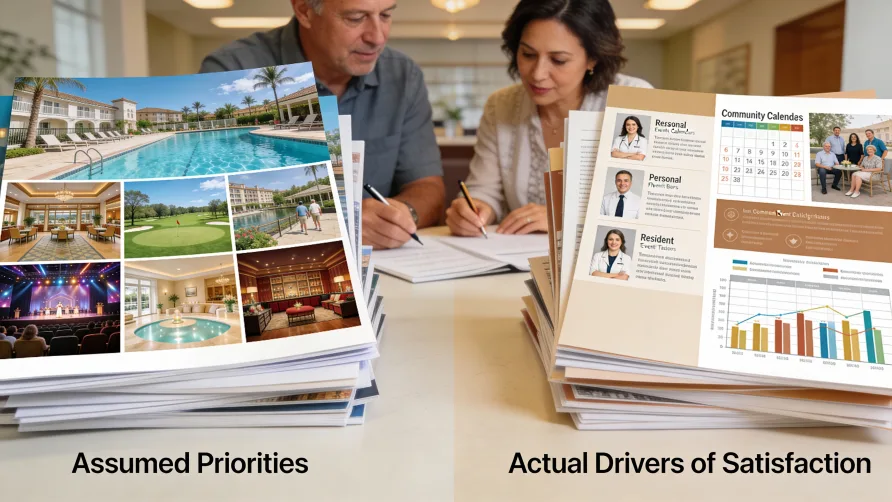
Communities where residents report high satisfaction with staff interactions, dining quality, and maintenance responsiveness see 25% higher overall satisfaction scores than communities with luxury amenities but poor execution of daily services. That's according to the 2025 J.D. Power Senior Living Satisfaction Study, which found that resident contentment increased significantly year over year, but not for the reasons marketing materials might suggest.
The granite countertops and resort-style pool photographed in the brochure don't determine whether your mother feels at home six months after moving in. What matters is whether maintenance responds quickly when her sink drips. Whether the dining room serves food she actually wants to eat. Whether staff members remember her name and notice when she seems off. Whether transportation takes her where she needs to go without requiring three days' notice.
This gap between what looks impressive on a tour and what actually makes daily life pleasant is what families often underestimate when evaluating senior living communities. You walk through a lobby that could belong to a boutique hotel and assume the experience will match. Sometimes it does. Often it doesn't.
This article answers the questions families actually have about senior living amenities. Not which communities have the most impressive feature lists, but which amenities impact residents' daily lives and overall satisfaction. What actually matters. What's just marketing. And how to tell the difference before signing a lease.
What Are the Standard Amenities in Most Senior Living Communities?
Walk through ten different senior living communities and you'll see remarkably similar feature lists. These amenities have become baseline expectations rather than differentiators:
Housing and Daily Services:
- Private apartments (studio, one-bedroom, or two-bedroom)
- Weekly housekeeping
- Flat linen service
- Maintenance for repairs
- Utilities included in monthly fee
- 24/7 emergency call systems
Dining:
- Communal dining room
- One to three meals daily included
- Some meal flexibility (eat in dining room or skip meals)
- Special dietary accommodations available
Transportation:
- Scheduled transportation to medical appointments
- Shopping trips to nearby stores
- Transportation to community activities and outings
Common Spaces:
- Multipurpose activity room
- Library or reading areas
- Outdoor courtyard or patio spaces
- Lounges for socializing
Activities:
- Weekly activity calendar
- Exercise classes (chair aerobics, stretching, walking groups)
- Social events (movie nights, bingo, card games)
- Occasional outings to restaurants, theaters, or local attractions
Basic Health Services (varies by community type):
- Wellness checks
- Medication reminders or management (assisted living and memory care)
- Assistance with activities of daily living (assisted living)
These aren't luxury features. They're standard offerings across most communities, from modest to upscale. The presence of a dining room and weekly housekeeping doesn't tell you anything useful about quality. Every community has these. What varies dramatically is execution.
Which Amenities Actually Matter for Daily Life?
Here's what families often underestimate: the difference between nice-to-have features and need-to-have reliability. A community might have a gorgeous fitness center that residents rarely use and inadequate transportation that creates constant problems. Impressive amenities don't compensate for poor execution of essential services.
Responsive Maintenance
This sounds boring. It doesn't photograph well for marketing materials. But responsive, competent maintenance directly impacts residents' daily comfort and sense of security.
When your mother's toilet won't stop running, does maintenance respond within hours or does she wait three days? When the air conditioning fails during summer, does someone address it immediately or tell her they'll get to it eventually? When she reports a burned-out light bulb in her bathroom, does someone replace it that day or does she struggle in dim lighting for a week?
In practice, this is where things break down. Communities promise 24/7 maintenance availability. What they mean is someone will answer the phone. Whether they'll actually fix problems promptly varies wildly. Some communities have dedicated maintenance staff who handle routine issues within hours. Others rely on understaffed teams that create multi-day backlogs for anything beyond emergencies.
Ask specific questions: What's your typical response time for non-emergency maintenance requests? How many maintenance staff work in this building? What happens on weekends and evenings? Can I see your maintenance request log to understand typical turnaround times?
Residents notice maintenance response more than any luxury amenity. Living with a broken toilet for three days impacts quality of life more profoundly than having access to a woodworking studio you'll never use.
Flexible, Appetizing Dining
Dining satisfaction has become one of the highest-weighted factors in overall resident satisfaction. Communities that get dining right retain residents longer and receive significantly higher satisfaction scores.
What makes dining work? It's not white tablecloths or farm-to-table buzzwords. It's practical flexibility and food residents actually want to eat.
Flexible meal times matter more than formal dining rooms. If your father likes breakfast at 6:30 a.m. and the dining room opens at 8:00 a.m., that's a daily frustration. If your mother isn't hungry at 5:00 p.m. when dinner is served but gets hungry at 7:00 p.m., what are her options?
The best dining programs offer multiple time windows, grab-and-go options, and the ability to take meals back to apartments without friction. Some communities serve only institutional-style fixed meals at fixed times. Others operate more like restaurants with varied hours and choices.
Menu variety and quality matter enormously. Walk through at lunch or dinner. What does the food look like? Smell like? Ask to see a month of menus. Is there genuine variety or do the same five entrées rotate endlessly? Can residents request specific dishes? How does the community accommodate dietary restrictions beyond "low sodium" and "diabetic"?
Talk to residents currently living there. Don't ask "How's the food?" during a tour when community staff are listening. Find residents sitting in common areas when you visit unannounced. Their unfiltered opinions about dining tell you more than any tour guide's description.
Reliable Transportation
Transportation seems like a simple amenity. Communities offer scheduled trips to medical appointments and shopping. What could go wrong?
In practice, transportation is one of the most common resident complaints. Limited availability, inflexible scheduling, last-minute cancellations, and restrictions on where drivers will go create constant frustration.
Good transportation programs offer frequent shopping trips (at least twice weekly), same-day or next-day scheduling for medical appointments, willingness to drive to providers of residents' choosing (not just the closest urgent care), and backup options when vehicles are in use.
Poor transportation programs require residents to schedule rides five to seven days in advance, limit medical appointment transportation to specific days of the week, refuse to drive to certain locations, or cancel trips with minimal notice due to staffing shortages.
Ask specific questions: How far in advance must residents schedule transportation? Are there restrictions on which medical providers you'll drive to? What happens if your scheduled driver calls in sick? How many vehicles do you have and how many residents need transportation daily?
Transportation limitations trap residents who've given up driving. If your mother can't get to her longtime doctor because community transportation won't drive that far, or if she misses appointments because the scheduled van was cancelled, her health suffers and frustration builds.
Engaging, Varied Activities
Activity programming ranges from communities that offer genuinely engaging, varied opportunities to those that post a calendar filled with time-killing "activities" that few residents attend.
Quality activity programs offer something for different interests and activity levels. Some residents want exercise classes and educational lectures. Others prefer card games and movies. Still others just want quiet spaces to read or chat with friends.
Watch what residents actually do during activity time. Are they engaged and participating? Or sitting passively while staff try unsuccessfully to generate interest? Are the same four residents at every activity while others never leave their apartments?
Talk to residents about what they do all day. If they struggle to name activities they regularly attend, the program probably isn't connecting with their interests. The goal isn't forcing participation. It's providing enough variety that most residents find something they genuinely enjoy.
Staff Who Know Residents as Individuals
This matters more than any physical amenity. The 2025 J.D. Power study found that satisfaction with community staff reached record highs, and staff quality impacts every other aspect of resident satisfaction.
Communities where staff know residents' names, notice when someone seems off, remember personal details, and treat residents with genuine respect create a sense of home that no amenity can replace. Communities where staff turnover is constant and residents interact with strangers daily feel institutional regardless of how beautifully appointed the building is.
During tours, watch how staff interact with residents. Do they greet residents by name? Stop to chat briefly rather than hurrying past? Show genuine warmth rather than professional politeness? When you see the same staff member twice during your visit, do they remember having spoken with you earlier?
Ask about staff retention rates. Communities with low turnover usually have happier residents. High turnover creates instability and prevents the relationships that make residents feel known and cared for.
Accessible Executive Leadership
The J.D. Power study found that when family members can easily contact the community's executive director, satisfaction scores increase 118 points on average. Yet only 48% of families report easy access to senior management.
This means residents and families can talk to the person who makes decisions when problems arise. It doesn't mean the executive director personally responds to every minor issue. It means there's a clear path to escalate concerns, and leadership is visible and accessible rather than distant and unknown.
Ask: How often does the executive director interact with residents? If I have concerns, what's the process for reaching leadership? Can residents schedule one-on-one meetings with management when needed?
What About Luxury Amenities Like Pools, Salons, and Fitness Centers?
These aren't useless. They're just less important than families assume. A community with a beautiful pool that's only used by a handful of residents hasn't provided value to everyone else paying for that amenity through higher monthly fees.
Fitness Centers and Exercise Programs
Many residents use fitness centers regularly if the equipment is appropriate for seniors and classes are offered at convenient times. This amenity provides genuine value when it's well-executed.
Good fitness programs include low-impact options (chair exercises, water aerobics, tai chi, yoga), convenient class times (multiple options throughout the day), and equipment designed for seniors rather than repurposed from a standard gym.
Poor fitness programs have equipment residents can't use safely, limited class offerings at inconvenient times, or facilities that always seem empty because programming doesn't match resident interests or abilities.
Beauty Salons and Barber Shops
On-site salons provide real convenience, especially for residents who no longer drive. Not having to arrange transportation for haircuts removes a barrier and helps residents maintain grooming and self-esteem.
Ask whether the salon is run by the community or leased to an independent operator, what services are offered, what prices are typical, and whether residents can choose to use outside salons if they prefer.
Swimming Pools
Pools photograph beautifully. They signal "luxury living" in marketing materials. But in many communities, pools sit mostly empty except during organized water aerobics classes.
Pools provide value if water aerobics classes are regularly scheduled, the pool temperature is appropriate for seniors (warmer than typical pools), and accessibility features exist (chairs for entering water, proper depth for exercises).
If you or your parent won't swim, the presence of a pool adds nothing to your experience except indirectly through higher monthly costs.
Pet-Friendly Policies and Amenities
For residents with pets, this isn't a luxury amenity. It's a necessity. Moving to senior living shouldn't mean giving up a beloved dog or cat.
Good pet policies allow common household pets (dogs, cats), have reasonable size and behavior limits, provide outdoor areas for dogs, and don't charge excessive pet fees.
Ask about weight limits for dogs, restrictions on breeds, required deposits or monthly pet fees, designated outdoor areas, and whether other residents' pets create problems (noise, aggression, accidents in common areas).
What Red Flags Should I Watch For?
Amenities That Exist But Aren't Accessible
A library that's always locked. A woodworking shop that closed due to "liability concerns" shortly after opening. A theater room that requires residents to reserve it weeks in advance and jump through administrative hoops. Amenities that technically exist but are functionally unavailable don't provide value.
Activities on the Calendar That Don't Actually Happen
The monthly calendar lists fifteen activities per week. When you visit unannounced at activity time, nothing's happening. Or one overwhelmed activities coordinator is trying to run a program for thirty residents simultaneously while most sit unstimulated.
Ask to see attendance records for activities. A calendar full of programs that three residents attend isn't valuable programming.
Staff Who Can't Answer Basic Questions
Tour guides who don't know maintenance response times, can't explain transportation scheduling, or defer every question to "someone in administration" signal either poor training or a community where information isn't shared with frontline staff.
Staff should be knowledgeable about the services they're selling. Uncertainty about basic operational details suggests problems with communication and coordination.
Promises That Sound Too Good to Be True
"We'll take you anywhere you need to go, anytime." "Our chef will prepare any meal you request." "We have staff available 24/7 for anything you need." These absolute promises rarely survive contact with reality.
Press for specifics. Exactly how much advance notice do you need for transportation? What if your requested meal isn't on the menu? What does "24/7 staff available" mean in practice?
How Do I Evaluate Which Amenities My Parent Actually Needs?
Think about your parent's current daily life. What do they do now that they'd want to continue doing? What has become difficult or impossible that senior living could address?
If your mother gardens daily, a community garden matters. If she's never gardened, that amenity provides zero value to her.
If your father attends concerts and theater regularly, proximity to cultural attractions and reliable transportation matter. If he prefers watching sports on television, the presence of private entertainment areas for hosting guests matters more.
Make a list of three categories:
Must-Haves: Amenities or services your parent will use daily or weekly. These directly impact quality of life.
Nice-to-Haves: Features that would be pleasant but aren't essential. Your parent might use them occasionally.
Irrelevant: Amenities that sound impressive but your parent will never use. Don't pay extra for these.
Be honest about the third category. Communities market themselves with long amenity lists. Most residents use a fraction of what's available. You're paying for all of it whether you use it or not.
What Actually Makes a Community Feel Like Home?
It's not the chandelier in the lobby or the resort-style pool. It's whether residents feel safe, known, and comfortable in their daily lives.
Does your mother know her neighbors? Does she look forward to meals rather than dreading them? When something breaks in her apartment, does someone fix it promptly? Can she get to her doctor when she needs to? Do staff members greet her by name and ask how she's doing?
These questions matter infinitely more than whether the community has a putting green or a movie theater.
The 2025 J.D. Power study found that 99% of residents feel safe in their senior living community, and 94% are happy with their choice. But that satisfaction comes from execution of essential services, not from impressive amenities.
When evaluating communities, spend less time being dazzled by the lobby and more time observing how staff interact with residents, what residents actually do during the day, how quickly maintenance responds to requests, whether residents seem engaged and content, and how flexible the community is about accommodating individual preferences.
The best amenity any senior living community can offer is competent, responsive, caring service in the areas that impact daily life. Everything else is window dressing.