
Most families try home care first. Seventy-three percent of dementia patients receive care at home initially, often from family members supplemented by paid caregivers. The plan seems straightforward: a few hours of help per day, your parent stays in familiar surroundings, and you avoid the $6,000+ monthly memory care bill.
Here's when that stops working.
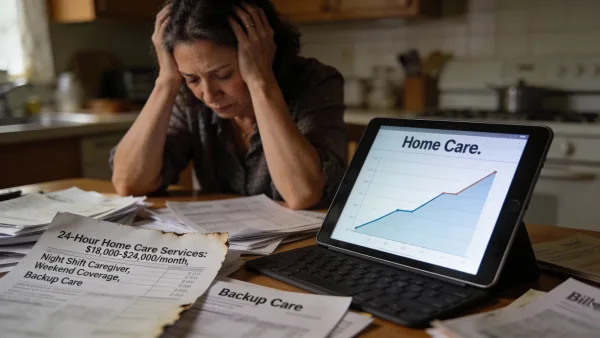
The average family reaches a financial breaking point between 6 and 12 months when home care hours creep from part-time assistance to round-the-clock supervision. At that point, you're paying $18,000 to $24,000 per month for 24/7 home care while memory care facilities charge $5,400 to $7,300 monthly. The math isn't close.
This article breaks down the actual numbers. You'll see detailed cost projections over 1, 2, and 3 years. You'll understand which hidden expenses destroy your budget and which safety issues force families to abandon home care regardless of cost. No philosophical discussion about "keeping Mom at home." Just the financial reality of each option and when the numbers stop making sense.
Base Monthly Costs: The Starting Point
Before calculating long-term expenses, understand the baseline monthly costs for each option as of 2025.
Memory Care Facility Costs:
- National median: $6,450 per month
- Range: $3,000 to $11,000 depending on location
- Daily rate: $176 to $459 (median $240)
- Includes: Room, meals, 24/7 supervision, activities, medication management
Home Care Costs:
- Hourly rate: $25 to $35 per hour (median $33)
- 44 hours per week (part-time): $5,720 to $6,292 per month
- 24/7 care (168 hours per week): $18,000 to $24,000 per month
- Live-in care: $6,000 to $10,500 per month (typically 8 hours on-duty)
Most families underestimate how quickly "a few hours of help" becomes "we need someone here all the time." That shift drives the entire financial equation.
Cost Comparison Over 1-3 Years: Where Money Actually Goes
The following analysis assumes your parent needs progressively more care, which happens in 90% of dementia cases. We'll compare three scenarios: part-time home care transitioning to full-time, continuous 24/7 home care, and memory care facility costs.
Year 1: The Deceptive Starting Phase
Scenario A: Part-Time Home Care (Months 1-6), Then 24/7 (Months 7-12)
Most families start with 30 to 44 hours per week of home care. You hire someone for mornings and evenings. It costs $4,290 to $6,292 monthly. At month 6 or 7, safety incidents increase. Your parent wanders at night, forgets to eat, or becomes aggressive during sundown hours. You add overnight care, then around-the-clock supervision.
Months 1-6:
- 44 hours per week at $33/hour = $6,292 per month
- Six-month subtotal: $37,752
Months 7-12:
- 168 hours per week at $33/hour = $23,760 per month
- Six-month subtotal: $142,560
Year 1 Total: $180,312
Add caregiver turnover costs (average 66% annual turnover at $2,600 per replacement), home modifications ($3,000 to $8,000 for grab bars, ramps, door alarms, locks), and family caregiver lost wages (average $7,242 annually), and you're approaching $200,000.
Scenario B: Memory Care From Day 1
- Monthly cost: $6,450 (national median)
- Year 1 Total: $77,400
The difference is $102,912 in the first year alone.
Year 2: When Costs Stabilize but Stay High
By year 2, most families have settled into a care pattern. Home care families paying for 24/7 coverage face consistent monthly expenses. Memory care residents typically see 3% to 8% annual rate increases.
24/7 Home Care Year 2:
- Base monthly cost: $23,760
- Annual turnover costs: $5,200 (replacing 2 caregivers)
- Backup care for caregiver sick days: $1,200
- Year 2 Total: $290,320
Memory Care Year 2:
- Monthly cost with 5% increase: $6,773
- Year 2 Total: $81,276
Cumulative Two-Year Costs:
- 24/7 Home Care: $470,632
- Memory Care: $158,676
The gap widens to $311,956 over two years.
Year 3: The Unsustainable Phase
In practice, this is where things break down for most families. Caregiver turnover accelerates. Family members burn out. The person with dementia requires more intensive supervision as the disease progresses. Many families move to memory care during year 2 or 3 simply because the logistics become impossible.
24/7 Home Care Year 3:
- Base monthly cost (3% wage increase): $24,473
- Annual turnover costs: $7,800 (replacing 3 caregivers)
- Additional medical alert systems: $600
- Year 3 Total: $301,476
Memory Care Year 3:
- Monthly cost with another 5% increase: $7,111
- Year 3 Total: $85,332
Cumulative Three-Year Costs:
- 24/7 Home Care: $772,108
- Memory Care: $244,008
Over three years, 24/7 home care costs $528,100 more than memory care.
The Real-World Hybrid Model
Most families don't go straight to 24/7 home care. They patch together a hybrid approach. Here's what that actually costs:
Year 1:
- Months 1-4: Family provides most care ($0)
- Months 5-8: 30 hours per week paid care ($17,160)
- Months 9-12: 80 hours per week paid care ($42,240)
- Lost family wages and out-of-pocket expenses: $10,000
- Year 1 Total: $69,400
Year 2:
- Months 13-18: 100 hours per week ($105,600)
- Months 19-24: 168 hours per week (full 24/7) ($142,560)
- Turnover and backup costs: $8,000
- Year 2 Total: $256,160
Year 3:
- Move to memory care at month 28 due to exhaustion
- Months 25-28: 24/7 home care ($95,040)
- Months 29-36: Memory care ($51,600)
- Year 3 Total: $146,640
Three-Year Hybrid Total: $472,200
Even with this gradual escalation and eventual transition to memory care, the hybrid approach costs $228,192 more than going directly to memory care and $300,092 less than maintaining 24/7 home care for three years.
Cost Comparison Table: Three-Year Summary
| Option | Year 1 | Year 2 | Year 3 | Total |
|---|---|---|---|---|
| 24/7 Home Care | $180,312 | $290,320 | $301,476 | $772,108 |
| Hybrid Approach | $69,400 | $256,160 | $146,640 | $472,200 |
| Memory Care | $77,400 | $81,276 | $85,332 | $244,008 |
The financial crossover happens between months 6 and 12 for most families. Once you need more than 100 hours of care per week, memory care becomes cheaper. Once you need 24/7 supervision, it's not even close.
Hidden Costs That Break Your Budget
The hourly rate doesn't tell the complete story. Both options carry hidden costs that families discover too late.
Home Care Hidden Expenses
Caregiver Turnover ($2,600 Per Replacement): Home care agencies experience 66% annual caregiver turnover. With 24/7 care requiring 3 to 4 caregivers rotating shifts, you'll replace at least 2 caregivers per year. That's $5,200 in agency markup costs passed to you, plus the disruption to your parent's care routine.
Backup Coverage ($150 to $300 Per Day): When your regular caregiver calls in sick or quits without notice, agencies charge premium rates for emergency coverage. Budget $1,200 to $3,000 annually for last-minute replacements.
Home Modifications ($3,000 to $15,000): Dementia-specific modifications go beyond basic accessibility. You need:
- Deadbolt locks placed high or low (out of sight line): $150 to $400 per door
- Door and window alarms: $500 to $2,000
- Pressure-sensitive floor mats for bed exits: $200 to $800
- Stove shut-off devices: $300 to $600
- Medication lock boxes: $50 to $200
- Grab bars and bathroom safety: $1,000 to $3,000
- GPS tracking devices: $200 to $600 plus monthly fees
Family Caregiver Costs ($7,000 to $40,000 Annually): Family members providing supplemental care face their own financial burden. According to AARP, family caregivers spend 26% of their income on caregiving activities. This includes:
- Reduced work hours (20% average reduction): $8,000 to $20,000 in lost wages
- Missed promotions: Potentially $40,000+ in lifetime earnings
- Transportation to appointments: $1,200 to $3,000 annually
- Out-of-pocket medical supplies: $500 to $2,000
- Increased healthcare costs from caregiver stress: $1,000+
Transportation and Medical Appointment Costs: Unless your caregiver's contract specifically includes transportation, you pay separately for:
- Medical appointments: $50 to $150 per trip
- Social activities or errands: $30 to $80 per trip
- Annual estimate: $2,400 to $6,000
Total Annual Hidden Costs for Home Care: $15,000 to $65,000
These aren't optional expenses. They're requirements for safe dementia care at home.
Memory Care Hidden Expenses
Memory care facilities have fewer surprise costs, but they exist.
Move-In Fees ($1,000 to $5,000): Most communities charge a one-time community fee. Some refund a portion when your parent leaves, others don't.
Annual Rate Increases (3% to 8%): Budget for consistent annual increases. A 5% annual increase on a $6,450 monthly rate means you're paying $7,591 monthly by year 5.
Level-of-Care Increases ($500 to $2,000 Per Month): As dementia progresses, some facilities charge additional fees for higher care needs. Not all communities do this. Ask specifically about their rate structure.
Incontinence Supplies ($100 to $300 Per Month): Most memory care communities don't include incontinence products in their base rate. You supply adult diapers, wipes, and creams.
Personal Care Items and Medications: You pay for toiletries, over-the-counter medications, and prescription copays. Budget $150 to $400 monthly.
Total Annual Hidden Costs for Memory Care: $3,000 to $15,000
Memory care's hidden costs are predictable and significantly lower than home care's.
Safety Breaking Points: When Home Care Becomes Dangerous
Cost aside, safety forces most families into memory care. Sixty percent of dementia patients wander at least once, and 43.7% of patients with even mild dementia exhibit wandering or elopement behaviors. Once wandering starts, home care becomes a 24/7 supervision requirement, and even that may not be enough.
The Wandering Threshold
Wandering presents the single biggest safety risk for home dementia care. The consequences range from mild (your parent walks around the block and forgets how to get home) to fatal (hypothermia, dehydration, traffic accidents). The Alzheimer's Association reports that wandering can be fatal if the person isn't found within 24 hours.
Warning Signs Your Parent Will Wander:
- Returns from walks or drives later than usual
- Talks about going to work, picking up children, or other past obligations
- Paces or makes repetitive movements
- Becomes anxious in crowded areas
- Can't locate familiar rooms in the house (bathroom, bedroom)
- Asks about the location of long-deceased relatives
Once these signs appear, you need either 24/7 home supervision or a secured memory care environment. There's no middle ground. One unsupervised moment means your parent could walk out the door and disappear.
The Reality of Home Security for Wandering: Securing a home against wandering is difficult and expensive. You need:
- Deadbolt locks on every exterior door placed out of normal sight lines
- Door and window alarms on all exit points
- Pressure-sensitive mats to alert when they get out of bed
- Hidden car keys (they may still remember how to drive)
- GPS tracking device on their person at all times
- Someone monitoring all alarms 24/7
Even with these measures, 35% to 60% of dementia patients wander at least once. When they do, family caregivers can't respond as quickly as trained memory care staff in a secured facility designed to prevent elopement.
The Sundowning Crisis
Sundowning (increased confusion and agitation in late afternoon and evening) affects up to 45% of dementia patients. During these episodes, your parent may become verbally or physically aggressive, try to leave the house, or engage in unsafe behaviors like turning on the stove.
Home caregivers, especially family members, often can't manage these behaviors safely. Professional memory care staff receive specific training in de-escalation techniques and work in secured environments designed to minimize sundowning triggers.
When Sundowning Makes Home Care Unsafe:
- Physical aggression toward caregivers
- Multiple attempts to leave during evening hours
- Operating appliances unsafely (stove, oven, space heaters)
- Inability to recognize family members as safe people
- Extreme agitation that puts the person at risk of falls or injury
Once sundowning reaches this intensity, home care requires either multiple caregivers present during evening hours or a memory care facility's structured environment and trained staff.
The Medication Management Problem
As dementia progresses, medication adherence becomes impossible to manage independently. Your parent forgets whether they took their pills, takes them multiple times, or refuses to take them at all.
Home caregivers can prompt and observe, but they can't force medication compliance. Memory care facilities have licensed nurses who manage medications directly. The person never handles their own pills.
Home Care Medication Risks:
- Taking double doses (or more) due to forgotten doses
- Skipping critical medications
- Mixing medications with unsafe foods or drinks
- Taking other people's medications found in the home
- Hiding or disposing of pills to avoid taking them
These risks increase hospitalization rates and medication-related emergencies. Once your parent actively resists medication or can't be trusted to take the correct doses even with supervision, home care becomes medically unsafe.
The Fall Risk Equation
Dementia increases fall risk through impaired judgment, poor balance, confusion about surroundings, and wandering behavior. Falls lead to hospitalization, broken bones, and often permanent decline. Home environments have more fall hazards than purpose-built memory care facilities.
Critical Fall Risk Factors:
- Cognitive impairment affecting balance and judgment
- Wandering during night hours (poor lighting, disorientation)
- Attempting activities beyond current physical capability
- Unstable gait combined with unmonitored movement
- Multiple medications affecting balance and coordination
Memory care facilities design environments to minimize fall risks: no stairs, cushioned flooring in high-risk areas, grab bars throughout, motion-sensor lighting, and staff trained to identify fall risk patterns. Your home probably has stairs, multiple levels, hard surfaces, and inadequate lighting in hallways.
The Isolation Factor
Home care often means social isolation, especially if your parent requires 24/7 supervision and can't safely leave the house. Isolation accelerates cognitive decline. Memory care provides daily social interaction, structured activities, and cognitive stimulation.
When Isolation Becomes a Safety Issue:
- Depression leading to medication non-compliance
- Lack of physical activity increasing fall risk and physical decline
- No cognitive stimulation accelerating dementia progression
- Caregiver burnout from sole responsibility for engagement
Social isolation doesn't seem like a "safety" issue, but it directly impacts your parent's physical and cognitive health, creating secondary safety problems.
The Honest Conversation: When It's Time
Most families know home care has become unsafe before they admit it. The breaking point usually involves one or more of:
- A wandering incident where your parent was lost or endangered
- Physical aggression toward a caregiver
- A serious fall resulting in hospitalization
- Multiple medication errors or refusals
- Caregiver inability to manage nighttime behaviors
- Fire or burn incidents from unsafe appliance use
When any of these happen repeatedly, home care isn't working. The question isn't "Can we make it work?" but "How much longer until something worse happens?"
In practice, this is where things break down. Families try to manage increasingly dangerous situations at home because moving to memory care feels like giving up. But continuing unsafe home care doesn't honor your parent. It puts them at risk.
When Home Care Makes Financial Sense
Despite the long-term cost disadvantage, home care makes sense in specific situations.
Early-Stage Dementia (Under 30 Hours Per Week): If your parent needs help with some daily activities but doesn't require constant supervision, home care costs $4,290 to $6,292 monthly. This is competitive with memory care facility costs.
Short-Term Recovery: Following hospitalization or a health event, short-term home care (3 to 6 months) provides transition support without the commitment of a facility move.
Strong Family Support Network: If multiple family members can share caregiving responsibilities and your parent only needs paid help for specific time blocks, costs remain manageable. This works until care needs escalate beyond family capacity.
No Wandering or Safety Risks: Some dementia patients never develop wandering behaviors or aggressive symptoms. Without these safety concerns, home care can continue longer with part-time paid support.
Financial Reality Check: Even when home care makes sense initially, plan for the transition. Most families underestimate how quickly "a few hours of help" becomes "we need someone here all the time." Budget for escalating care needs and be ready to pivot when safety or costs reach unsustainable levels.
When Memory Care Makes Financial Sense
Memory care becomes the better financial choice when care needs exceed 100 hours per week or when safety issues require 24/7 supervision.
24/7 Supervision Required: Once your parent can't be left alone at any time, memory care costs one-third of 24/7 home care ($6,450 versus $18,000 to $24,000 monthly).
Wandering or Elopement Behaviors: Securing a home environment costs thousands in modifications and still may not prevent wandering. Memory care facilities build security into their design.
Multiple Safety Concerns: When your parent exhibits several high-risk behaviors (wandering, aggression, medication resistance, fall risk), the cost and logistics of managing all these issues at home become unsustainable.
Family Caregiver Burnout: If family members are providing most care and experiencing health problems, job loss, or relationship strain from caregiving stress, memory care protects both your parent and your family.
Caregiver Turnover Is Constant: If you're replacing home caregivers every few months due to the difficulty of the care situation, you're paying turnover costs plus dealing with constant care disruption. Memory care staff turnover exists but doesn't directly affect your family.
Long-Term Planning (2+ Years): If your parent likely needs care for 2 or more years, memory care's lower cost and stable environment make more financial sense than trying to maintain home care.
Making the Decision: A Financial Framework
Use this framework to evaluate your situation.
Calculate Your True Current Costs: Add up all home care expenses including hourly rates, caregiver turnover, home modifications, family lost wages, transportation, and hidden costs. Compare this to all-inclusive memory care rates in your area.
Project 12 Months Forward: Based on your parent's current disease progression, estimate care hours needed in 6 and 12 months. If you'll need more than 100 hours per week within a year, memory care will cost less.
Assess Safety Honestly: List every safety concern: wandering risk, aggression, medication issues, fall risk, sundowning. If you have three or more significant safety concerns, home care likely can't address them adequately.
Evaluate Family Capacity: How many family members can provide care? How many hours per week? For how long? If family caregivers are burning out or experiencing health problems from caregiving stress, the situation is already unsustainable.
Factor In Quality of Life: Is your parent isolated at home? Are they receiving adequate social interaction and cognitive stimulation? Memory care provides structured activities and daily engagement that home care rarely replicates.
The math is straightforward once you include all costs and safety requirements. For most families, memory care becomes both the safer and more affordable option within the first year.
The Real Bottom Line
Most families start with home care. The transition to memory care usually happens between months 6 and 18 when safety incidents increase and costs spiral upward. Three-year costs for 24/7 home care exceed $770,000 compared to $244,000 for memory care.
The financial crossover happens when care needs exceed 100 hours per week. The safety crossover happens when wandering, aggression, or other high-risk behaviors make home supervision inadequate regardless of cost.
This isn't about whether you love your parent enough to keep them home. It's about providing safe care within a sustainable budget. For families facing years of care ahead, memory care delivers better outcomes at one-third the cost of 24/7 home care.
Run your actual numbers. Include hidden costs. Be honest about safety. The data will tell you when it's time to make the transition.