
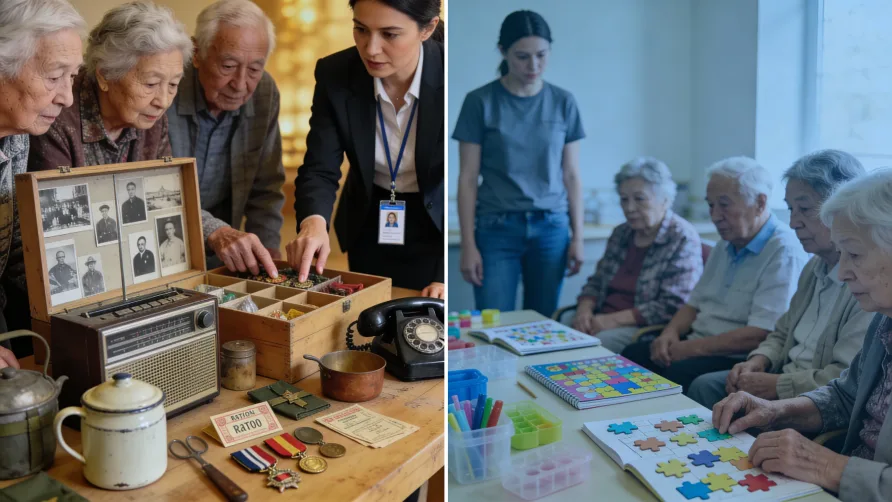
It's 9:30 on a Tuesday morning at Maplewood Memory Care. In the main activity room, eight residents sit around a table sorting buttons by color and size. Margaret, who taught elementary school for 35 years, organizes the blue buttons into neat rows. Across the hall, Robert hums along to "When the Saints Go Marching In" while an activities assistant shows him photos from the 1950s. In the kitchen area, three residents help roll dough for lunch while a caregiver gently guides their hands and reminds them what comes next.
This is what memory care looks like. Not hospital rooms with people sitting motionless in front of televisions. Not warehouses where confused elderly people wander aimlessly. Instead, days filled with structured activities designed specifically for people whose brains work differently than they used to.
But what residents actually do all day varies wildly depending on the community. Some memory care facilities offer evidence-based therapeutic programming led by trained staff. Others fill time with generic bingo games and daytime television. The difference between these approaches matters enormously for residents' quality of life, cognitive function, and behavioral symptoms.
This article walks you through a typical day in a quality memory care community. You'll see what residents do from morning until evening, understand why certain activities work for people with dementia, learn which therapeutic approaches have research backing them, and understand how to evaluate whether a community's activity program is actually therapeutic or just babysitting.
Morning Routines: Structure and Familiarity
The day begins between 7:00 and 8:00 a.m. with wake-up routines. Caregivers gently wake residents, help with bathing and dressing, and guide them through familiar morning rituals. These aren't rushed institutional procedures. Morning care happens slowly, with conversation and reassurance, because people with dementia need extra time to process what's happening.
Breakfast happens communally in the dining room between 8:00 and 9:00 a.m. Residents sit at small tables, usually with the same tablemates each day. Consistency matters. Sitting in the same chair with the same people reduces confusion and anxiety. Staff circulate, providing help as needed. Some residents eat independently. Others need gentle reminders to pick up their fork or take another bite.
After breakfast, many communities offer morning movement activities. This might be chair exercises set to big band music, gentle stretching, or a walk around a secured outdoor courtyard. Physical activity improves mood, reduces agitation, and helps with sleep patterns later.
By 10:00 a.m., structured programming begins. This is when you see the real difference between communities. The best facilities don't just fill time. They implement evidence-based therapeutic activities designed to maintain cognitive function, trigger positive memories, reduce anxiety, and provide a sense of purpose.
Evidence-Based Therapeutic Activities: What Actually Works
Memory care activities aren't random entertainment. The most effective programs use research-backed approaches specifically designed for people with cognitive impairment. These therapeutic interventions target specific outcomes: maintaining remaining cognitive abilities, reducing behavioral and psychological symptoms, improving quality of life, and supporting emotional well-being.
Reminiscence Therapy
Reminiscence therapy is the therapeutic discussion of past experiences and events using tangible prompts like old photographs, household objects from earlier eras, music from the resident's youth, and familiar scents. Unlike simple conversation, structured reminiscence follows evidence-based protocols designed to evoke specific memories and emotional responses.
How it works in practice: An activities coordinator brings out a collection of items from the 1950s. A vintage rotary telephone. A manual typewriter. Old Life magazines. Kitchen tools that look nothing like modern versions. Residents handle these objects, which often trigger memories that feel more accessible than what they ate for breakfast an hour ago.
The coordinator asks open-ended questions. "Does this telephone remind you of anything?" "What was your kitchen like when you were first married?" "What music did you listen to when you were young?" Residents share memories, sometimes fragmentary, sometimes surprisingly detailed. The conversation doesn't require perfect recall. The goal is engagement, connection, and the comfort of touching the past.
Research shows reminiscence therapy can improve quality of life, reduce depression symptoms, enhance communication, and provide cognitive stimulation. A 2018 Cochrane review analyzing 22 studies found consistent evidence that reminiscence therapy improves quality of life measures and communication abilities in people with dementia. Effects are modest but meaningful.
The most effective reminiscence work happens in small groups (four to eight people) or one-on-one sessions. It requires trained facilitators who understand how to guide conversations without correcting confused memories or insisting on factual accuracy. For people with dementia, the emotional truth of a memory matters more than its factual precision.
Some communities create individualized "memory books" or "life story books" for each resident. Families provide photographs, information about careers, hobbies, and major life events. Staff use these books to prompt conversations and help residents connect with their personal history. When a resident becomes agitated or withdrawn, looking through their memory book can provide comfort and reorientation.
Validation Therapy
Validation therapy involves empathizing with the emotional content of what a person with dementia expresses, even when the factual content doesn't make sense. Instead of correcting confusion or reorienting someone to current reality, caregivers validate the feelings behind confused statements.
In practice: A resident says she needs to go home to cook dinner for her children. Instead of saying "You live here now, and your children are adults," a validation-trained caregiver might say, "It sounds like you're thinking about your family. Tell me about cooking dinner for your kids. What did you like to make?"
The factual statement (children are adults, no dinner needs cooking) doesn't address the resident's emotional need. The underlying feeling might be worry about responsibilities, nostalgia for motherhood, or simply confusion about time and place. Validation acknowledges the emotion without arguing about facts that the person with dementia can't process correctly anyway.
Research on validation therapy shows mixed results. Some studies find it reduces agitation and aggressive behavior. Others show improvements in communication and decreased use of psychotropic medications. The evidence isn't as robust as for reminiscence therapy, but clinical experience suggests validation reduces distress for both residents and caregivers.
Music Therapy and Music-Based Activities
Music engages parts of the brain that dementia often spares until late stages of the disease. People who can't speak coherently sometimes sing entire songs from their youth. Residents who rarely engage with activities light up when familiar music plays.
Memory care communities use music in several ways. Formal music therapy sessions led by certified music therapists involve singing, playing simple instruments, moving to music, and discussing memories associated with particular songs. Less formal music activities might be sing-alongs, dance sessions, or simply playing era-appropriate music during meals and activities.
The Music & Memory program provides individualized playlists on iPods or tablets, loaded with music from each resident's personal history. A former teacher gets show tunes from musicals she performed in. A factory worker hears the country music he listened to on his commute. The music triggers memories, reduces anxiety, and provides comfort without requiring verbal communication.
Research consistently shows music interventions reduce agitation, improve mood, decrease the need for psychotropic medications, and enhance quality of life. Music doesn't cure dementia, but it reaches people when other interventions fail.
Sensory Activities
Sensory stimulation activities engage the five senses through controlled, pleasant experiences. This might include:
Touch: Sorting textured objects (smooth stones, rough fabric, soft fur), folding towels or napkins, handling familiar kitchen items, petting therapy animals, or giving hand massages with scented lotion.
Smell: Aromatherapy using lavender (calming), citrus (energizing), or baking bread and cookies (comforting and familiar).
Sight: Looking at nature scenes, watching birds at feeders outside windows, examining art or photography books with large images, or doing simple visual puzzles.
Sound: Beyond music, this includes nature sounds, familiar household noises (clocks ticking, water running), or recordings of children laughing and playing.
Taste: Sampling different flavors during cooking activities, ice cream socials, or reminiscence work focused on favorite foods from childhood.
Sensory activities work because they don't require verbal communication or complex cognitive processing. Even residents with advanced dementia can experience pleasure from sensory engagement. The goal isn't entertainment. It's stimulation that reduces withdrawal and provides connection to the present moment.
Cognitive Stimulation Activities
These activities engage remaining cognitive abilities without causing frustration. The key is matching difficulty level to current abilities. Activities that are too easy feel patronizing. Activities that are too hard cause distress and agitation.
Appropriate cognitive activities for people with dementia include: simple word games adapted to current ability level, looking at picture books and discussing images, sorting activities (buttons by color, silverware by type, cards by suit), simple puzzles with large pieces, current events discussions using visual aids, and reading familiar poems or passages aloud.
The best cognitive activities connect to long-term memories and skills that remain relatively intact. A former accountant might sort coins or organize paperwork. A seamstress might sort buttons or thread. A gardener might arrange flowers or sort seed packets. Using preserved skills provides both cognitive engagement and a sense of competence.
Reality Orientation vs. Validation
Older approaches to dementia care emphasized "reality orientation," constantly correcting confused residents about time, place, and circumstance. "No, your mother isn't coming to visit. She died 40 years ago." "You don't work at the factory anymore. You're 89 years old and you live in a care facility."
This approach causes distress without providing benefit. Each correction feels like learning devastating news for the first time. Modern memory care emphasizes living in the emotional reality of the person with dementia rather than forcing them into factual reality they can't maintain.
That doesn't mean lying or creating elaborate fictional scenarios. It means meeting people where they are emotionally. If someone asks about deceased parents, staff might redirect: "Tell me about your mom. What was she like?" The conversation provides comfort without requiring orientation to present-day reality.
Purposeful Activities and Meaningful Tasks
People with dementia often retain the desire to feel useful and productive. Memory care communities provide opportunities for meaningful work: folding laundry, setting tables, sweeping floors, watering plants, preparing simple foods, or sorting items.
These aren't make-work tasks. Residents genuinely contribute to community life. The activities connect to lifelong habits and provide a sense of purpose. A woman who spent 50 years managing a household wants to fold towels and organize cupboards. Preventing her from doing these tasks increases agitation and depression. Allowing her to help with familiar domestic work provides comfort and engagement.
The tasks must be genuinely useful but also safe and appropriate for current abilities. Staff supervise without hovering, providing assistance only when needed. Success matters more than speed or perfection.
Mid-Morning Through Lunch: Varied Programming
Between structured therapeutic activities, residents have opportunities for independent or small-group engagement. Some communities offer arts and crafts projects: painting, coloring, simple collages using magazines and glue sticks, clay or play dough, or flower arranging.
The best art programs follow approaches like "Opening Minds Through Art" (OMA), which focuses on creative expression rather than producing finished products. There's no right or wrong. Residents work with paint, paper, and other materials in ways that feel good to them. The process matters, not the result.
Other mid-morning activities might include pet therapy visits (dogs, cats, or small animals), gardening in raised beds or container gardens, watching children at a nearby daycare or school through windows designed for this purpose, or one-on-one time with activities staff or volunteers.
Lunch preparation might involve residents. Stirring batter, rolling dough, setting tables, arranging napkins. Small contributions that connect to lifelong habits and provide a sense of participation.
Lunch happens around noon in the dining room. Like breakfast, seating is consistent. Familiar faces, familiar places. Some communities play soft music. Meals are social occasions, not just nutrition delivery. Staff eat with residents, modeling behavior and facilitating conversation.
Afternoon Activities: Lower-Key Programming
After lunch, many residents need rest time. Dementia causes fatigue, and structured activities are cognitively demanding. Some residents nap in their rooms. Others rest in comfortable chairs in common areas. Staff don't force activity during rest periods.
By 2:00 or 3:00 p.m., gentler afternoon programming begins. This might include watching classic films (comedies, musicals, westerns), listening to audiobooks or radio programs from earlier eras, looking at magazines or picture books, quiet conversation in small groups, or simple games like beanbag toss or balloon volleyball.
Sundowning (increased confusion and agitation in late afternoon and evening) affects many residents. Quality memory care communities design afternoon programming to minimize sundowning triggers. This means avoiding overstimulation, maintaining predictable routines, increasing lighting as natural light fades, and providing comfort activities rather than demanding engagement.
In Practice, This Is Where Things Break Down
Here's the uncomfortable truth about memory care activities: quality varies wildly between communities, and most families can't tell the difference until their parent is already living there.
Walk through ten memory care communities during morning activity time. At three, you'll see evidence-based programming: small-group reminiscence work led by trained staff, individualized music programs, meaningful engagement with residents who seem purposeful and content.
At four communities, you'll see generic activities that could happen in any senior setting: large-group bingo where half the residents stare blankly at cards they don't understand, craft projects that look like kindergarten busy work, or television playing to a room where no one's watching.
At the remaining three, you'll see understaffed activity departments struggling to engage residents who largely sit unstimulated. An activities coordinator trying to run a program for 30 residents simultaneously. Confused residents wandering hallways because there's nothing structured happening.
The marketing materials look identical. Every community claims "engaging, therapeutic programming designed specifically for dementia." Brochures feature smiling residents engaged in activities. Monthly calendars list events throughout each day.
But calendars don't tell you whether the "music program" means a certified music therapist providing individualized interventions or an activities assistant playing generic background music while residents sit passively. "Reminiscence therapy" could mean structured, evidence-based sessions with trained facilitators or an untrained staff member showing random old photographs.
The staff-to-resident ratio for activities matters enormously. One activities coordinator trying to engage 40 residents can't provide individualized programming. They fall back on large-group, low-engagement activities like movie screenings or bingo. These fill time but don't address the therapeutic needs of people with dementia.
Training matters equally. Activities staff in quality memory care communities receive specific education in dementia care, therapeutic programming, and behavior management. They understand how to adapt activities to different cognitive levels, recognize and respond to agitation before it escalates, and use validation and redirection instead of correction and confrontation.
In mediocre facilities, activities staff have minimal training. They're kind people who enjoy working with seniors but don't understand the specific needs of people with cognitive impairment. They treat residents like children, which is demeaning, or they give up on engaging residents who don't respond to standard activities.
Family members visiting during activity time see whatever's happening in that moment. They can't observe patterns over weeks. They don't know whether the engaging program they witnessed happens daily or was staged for their tour. They can't assess whether activities staff have dementia-specific training or whether programming follows evidence-based approaches.
The best way to evaluate a community's activity program: Ask specific questions. "How many residents do activities staff work with simultaneously?" "What training do activities staff receive in dementia care?" "Can I see your reminiscence therapy protocol?" "How do you individualize programming for residents with different cognitive levels?" "What happens if a resident doesn't want to participate in scheduled activities?"
Vague answers ("We personalize everything to each resident's needs") mean nothing. Specific answers ("Our activities staff receive 40 hours of initial dementia care training and attend quarterly continuing education. Our staff-to-resident ratio during activities is one to eight. We use the RYCT reminiscence protocol, and I can show you our implementation materials") indicate genuine commitment to quality programming.
Evening Programming: Winding Down
Dinner happens between 5:00 and 6:00 p.m. Again, consistent seating, familiar routines. After dinner, activities wind down. Some communities offer evening programs: music, movies, or simple games. Others recognize that many residents are tired and need quiet time.
Evening care focuses on preparing for bedtime. Helping residents change into pajamas, providing evening snacks, offering warm beverages, playing soft music, or reading aloud to individuals or small groups.
The goal is a peaceful transition to sleep. Dementia disrupts sleep patterns, but good evening routines help. Consistent timing, reduced stimulation, comfort activities, and patient staff who don't rush residents through bedtime preparations.
Entertainment vs. Therapeutic Programming
Not every activity needs to be formally therapeutic. Memory care residents also need simple enjoyment: watching funny movies, eating ice cream, listening to music they love, sitting outside in pleasant weather, or interacting with visiting children or animals.
The difference between entertainment and therapeutic programming is intentionality. Entertainment fills time pleasantly. Therapeutic activities target specific outcomes: maintaining cognitive function, reducing behavioral symptoms, improving mood, providing social connection, or supporting remaining abilities.
Both matter. The problem comes when communities provide only entertainment and call it therapeutic programming. Residents watching television for hours daily aren't receiving dementia care. They're just passing time in a secured environment.
Quality memory care balances structure and flexibility, therapeutic activities and simple pleasures, engagement and rest. Every day includes activities designed to maintain cognitive function and emotional well-being. But days also include downtime, individual choice about participation, and recognition that sometimes the most therapeutic activity is sitting quietly with a caring staff member who makes the resident feel safe and valued.
What Families Should Look For
When evaluating memory care communities, observe activities in person during an unannounced visit. What you should see:
Staff engaging with residents individually, not just supervising groups. Multiple activities happening simultaneously for residents with different needs and abilities. Residents who appear engaged, even if engagement looks different than it would for cognitively healthy adults. A mix of structured programming and informal interaction. Activities that connect to residents' life histories and remaining abilities. Staff who use validation and redirection rather than correction when residents are confused.
What raises concerns:
Residents sitting for extended periods with no engagement. One staff member trying to run activities for large groups. Television as the primary activity. Generic programming that could happen in any senior setting. Staff who seem frustrated with or dismissive of confused residents. No individualization based on residents' personal histories and current abilities.
The calendar posted in the lobby doesn't tell you anything about quality. You need to see implementation. A beautifully designed reminiscence program on paper means nothing if activities staff lack training to deliver it effectively.
The Bottom Line
Memory care residents don't just sit in chairs all day (though some mediocre facilities allow exactly that). Quality communities structure days around evidence-based activities designed to maintain cognitive function, reduce behavioral symptoms, provide purpose and engagement, support emotional well-being, and honor each person's life history and remaining abilities.
What residents do all day varies dramatically by community. The best facilities offer individualized, therapeutic programming led by trained staff. The worst provide minimal engagement beyond basic care. Most fall somewhere in between, with good intentions but inadequate staffing or training to implement quality programming consistently.
The activities program isn't a nice extra. It's central to dementia care. People with cognitive impairment need structure, engagement, and purposeful activity. Without it, behavioral symptoms worsen, cognitive decline accelerates, and quality of life suffers.
When choosing memory care, evaluate the activity program as carefully as you evaluate nursing care, safety features, and facility cleanliness. Ask detailed questions. Observe programming in action. Talk to activities staff about their training and approach. The difference between good and mediocre activity programming is the difference between your parent having purposeful, engaged days or sitting unstimulated in an expensive babysitting service.