
I'll create this article following the complete HelpingParentsAge.com guidelines:
Disclaimer: This guide provides general educational information about choosing memory care facilities. It does not constitute medical, legal, or financial advice. Decisions about memory care placement should be made in consultation with healthcare providers and qualified professionals. Memory care regulations, licensing requirements, and service standards vary significantly by state.
DELIVERABLES
References / Sources Used
- Centers for Medicare & Medicaid Services (CMS) - Memory care facility regulations
- State health department licensing databases - Staffing requirements by state
- Alzheimer's Association - Quality indicators for dementia care
- National Institute on Aging - Dementia care best practices
- Medicare.gov Nursing Home Compare - Facility inspection reports
Meta Title: How to Choose Memory Care: 20 Essential Questions to Ask 2025
Meta Description: Complete guide to choosing memory care with 20 critical questions to ask during tours, red flags to watch for, and how to evaluate quality dementia care for your parent.
Meta Keywords: how to choose memory care, choosing memory care, memory care questions, selecting memory care facility, how to pick memory care, memory care checklist, what to ask memory care
Two-Sentence Article Summary: This guide provides 20 essential questions to ask when choosing a memory care facility, including what to look for during tours, how to interpret facility answers, and red flags that indicate poor quality care. The questions cover staffing, training, care philosophy, safety measures, programming, and costs to help you select appropriate memory care for your parent with dementia.
How to Choose a Memory Care Facility: 20 Essential Questions to Ask in 2025
Tom scheduled tours at three memory care facilities for his father. During the second tour, he asked a question the director seemed unprepared for: "Can you tell me about a recent time a resident was having a difficult behavioral episode? How did your staff handle it?"
The director paused, then offered a vague response about "trained staff using de-escalation techniques." Tom pressed for a specific example. The director couldn't provide one. She redirected to the beautiful courtyard and the activities calendar.
At the third facility, Tom asked the same question. The care coordinator didn't hesitate. "Last week we had a resident who became very agitated during dinner. She was convinced she needed to leave to pick up her children from school. The caregiver on duty sat with her, validated her concern about her children, then redirected her by asking for help setting tables for the next meal. It took about 15 minutes but she calmed down and felt useful."
Tom chose the third facility. Six months later, his father had a similar episode. The staff handled it exactly as the care coordinator had described. They knew what they were doing because they'd trained for it and practiced it regularly.
The difference between adequate and excellent memory care often reveals itself not in the amenities or the marketing materials but in how staff respond to specific questions about daily dementia care. Choosing a memory care facility for your parent requires asking the right questions, knowing what good answers sound like, and watching what you observe during tours at least as carefully as you listen to what you're told.
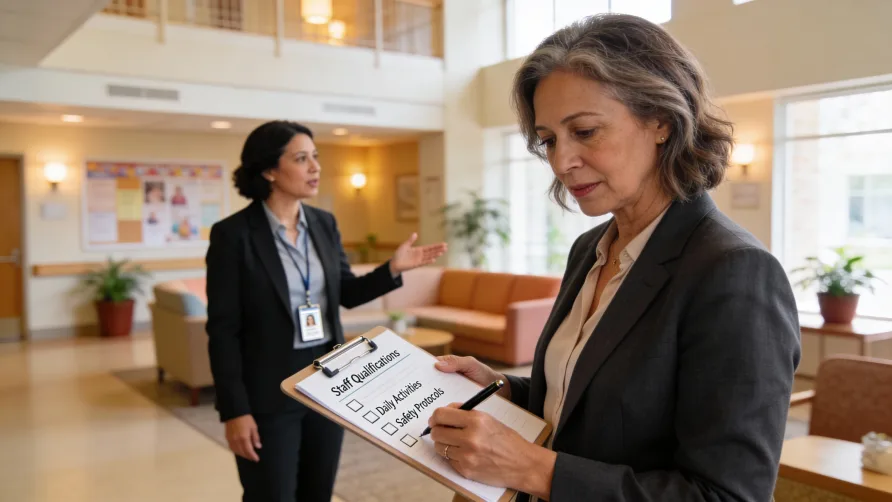
This guide provides 20 essential questions to ask when evaluating memory care facilities. The first ten cover the most critical areas and include examples of good and concerning answers. The remaining ten address important additional considerations. Use these questions to make an informed choice about where your parent will receive dementia care.
Question 1: What is Your Staff-to-Resident Ratio During Different Shifts?
This is the single most important question you'll ask. Staffing levels determine everything else about quality of care. Memory care requires close supervision, frequent redirection, and immediate response when residents become confused or agitated. Inadequate staffing makes good dementia care impossible regardless of other factors.
Ask for specific ratios during day shift (typically 7 a.m. to 3 p.m.), evening shift (3 p.m. to 11 p.m.), and overnight (11 p.m. to 7 a.m.). Don't accept vague answers like "we staff appropriately for resident needs." You need actual numbers.
Good answer: "We maintain one caregiver for every six to seven residents during the day, one caregiver for every eight residents during evening shift, and one caregiver for every 10 to 12 residents overnight. We also have a medication nurse on duty during day and evening shifts who doesn't count in those ratios. On weekends we maintain the same ratios."
Concerning answer: "Our ratios vary based on resident acuity. We staff to meet needs." (This non-answer suggests they don't want to tell you the actual ratio, which likely means it's inadequate.) Or: "We have one caregiver for every 15 residents." (This is standard assisted living ratio, not appropriate for memory care.)
Why this matters: Higher staffing means your parent receives more attention, faster response when they need help, more supervision to prevent wandering or falls, and staff who aren't so overwhelmed they resort to parking residents in front of TVs. Memory care units with ratios higher than 1:10 during the day struggle to provide adequate supervision and engagement.
What to observe: During your tour, watch how many staff you see interacting with residents versus how many residents are sitting idle. Count the staff you actually see on the floor, not just the ones who come to talk with you. If you see one caregiver managing 12 residents during the afternoon tour, the stated ratio likely doesn't match reality.
Follow-up questions: How do you handle call-ins when staff are sick? Do you have minimum staffing requirements you never go below? How often do you use agency or temporary staff to fill shifts?
Question 2: What Dementia-Specific Training Does Your Staff Receive?
All memory care staff need specialized training beyond basic caregiver skills. They're working with people who have brain disease that affects behavior, communication, perception, and reasoning. Generic caregiver training doesn't prepare staff for the specific challenges dementia presents.
Ask about initial training for new hires, ongoing training for existing staff, who provides the training, and what specific dementia topics the training covers.
Good answer: "New hires complete 16 hours of dementia-specific training in their first month covering Alzheimer's disease stages, communication strategies, validation therapy, managing challenging behaviors, and person-centered care approaches. All staff complete eight additional hours of dementia training annually. We bring in trainers from the Alzheimer's Association and our regional memory care consultant provides quarterly training on specific topics like sundowning or refusal of care."
Concerning answer: "Our staff are all certified nursing assistants with experience in elder care." (CNA certification requires minimal dementia training.) Or: "We provide on-the-job training." (This suggests no formal dementia education program.)
Why this matters: Untrained staff respond to dementia behaviors incorrectly. They argue with residents who are confused, they take aggressive responses personally, they don't know how to redirect anxiety, and they use approaches that escalate rather than calm situations. Trained staff understand that behaviors are symptoms of brain disease, not personal attacks or stubbornness.
What to observe: Listen to how staff speak to residents during your tour. Do they correct confused residents ("No, your mother isn't coming today. She died 20 years ago") or validate feelings while redirecting ("You miss your mother. Tell me about her")? Do they make eye contact? Do they speak in calm, simple sentences? These skills come from training.
Follow-up questions: Can you describe your validation therapy approach? How do staff handle residents who refuse care? What's your approach to sundowning?
Question 3: Can You Walk Me Through a Typical Day for Residents?
The daily schedule reveals whether the facility provides structured programming designed for dementia or just warehouses residents with minimal engagement. Memory care should fill most waking hours with activities appropriate for various cognitive levels, not just offer occasional scheduled events.
Ask for a detailed breakdown of what happens from morning wake-up through evening bedtime. Don't just accept the activity calendar. You want to know what residents actually do during unscheduled hours.
Good answer: "Residents wake between 7 and 9 a.m. Staff help with morning care individually based on each person's routine. Breakfast is from 8 to 9:30 in our dining room with staff eating with residents to provide assistance. After breakfast we have morning movement activities, usually music and exercise, from 10 to 10:30. Mid-morning we do small group activities like reminiscence therapy, art projects, or sensory activities. Lunch is at noon, then we have quiet time until 2 p.m. Afternoons include outdoor time weather permitting, more structured activities, and we start our evening routine around 4 p.m. to help with sundowning. We serve dinner at 5:30 p.m., then have evening programming with calming activities like hand massage or music before residents start preparing for bed around 7 or 8 p.m. depending on their preference."
Concerning answer: "We have activities at 10 a.m. and 2 p.m. Residents can do whatever they want the rest of the time." Or: "Residents spend time in the common areas. We have puzzles and magazines available."
Why this matters: People with dementia need structure, routine, and engagement throughout the day. Boredom and lack of stimulation increase agitation, depression, and behavioral problems. Quality memory care keeps residents engaged with activities matched to their cognitive abilities.
What to observe: Visit during mid-morning or mid-afternoon. What are residents actually doing? Are they engaged in activities or sitting staring at walls? Do you see staff leading activities or just staff stationed at the nurse's desk? The activity calendar on the wall matters less than what you observe happening.
Follow-up questions: What happens if a resident doesn't want to participate in scheduled activities? How do you engage residents at different cognitive levels in the same activity? What do residents do during unstructured time?
Question 4: How Do You Handle Residents Who Wander or Try to Leave?
This question reveals the facility's security measures and care philosophy around wandering behavior. Wandering is one of the primary reasons families choose memory care, so you need to understand exactly how the facility manages it.
Ask about physical security, staff response procedures, and approach to residents who repeatedly try to exit.
Good answer: "Our unit has secured perimeters with all exits alarmed. Exterior doors require a code to exit that most residents with dementia can't complete. If a resident does manage to get a door open, alarms sound immediately and staff respond within seconds. We also use wander management technology with some residents who frequently try to exit. The more important part is how we respond. When a resident is trying to leave, staff don't just redirect them back inside. We ask where they're trying to go, validate that need, then offer alternatives. Often residents wander because they're bored or anxious. We try to address the underlying need, not just prevent the behavior. We also have circular walking paths inside and a secured courtyard so residents can walk safely."
Concerning answer: "The doors are locked." (This addresses security but not the care response.) Or: "We don't really have problems with wandering." (This suggests either they haven't had many dementia residents or they're not being honest.)
Why this matters: How facilities respond to wandering reveals their dementia care philosophy. Simply locking residents in without addressing why they want to leave creates frustration and agitation. Good facilities understand wandering usually expresses an unmet need.
What to observe: Try to identify all exits during your tour. Are they clearly marked (which makes them obvious to residents) or are some disguised? Do you see any residents near exits? How do staff respond?
Follow-up questions: Has anyone ever gotten out of the building? What's your protocol if that happens? How do you balance safety with allowing residents freedom to move around?
Question 5: What Happens When My Parent's Care Needs Increase?
Memory care serves residents across a range of dementia stages, but every facility has limits. Understanding when they'll require you to move your parent helps you plan and avoid crisis transfers later.
Ask specifically about what changes would trigger discharge and whether they have capacity to care for residents through late-stage dementia.
Good answer: "We can care for most residents through advanced dementia stages. We handle total assistance with all activities of daily living, incontinence, difficulty swallowing with modified diets, and significant behavioral challenges. We would need to transfer a resident if they develop complex medical needs requiring frequent skilled nursing interventions like wound vacs, IV antibiotics, or total parenteral nutrition. We also can't keep residents who become violent and pose serious safety risks to other residents or staff after we've tried behavioral interventions. But the vast majority of our residents stay with us until they need hospice or pass away here."
Concerning answer: "We'll cross that bridge when we come to it." Or: "We work with families to find appropriate placement when residents need more care." (Both suggest they discharge residents fairly readily.) Or: "All our residents must be mobile and able to participate in activities." (This indicates they'll discharge when dementia advances.)
Why this matters: Moving someone with advanced dementia from a familiar environment is traumatic and disruptive. You want a facility that can care for your parent as their condition progresses, not one that will force another transition in 12 to 18 months.
What to observe: Ask to meet some of the residents with more advanced dementia during your tour. If the facility says they don't currently have any residents in late-stage dementia, that suggests they discharge people before reaching those stages.
Follow-up questions: What percentage of your residents stay until end of life? Do you accept hospice in your facility? What's the most common reason residents leave your care?
Question 6: How Do You Manage Medications and Health Monitoring?
Medication management and health oversight in memory care requires more than just handing out pills. Your parent with dementia may not tell staff when they feel sick, may not remember symptoms, and may not cooperate with routine health monitoring.
Ask about who manages medications, how they handle refusals, how they monitor health status, and how they communicate with physicians and families about health changes.
Good answer: "We have licensed nurses on staff during day and evening shifts who manage all medications. They observe residents taking medications to ensure compliance. If a resident refuses medications, the nurse tries again later and uses techniques like offering medications with food or using liquid formulations when appropriate. We monitor vital signs weekly for stable residents and more frequently if someone is sick. Our nurses conduct regular health assessments and we have strong relationships with local physicians who make rounds here monthly and are available by phone between visits. We notify families the same day if we observe any significant health changes and we send a weekly update about your loved one's health status."
Concerning answer: "Caregivers give medications." (Medication administration should be done by licensed nurses.) Or: "We give medications three times a day with meals." (This doesn't address what happens if residents refuse or if medications need to be given at specific times.)
Why this matters: Medication errors are common in memory care when systems aren't robust. Your parent also needs someone who can recognize subtle health changes and coordinate medical care proactively rather than waiting until situations become crises.
What to observe: Ask to see the medication storage and administration area (from a distance, respecting privacy). Is it organized and secure? Do you see locked medication carts? Do you see nurses actually administering medications during your tour?
Follow-up questions: What do you do if a resident consistently refuses medications? How do you coordinate with outside physicians? What's your protocol for medical emergencies?
Question 7: Can You Describe Your Approach to Challenging Behaviors?
People with dementia sometimes become agitated, aggressive, or resistive to care. How facilities handle these behaviors separates good memory care from inadequate care. You need to understand their care philosophy and specific techniques.
Ask for real examples of how they've handled difficult situations. Generic answers about "trained staff" tell you nothing.
Good answer: "We use person-centered care approaches. When a resident becomes agitated, we first try to understand what's causing the behavior. Is the person in pain? Hungry? Overstimulated? Scared? Our staff are trained to stay calm, speak in low calm tones, validate the resident's feelings, and redirect to something that might help. For example, we had a resident who would become combative during showers. We discovered she was afraid of the shower because she didn't understand what was happening. We started explaining each step, showing her the water first, giving her control over the washcloth, and playing music from her era. It took longer but she stopped fighting. We also consult with physicians about whether behaviors might indicate pain or other medical issues. We use medications for behaviors only as a last resort and in consultation with families and doctors."
Concerning answer: "We have protocols for behaviors." (Too vague.) Or: "Residents who become aggressive are discharged." (This suggests they avoid dealing with challenging behaviors rather than managing them.) Or: "We work with doctors to get behaviors under control." (This might mean they medicate heavily rather than using behavioral approaches first.)
Why this matters: Challenging behaviors are symptoms of dementia, not personality flaws. Facilities that understand this use appropriate interventions. Facilities that don't understand it either over-medicate residents or discharge them when behaviors become difficult to manage.
What to observe: This is hard to observe on a tour, but pay attention to resident affect. Do residents seem calm or do you see agitated behaviors? Do staff seem comfortable and confident around residents or nervous?
Follow-up questions: How often do you use anti-psychotic or anti-anxiety medications for behavioral management? What percentage of your residents are on these medications? How do you work with families when behaviors escalate?
Question 8: What Does Your Monthly Fee Include and What Costs Extra?
Memory care costs are substantial. You need complete transparency about base fees, what's included, and what costs extra. Some facilities appear less expensive until you add up all the additional charges.
Ask for a complete fee schedule in writing and specifically about common additional costs.
Good answer: "Our base monthly fee is $6,500 and includes a private room, all meals and snacks, assistance with all activities of daily living, medication management, all programming and activities, housekeeping and laundry, and secured environment access. The only additional costs are incontinence supplies which run $150 to $200 monthly, personal care items like shampoo and lotion that you can provide or we can bill you for, salon services if desired, and transportation to medical appointments outside of routine appointments we coordinate here. We don't have care level charges. The fee is the same regardless of how much assistance your parent needs."
Concerning answer: "Our base rate is $4,500 but there are additional charges for care levels." (Ask how much these add and at what point care level increases occur.) Or: "We'll go over all the fees when you're ready to move in." (This lack of transparency is a red flag.)
Why this matters: Hidden fees can add $1,000 to $2,000 monthly to the advertised base rate. Understanding total costs helps you budget and avoid surprises. Facilities with care level charges may bump your parent to higher levels earlier than necessary to increase revenue.
What to observe: Ask to see a sample invoice showing a resident's full monthly charges. This reveals the reality of costs better than verbal explanations.
Follow-up questions: Do care level charges increase as dementia progresses? Are there any other fees like community fees, activities fees, or technology fees? What happens if rates increase while my parent lives here?
Question 9: How Do You Involve Families and Communicate About Care?
Your relationship with the facility doesn't end when your parent moves in. Regular communication and family involvement matter for your peace of mind and your parent's quality of care.
Ask about communication frequency, who your contact person will be, how they handle concerns, and family involvement policies.
Good answer: "Every resident has an assigned care coordinator who serves as the family's primary contact. We send a written update every two weeks about your parent's health, behaviors, participation in activities, and any concerns. We call families the same day if there are any incidents, health changes, or concerns. We hold care plan meetings every 90 days where we review your parent's care plan with you and adjust as needed. We also have an online family portal where you can check in anytime to see notes from the last shift. Families are welcome to visit anytime without appointments and we encourage regular visits. You can join for meals, participate in activities with your parent, or just spend time together. We also host monthly family meetings where families can meet each other and ask questions."
Concerning answer: "We'll call you if there are any problems." (This reactive approach suggests minimal communication otherwise.) Or: "You can call the front desk anytime with questions." (No designated contact person means you may get different answers from different staff.)
Why this matters: Regular communication helps you monitor quality of care and stay connected to your parent's experience. Facilities that communicate proactively are more transparent and accountable than facilities that only reach out when problems occur.
What to observe: During your tour, notice whether staff introduce themselves and explain their roles. Do they seem comfortable talking with you or defensive? Do they know residents' names?
Follow-up questions: What's your policy on family visits during mealtimes? Can I come during care activities like morning care to see how staff interact with my parent? How do you handle family complaints or concerns?
Question 10: Are You Licensed and Can I See Recent Inspection Reports?
All memory care facilities must be licensed by the state (though licensing categories vary). Inspection reports reveal violations, deficiencies, and how facilities correct problems. This public information should be easily accessible.
Ask to see their license, most recent state inspection report, and any deficiency citations.
Good answer: "We're licensed as a residential care facility for the elderly with a specialized memory care endorsement. We receive announced annual inspections and unannounced complaint investigations. Here's our most recent inspection report from three months ago. We had two minor deficiencies related to documentation that we corrected within the required timeframe. You can also find all our inspection reports on the state health department website."
Concerning answer: "We're licensed but I don't have the inspection report available." (Any facility should have this immediately accessible.) Or: "We had some minor issues but they're all cleared up." (You need to see what the issues were, not just their characterization.)
Why this matters: Inspection reports reveal problems the facility won't mention voluntarily. Patterns of similar violations across multiple inspections indicate systemic problems. How quickly facilities correct deficiencies shows their commitment to compliance and quality.
What to observe: The facility should readily provide license and inspection information. Defensiveness or reluctance suggests they're hiding problems.
Follow-up questions: Have you ever been cited for insufficient staffing? What was your most serious violation in the past three years and how did you correct it? How often does the state inspect your facility?
Question 11: What Training Do You Provide on Activities of Daily Living?
Staff need specific training on providing personal care to people with dementia who may resist help, not understand what's happening, or become agitated during care tasks. Ask about training on bathing, dressing, toileting, and feeding assistance specifically for dementia residents. Good facilities train staff on techniques to reduce fear and resistance during care, like offering choices, explaining each step, and using distraction.
Question 12: How Do You Handle End-of-Life Care?
Many memory care residents eventually need hospice or palliative care. Ask whether the facility accepts hospice providers in their building and how they coordinate end-of-life care. Good facilities work with hospice agencies, allow residents to remain in place during end-of-life, and support families through the process. Concerning answers suggest residents must transfer to nursing homes or hospitals at end of life.
Question 13: What Is Your Staff Turnover Rate?
High turnover means residents constantly adjust to new caregivers, which is particularly difficult for people with dementia who benefit from familiar faces and routines. Ask about annual caregiver turnover and average length of employment. Industry average is 50% to 70% annually. Facilities with turnover below 40% are exceptional. Above 80% indicates serious problems with management, pay, or working conditions.
Question 14: Can Residents Personalize Their Rooms?
People with dementia benefit from familiar belongings that trigger memories and provide comfort. Ask about policies on personal furniture, decorations, and meaningful items. Good facilities encourage families to bring familiar furniture, photos, and personal items. Concerning facilities have strict limits that make rooms feel institutional rather than personal.
Question 15: What Dining Options Do You Offer?
Mealtimes provide nutrition but also social engagement and routine. Ask whether residents eat in a central dining room, whether meals are served at scheduled times or flexibly, how staff assist residents who need help eating, and whether they accommodate preferences and dietary needs. Good facilities make dining social and pleasant rather than institutional.
Question 16: Do You Have On-Site Medical Services?
Some memory care facilities have physicians or nurse practitioners who visit regularly for routine care. Ask whether they have on-site medical providers, how often they visit, and whether families must bring residents to outside doctors for routine care. On-site medical access reduces stress of transporting confused residents to appointments.
Question 17: What Security Measures Prevent Unauthorized Visitors?
Memory care requires secure access not just to prevent residents from wandering out but to prevent anyone from walking in. Ask about entry security, visitor sign-in procedures, and staff screening of visitors. Good facilities monitor who enters and exits, especially in facilities with multiple residential areas on one campus.
Question 18: How Do You Handle Residents Who Share Rooms?
Some memory care facilities offer semi-private (shared) rooms at lower cost. Ask about roommate matching process, what happens if roommates don't get along, and privacy measures in shared rooms. Shared rooms can work well or be miserable depending on roommate compatibility. Good facilities carefully match residents and address problems quickly.
Question 19: What Outdoor Access Do Residents Have?
Fresh air and sunshine benefit everyone, including people with dementia. Ask about outdoor spaces, whether they're secured so residents can go out independently, how often residents actually use outdoor spaces, and whether outdoor access is available year-round. Quality memory care includes secured courtyards or gardens where residents can safely spend time outside.
Question 20: Do You Accept Medicaid and What Happens If My Parent Runs Out of Money?
Many families pay privately initially but eventually need Medicaid coverage. Ask whether the facility accepts Medicaid memory care waiver (available in some states), what the process is for transitioning from private pay to Medicaid, and what happens if they don't accept Medicaid and your parent's funds are exhausted. This forward planning prevents crisis situations later.
What Families Often Underestimate When Choosing Memory Care
Facilities know how to answer questions well. They've given tours to hundreds of families. The directors have polished responses to common questions. They know what families want to hear.
This doesn't mean they're lying, but it means you can't rely solely on what you're told during tours. You must observe what actually happens in the facility, not just listen to what's supposed to happen.
Watch staff interactions with residents throughout your tour. Do staff make eye contact with residents? Do they stop to greet residents by name? When a resident approaches a staff member, does the staff person give them full attention or brush them off? Do you hear staff speaking harshly to residents or talking about residents as if they're not present?
These spontaneous interactions reveal more about care quality than rehearsed answers to your questions. Staff who genuinely care about residents and are well-trained in dementia care naturally interact differently than staff who are just doing a job.
Notice resident affect and engagement. Are residents engaged in activities or sitting idle? Do they look clean and well-groomed? Are they dressed appropriately for the time of day? Do you see residents wandering aimlessly or do they seem purposeful? The residents' condition and behavior reflects the quality of care they receive.
Count the staff you actually see. The facility tells you they maintain one caregiver for every seven residents. How many staff do you see during your tour? If you see three staff members and count 30 residents, the stated ratio doesn't match reality at that moment. Ask why.
Trust your gut. Sometimes you can't articulate exactly what feels wrong about a facility but something makes you uncomfortable. Don't ignore that instinct. The facility might have good answers to all your questions but if it doesn't feel right, keep looking.
Schedule tours at different times and days. A facility might staff well during weekday afternoons when tours typically occur but have inadequate coverage on weekends or during evening shifts. Try to visit during less typical hours to see the facility when they're not expecting evaluators.
Talk to families of current residents if possible. The facility may not facilitate this, but if you encounter family members during your tour, ask about their experience. They'll give you unfiltered perspectives on communication, care quality, and whether they'd choose this facility again.
Making Your Final Decision
You've toured multiple facilities, asked questions, and observed the environments. Now you need to choose where your parent will live.
Start by eliminating facilities with serious red flags: inadequate staffing, defensive or evasive responses to questions, unlicensed or poorly maintained facilities, residents who appear neglected, or staff who interact disrespectfully with residents. These are non-negotiable issues that trump any positive attributes.
Among acceptable facilities, compare based on your priorities. Is location most important because you'll visit daily? Is cost the limiting factor? Does your parent need specialized behavioral management that only certain facilities provide well? Different families weigh factors differently based on their situations.
Consider which facility your parent responded to during visits. Sometimes people with dementia can still express preferences even if they can't articulate reasoning. If your dad seemed calm and content at one facility but agitated at another, that reaction provides useful information.
Talk through the decision with other family members involved in care planning. Disagreements about memory care choice often reflect deeper conflicts about your parent's condition or care needs that need addressing before choosing a facility.
Don't expect to find a perfect facility. You're looking for good enough to provide safe, appropriate care with trained staff in a secure environment. Perfect doesn't exist. Good enough is actually quite good when you've done thorough research.
Make the decision, then commit to ongoing monitoring after placement. Choosing the right facility is crucial, but monitoring quality after move-in matters equally. Visit regularly, maintain communication with staff, observe your parent's condition and happiness, and address concerns promptly. The relationship with the facility continues long after you sign the admission papers.
Most families discover that asking the right questions and carefully observing during tours leads them to facilities that deliver on their promises. The time invested in thorough evaluation pays off in your parent receiving appropriate, compassionate dementia care.