
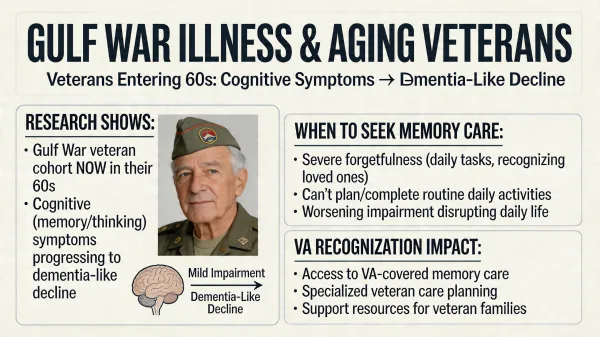
This article covers Gulf War Illness research and related VA recognition as of 2026. Eligibility for service connection, disability benefits, and care resources depends on service history, current VA rules, and individual medical findings, all of which change over time. This is educational content, not medical or legal advice. Verify current benefits at VA.gov or with a VA-accredited representative, and consult your veteran's physician for clinical decisions.
"Is my father's Gulf War Illness progressing into dementia, or is this something else?" That question, or some version of it, has been landing in my inbox more often lately. Gulf War veterans from the 1990-1991 deployment are now in their late 50s and 60s, and the cognitive fog many have lived with since the mid-1990s is starting to look different. Harder to write off. Harder to work around.
If you're the adult child of a Gulf War veteran, you may already know the script by heart. Your dad has had chronic fatigue, brain fog, and memory trouble for 30 years, with good days and bad days. The VA has long acknowledged his Gulf War Illness, and life continued. But now something has shifted. He's repeating stories. He's losing track of appointments he used to manage without a note, and his wife is exhausted in a way she hasn't been before.
The honest answer is that distinguishing a worsening GWI baseline from emerging dementia is hard, and families deserve to know why. This article walks through what peer-reviewed research has actually established about Gulf War Illness and cognitive decline, where the science stands on progression to dementia, how to tell when symptoms have crossed into memory care territory, and what the VA does and doesn't currently recognize for aging Gulf War veterans.
I went into this research cautious, because GWI has been studied and argued about for 30 years, and I wanted to make sure I wasn't writing past what the evidence actually shows. What follows stays inside those lines.
What Gulf War Illness Is and How It Affects the Brain
Gulf War Illness (GWI) is a chronic multisymptom condition affecting roughly 25 to 32 percent of the nearly 700,000 U.S. service members who deployed to the 1990-1991 Persian Gulf War, according to VA-funded research published in Cortex in 2016. Core symptoms include persistent cognitive dysfunction, debilitating fatigue, widespread muscle and joint pain, headaches, gastrointestinal problems, sleep disturbance, and skin rashes. The cognitive piece, often called Gulf War brain fog, includes memory trouble, concentration problems, word-finding difficulty, and slowed mental processing.
GWI isn't a single disease with a single test. The VA refers to it as Chronic Multisymptom Illness or Medically Unexplained Chronic Multisymptom Illness (MUCMI), and the two most widely used research definitions are the Kansas Gulf War Illness criteria and the CDC Chronic Multisymptom Illness criteria. Both require multiple chronic symptoms lasting six months or more in at least three symptom domains, one of which typically includes neurologic or cognitive problems.
Researchers believe the condition stems from deployment-related toxic exposures. The strongest associations tie to pyridostigmine bromide anti-nerve agent pills, pesticides, oil well fire smoke, and possible low-level sarin exposure from chemical weapon depot demolitions at Khamisiyah, Iraq. Twenty years of hospital radiology work has shown me that exposure histories matter enormously, and a military service period this specific almost always shapes later health in ways routine workups miss.
The State of the Research on GWI and Cognitive Decline
Here's where families need precise language, because the research tells a more nuanced story than either side of the decades-long debate has allowed. What's been established is that cognitive dysfunction in Gulf War veterans isn't just a reported complaint. It's been measured. What's suggested but not yet confirmed is that GWI cognitive decline may progress into dementia at rates higher than the general population. What remains unknown is the precise biological mechanism and whether current treatments can slow that progression.
What the peer-reviewed evidence has established
Multiple studies have documented objective cognitive deficits in GWI veterans on formal neuropsychological testing. A 2017 meta-analysis in PLOS ONE confirmed consistent deficits in attention, executive function, and visuospatial abilities across the Gulf War veteran research literature. Brain imaging studies have found reduced hippocampal volume, thinner parietal cortex, altered cerebral blood flow regulation, and measurable neuroinflammation on PET scans using TSPO ligands. These aren't self-report artifacts. They show up on objective measures.
A 2020 study by Chao published in the International Journal of Environmental Research and Public Health found that 12 percent of a sample of middle-aged Gulf War veterans, median age 52, met criteria for mild cognitive impairment (MCI). That's a rate materially higher than the 1 to 3 percent expected for that age group. The 2024 follow-up by Chao and colleagues, published in Frontiers in Neuroscience, expanded the analysis to 952 veterans and found an MCI rate of 17.2 percent, compared to a general-population benchmark of roughly 7.6 percent for adults age 55 to 59.
What the research suggests but has not confirmed
MCI isn't dementia, but it's often a precursor. In the general population, people with MCI develop dementia at a rate of roughly 10 to 15 percent per year, compared to 1 to 2 percent in people without MCI. If the GWI cognitive decline pattern behaves the same way biologically, the large pool of Gulf War veterans with MCI in midlife may translate into elevated dementia rates in coming years. Multiple researchers have flagged this as a likely scenario, but no study has yet tracked a cohort long enough to confirm the conversion rate. A 2024 analysis in the Veteran Health Administration system found that veterans with severe GWI reached chronic-disease thresholds earlier than their peers, consistent with accelerated biological aging, and a separate VA Frailty Index study reported higher rates of dementia diagnoses among CMI-positive Gulf War veterans than age-matched controls. The cohort is now entering the age window where dementia typically becomes detectable, so the research picture will clarify considerably over the next five to ten years. Until then, families are working through decisions with a partially written playbook.
What the research has not yet answered
It isn't clear whether GWI cognitive decline converts specifically into Alzheimer's-type dementia, vascular dementia, a unique toxicant-exposure dementia, or some combination. Biomarker studies looking at amyloid and tau in GWI veterans are still early. The Gulf War Illness Research Program, now housed under the Toxic Exposures Research Program at the Department of Defense, has been funding biomarker and treatment research since 2006. The field is still roughly a decade behind Alzheimer's research in terms of diagnostic clarity.
The short version: the cognitive symptoms are real, they're measurable, and the trajectory for aging Gulf War veterans is concerning but not yet fully mapped.
How GWI Cognitive Symptoms Differ From Normal Aging
For families, the hardest part is that a Gulf War veteran with longstanding GWI has had a degraded cognitive baseline for so long that spotting new decline takes careful attention. Normal age-related cognitive slowing tends to start in the 60s for most people, and it tends to be mild: slower recall, taking a beat longer to find a word, occasionally misplacing keys. GWI cognitive symptoms look different. They've been present since the 1990s, they affect multiple domains, they fluctuate with fatigue and pain, and they don't improve with good sleep the way normal aging does.
The signal families need to watch for isn't the presence of cognitive symptoms. It's a change in the pattern: new symptom types your parent didn't have before, sharper gaps on the bad days, a narrower window of good days.
When GWI Symptoms Cross Into Memory Care Territory
Memory care is a specific level of senior living designed for people whose cognitive impairment has progressed to the point that they can't safely live independently. The trigger isn't forgetfulness. It's safety risk and the need for structured, secured, dementia-informed care. When families ask how to know if their Gulf War veteran parent has crossed that line, the answer points to specific categories of change.
Functional signs that warrant a memory care evaluation
The list below isn't exhaustive, but these changes consistently show up in families walking through a parent's decline:
- Getting lost driving a familiar route
- Leaving the stove on after cooking
- Missing medications or doubling up on doses
- Being unable to manage finances that were previously handled fine
- Wandering or confusion about time of day
- Calling adult children by a grandchild's name, or asking the same question within the same hour
- Significant personality changes, especially increased agitation, paranoia, or withdrawal
- New trouble with sequencing tasks like dressing or operating familiar appliances
One or two of these on a bad GWI day doesn't mean memory care is needed. A pattern of them across good and bad days does.
Why the timeline can catch families off guard
In my own family, the speed of a loved one's cognitive decline is what caught us off guard. Not the fact that it happened, but how little time we had between "we need to think about this" and "we need to act on this." Gulf War veteran families often face an even harder version of this because the baseline was already impaired, so the slope of change can look flat until suddenly it isn't. If you're reading this and wondering whether to start the conversation, that's usually a sign the time has come to start it.
The memory care setting versus other care levels
Assisted living provides help with daily activities but doesn't offer secured memory care units, dementia-specific staff training, or the structured routines that people with significant cognitive impairment need. If your parent is a wander risk, can't reliably take medications safely, or needs supervision around kitchen or bathroom tasks, memory care or a nursing home with a memory care wing is the right level, not standard assisted living.
Why Standard Dementia Workups Sometimes Miss What's Happening
A standard dementia evaluation usually includes a cognitive screen like the MoCA or MMSE, a blood panel to rule out reversible causes, possibly a brain MRI, and a neuropsychological battery if the screen comes back concerning. Those tools were built and validated on general-population patients, and they can under-detect decline in Gulf War veterans for two reasons.
First, a veteran with longstanding GWI may have a low cognitive baseline to begin with, so a score in the normal range on screening can mask meaningful loss from their own earlier level. Second, GWI symptom patterns overlap heavily with depression, PTSD, chronic pain, and sleep disruption, and clinicians unfamiliar with Gulf War veteran health often attribute findings to those comorbidities without probing further.
If you can, bring your parent to a VA neuropsychology team or a civilian clinician with Gulf War veteran experience. Ask specifically about change from prior baseline, not just current score. That one question changes the quality of the evaluation.
VA Recognition of Gulf War Illness and Care Planning
The VA recognizes GWI as a presumptive condition for service connection, which means Gulf War veterans don't have to prove their chronic symptoms were caused by deployment. Under current regulation, presumptive conditions include medically unexplained chronic multisymptom illness and undiagnosed illness that manifest to at least 10 percent disability by December 31, 2026, in veterans who served in the Southwest Asia theater after August 2, 1990.
What the VA doesn't currently do is recognize dementia itself as a presumptive Gulf War condition. A veteran whose GWI progresses into a clinically diagnosed dementia would need the dementia evaluated separately, often through secondary service connection claims arguing the dementia was caused or aggravated by the service-connected GWI. This is an area where Veterans Service Organizations (VSOs such as DAV, VFW, or American Legion) and VA-accredited representatives handle the paperwork well, and families shouldn't try to manage the claim alone.
A service-connected GWI rating can open the door to VA health care for cognitive symptoms and, in some cases, Aid and Attendance pension benefits that help pay for memory care.
Planning for Memory Care for a Gulf War Veteran
Memory care is expensive. As of 2025, CareScout reports median national monthly costs for memory care running roughly $6,200 to $7,800 depending on region, which works out to about $74,000 to $94,000 annually. Families often don't plan for that. The sticker shock hits hard, and I know from my own family's experience how fast those first numbers can land.
Gulf War veteran families have more payment pathways than most civilian families, but only if they set them up early. Aid and Attendance pension, available to wartime veterans who need help with daily activities, can add up to roughly $2,700 per month to a veteran's pension as of 2026 rates, subject to income and asset limits. Service-connected disability compensation for GWI doesn't pay for memory care directly, but it doesn't count against most need-based benefit calculations. State veterans homes often offer subsidized memory care, with eligibility rules varying by state. VA Community Living Centers provide nursing-level care for qualifying veterans, and some have memory care wings.
If your parent is moving toward memory care, schedule a VSO appointment early. These benefits take months to process, and families who start before a crisis hits have far more options than families who start after.
Getting Started If You Suspect Progression
When you suspect your parent's Gulf War Illness is progressing, work the problem in order. First, document the changes in writing. A two-column list of how things used to be versus how they are now over the past six to twelve months gives any doctor something to work with. Second, ask their primary care physician for a referral to a neuropsychologist or neurologist, ideally one familiar with GWI. If your parent uses the VA system, ask specifically for a War Related Illness and Injury Study Center referral, which exists precisely for complex cases like this one.
Third, connect with a VSO before you need them. DAV, VFW, American Legion, and Vietnam Veterans of America all have benefits counselors who handle Gulf War veteran cases regularly, and they charge nothing for their help. Fourth, start the memory care research early, even if you're months from needing it. Touring memory care communities with your parent's input, while they can still participate in the decision, is one of the gentler paths through this.
A Final Word for Gulf War Veteran Families
Gulf War veterans have been dismissed by parts of the medical system for 35 years. Their symptoms were called stress, or psychological, or vague. They weren't. The research has caught up, even if it's still catching up, and the families living this know what they're seeing.
If your parent's GWI is changing in ways that worry you, you aren't imagining it. The research supports the concern that cognitive symptoms in Gulf War veterans can worsen with age, and a subset may progress into dementia-level decline. You aren't being alarmist by taking it seriously. You're being accurate.
The work ahead is to get a careful evaluation from someone who knows Gulf War veteran health, to line up the VA benefits your parent has earned, and to plan memory care before it becomes a crisis instead of a decision. That work is hard. Start anyway. Your parent served through one of the hardest deployments of the modern era, and they deserve a family that shows up for this chapter with the same resolve. Start where you are.