
Important for Veterans' Families
This article outlines general information about PACT Act benefits and current research on burn pit exposure and cognitive health. Eligibility and presumptive conditions depend on service history, deployment location, and medical diagnosis, and the VA's presumptive list changes as new evidence is reviewed. Verify current benefits, eligibility, and presumptive conditions at VA.gov or with a VA-accredited representative.
My husband served near burn pits in Iraq. Should we be worried about his brain too?
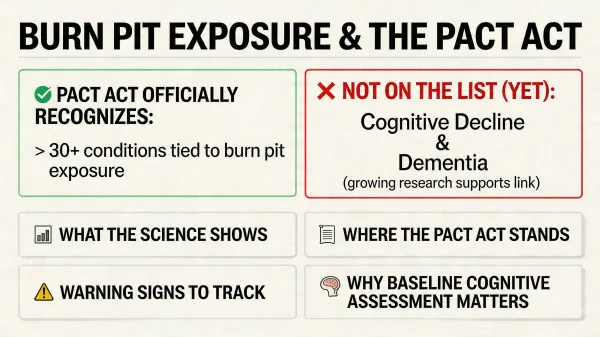
That's a question families are asking more often, and it's the right question to ask. Post-9/11 veterans are now moving into their 40s and 50s with a growing list of health conditions tied to burn pit exposure. I've worked in hospital settings with post-9/11 veterans for years, and the cognitive complaints, word-finding trouble, mental fog, loss of focus, are coming up more often in the younger ones than I would have predicted even five years ago. The PACT Act, signed in 2022, officially recognized more than 30 of those conditions as presumptively service-connected. Respiratory diseases, certain cancers, and brain cancer made that list. Cognitive decline and dementia didn't, and that gap is what this article is about.
Research on burn pit cognitive effects is still young, and I want to be honest about that from the start. I wrote this piece to help families know what's known, what's suspected, and what to watch for. The goal isn't to alarm you. Post-9/11 veterans are mostly decades from typical dementia age, and the signals we have right now are early, not conclusive. But the signals do exist, and families who notice changes deserve information that takes those changes seriously without overclaiming.
What you'll find below is a measured look at the current science, where the PACT Act stands on cognitive conditions, the warning signs worth tracking in a younger veteran, and why establishing a baseline now can matter years from now.
Burn Pits, the Brain, and Why Cognitive Concerns Emerged
Burn pits were open-air waste disposal sites used on military bases across Iraq, Afghanistan, and other post-9/11 deployment locations. Anything the military needed to get rid of, plastics, medical waste, batteries, paints, solvents, metals, even ammunition, went into the pit and was set on fire with jet fuel. The Department of Defense estimates nearly 3.5 million service members were exposed to the smoke from these operations.
That smoke carried a toxic mixture: fine particulate matter, volatile organic compounds, heavy metals, dioxins, and polycyclic aromatic hydrocarbons. These are the same families of pollutants that decades of environmental research have tied to respiratory disease, cancer, and increasingly, to changes in the brain. The reason cognitive concerns are emerging now is that the research on air pollution and neurodegeneration has matured in parallel with the aging of the post-9/11 veteran population. Questions that couldn't be answered ten years ago are being asked now.
What the Research Shows So Far: Burn Pits and the Brain
The honest summary is this: there is a growing body of evidence suggesting that burn pit exposure affects the brain, but the specific link to dementia and long-term cognitive decline is still being established. The research is suggestive, not conclusive. Here's what the published literature actually shows.
A 2024 peer-reviewed review published in the International Journal of Molecular Sciences synthesized research on burn pit toxins and brain health. The authors, affiliated with the Minneapolis VA and the University of Minnesota, reported that veterans exposed to burn pit toxins had higher rates of neuroinflammatory markers, accelerated cognitive decline, and increased risks of neurodegenerative diseases. The proposed mechanism is neuroinflammation. Airborne pollutants are inhaled, enter the bloodstream, cross the blood-brain barrier, and trigger inflammatory responses in the central nervous system. Sustained inflammation over time contributes to oxidative stress, neuronal damage, and cognitive impairment. Animal models of burn pit exposure have shown increased inflammatory biomarkers in brain tissue, and broader air pollution research in civilian populations has linked fine particulate matter exposure to higher risk of Alzheimer's disease and related dementias. These parallels give biological plausibility to what veterans are self-reporting.
The self-reported data is striking. The VA's Airborne Hazards and Open Burn Pit Registry (AHOBPR) collects health information from deployed veterans. In registry data reviewed through recent years, roughly 70 percent of participating veterans reported neurological symptoms, including numbness, tingling, weakness, and thinking or memory problems. None of those neurological symptoms are currently presumptive under the PACT Act. They are, however, being documented at rates that suggest something real is happening in this population.
A 2025 study published in the Journal of the Neurological Sciences drew on the VA's Million Veteran Program. Researchers looked at more than 6,700 post-9/11 veterans and examined how traumatic brain injury history and environmental exposures related to cognitive complaints. They found that both TBI and environmental exposures, including burn pits, independently contributed to worse subjective cognition. In other words, the cognitive effects of exposure weren't simply a stand-in for TBI. Veterans who had been exposed but didn't have a TBI history still reported more cognitive difficulty than unexposed peers.
Related populations add further context. Gulf War veterans exposed to pesticides, pyridostigmine bromide, and oil well fire smoke have documented cognitive decrements on neuropsychological testing decades after service. Over my years in the ER, I've seen Gulf War veterans come in with symptom patterns their civilian doctors hadn't been able to tie to any single diagnosis. World Trade Center responders, who inhaled a similarly complex toxic mixture, have higher rates of cognitive impairment than expected for their age. Camp Lejeune veterans exposed to contaminated water show increased rates of Parkinson's disease. None of these populations match burn pit exposure exactly, but together they describe a consistent pattern: toxic inhalation and environmental exposure during military service can produce neurological effects that emerge years later.
What the research doesn't yet show is a direct, causal link between burn pit exposure and Alzheimer's disease or vascular dementia. That study would require decades of follow-up in a large, well-characterized exposed cohort, and the PACT Act's mandate for expanded research is intended to help build that evidence base. VA researchers are actively investigating these questions through the AHOBPR, the Million Veteran Program, and toxic exposure research centers established under the law. For now, families should understand the evidence as strong enough to take seriously and too early to draw firm conclusions from.
The PACT Act and Cognitive Conditions: Where Things Stand
The PACT Act currently recognizes more than 30 presumptive conditions related to burn pits and other toxic exposures. Brain cancer is on that list, along with a range of other cancers and respiratory diseases. Cognitive decline, dementia, Alzheimer's, and mild cognitive impairment are not presumptive under the PACT Act as of early 2026. Peripheral neuropathy, memory problems, and similar neurological symptoms are also not currently covered, despite being commonly reported in the registry.
That could change. The PACT Act requires the VA to continue reviewing scientific evidence and adding presumptive conditions as the research supports it. The January 2025 additions of leukemias, multiple myeloma, and several genitourinary cancers show the list is still moving. Neurological conditions are under active review. Families shouldn't assume the current list is final.
Cognitive Warning Signs Worth Tracking
For families who are watching someone they love, the question becomes practical: what are the signs worth paying attention to, and when should you push for an evaluation?
Consider a situation where your husband is in his mid-40s, served near burn pits in Iraq, and already has a PACT Act-recognized respiratory condition. Over the past year, you've noticed him reaching for words more often, forgetting where he put his keys, and losing the thread of conversations in ways that feel new. You're trying to figure out whether this is stress, age, poor sleep, something else, or potentially connected to the exposure. That's exactly the situation this section is written for. Here are the changes worth documenting in a post-9/11 veteran:
- Word-finding difficulty, especially for familiar names or everyday objects
- Short-term memory lapses that are new, such as forgetting recent conversations, appointments, or where they put commonly used items
- Trouble concentrating, following complex conversations, or tracking plot lines in movies or shows
- Difficulty with tasks that used to be automatic, like paying bills, planning a trip, or navigating to a familiar place
- Slowed processing speed, where they need more time to answer questions or respond to what's happening around them
- Personality or mood changes, including increased irritability, apathy, or withdrawal that doesn't fit their usual pattern
- Worsening organization, missed deadlines, or repeated errors at work in someone who was previously high-functioning
One caution before you take these to a doctor. Many of these symptoms overlap with PTSD, depression, chronic pain, poor sleep, and the cognitive effects of a prior traumatic brain injury. In the ER, I've seen post-9/11 veterans present with constellations of symptoms that could be explained multiple ways. Your parent or spouse may have several of these conditions stacked on top of each other, and untangling them takes a clinician who will look at the whole picture rather than settle on the first explanation.
When should you push for a neurological evaluation? If the changes are persistent, getting worse, or interfering with work or daily functioning, that's the threshold. A few forgotten names aren't the same as consistent trouble finishing familiar tasks. Start with a primary care provider, ideally through the VA so the exposure history is part of the record. Ask specifically for a cognitive screening and, if the screen raises concerns, a referral to neuropsychology. A full neuropsychological evaluation is more sensitive than a brief office screen. It can pick up patterns that suggest toxic exposure, vascular changes, TBI effects, or early neurodegenerative disease.
Document what you're seeing. A written log of specific incidents with dates is far more useful to a clinician than a general sense that "something is off." Note when the change started, how often it happens, and whether it's getting worse.
Why Baseline Cognitive Testing Makes Sense Now
For a veteran in their 30s, 40s, or early 50s, a baseline cognitive assessment now creates a reference point that doesn't exist otherwise. Without it, a clinician ten or fifteen years from now has to guess whether current performance represents decline or normal variation. With it, the question becomes measurable.
In my own family, the speed of a loved one's cognitive decline caught all of us off guard. We had no early measurements to compare against, so by the time anyone raised the question, we were trying to reconstruct what "normal" had looked like from memory. Families who were in the same position will tell you the same thing. That experience is part of why I think baseline testing is worth the effort now, years before anyone would typically consider it. The cost of establishing a baseline is a short appointment. The cost of not having one, if cognitive changes do appear later, is the inability to measure how far things have moved.
Common baseline screening tools include the Mini-Cog, the Montreal Cognitive Assessment (MoCA), and the Self-Administered Gerocognitive Exam (SAGE). None of these diagnose anything on their own. They establish a starting score and flag whether fuller neuropsychological testing is warranted.
What Families Can Do Right Now
If your veteran hasn't already, confirm enrollment in the Airborne Hazards and Open Burn Pit Registry. As of August 2024, the VA automatically enrolls eligible veterans based on DoD records, but participation means keeping the exposure profile updated. Registry data is what's driving the research, and documented exposure strengthens any future claim if the presumptive list expands.
Request a toxic exposure screening through the VA. The PACT Act requires this screening for all enrolled veterans at least every five years, and it's designed to flag potential exposures and connect veterans to follow-up care. If cognitive symptoms come up during that screening, the VA can route the veteran to neurological evaluation.
Build the documentation trail. Keep a dated record of deployment locations, proximity to burn pits, duration of exposure, and any symptoms, respiratory, cognitive, or otherwise, that have appeared since service. File for any PACT Act presumptive conditions the veteran currently qualifies for. Each documented condition strengthens the overall service-connected health record.
Connect with a VA-accredited representative if you're filing claims. Veterans Service Organizations like DAV, VFW, and American Legion can help at no cost, and they know how to build a claim that matches the current evidence.
Common Questions Families Ask
Is burn pit exposure dementia a recognized VA condition? Not as of early 2026. Brain cancer is presumptive, and a range of other conditions are covered, but dementia and cognitive decline are not currently on the PACT Act presumptive list. That doesn't mean a claim can't be filed for a service-connected cognitive condition. It means the claim won't benefit from automatic presumption and will require medical evidence and a nexus opinion.
Should a younger veteran have cognitive testing even without symptoms? If exposure was significant and other burn pit-related conditions are already present, a baseline assessment makes sense. It's a low-cost, short appointment that creates a reference point for the future. Ask your VA primary care provider or a civilian neurologist.
Could these cognitive changes be from PTSD or TBI instead? Often, yes, at least in part. Many post-9/11 veterans have PTSD, a history of mild TBI from blasts, or both. All three can affect memory, attention, and word-finding. A neuropsychological evaluation is designed to sort out which factors are contributing and in what proportion.
Looking Ahead
The research on burn pit exposure and cognitive health is moving, and families of post-9/11 veterans are right to pay attention. What the literature suggests so far is that the toxins in burn pit smoke have biological effects on the brain that plausibly contribute to cognitive changes over time. What it doesn't yet prove is a direct causal path to dementia. The honest stance for families right now is to take changes seriously, document what you see, push for evaluation when symptoms are persistent, and maintain a baseline if possible.
Your veteran's cognitive future isn't fixed. Many of the modifiable risk factors for cognitive decline, sleep, depression, cardiovascular health, hearing, physical activity, are things that can be addressed now. Treating PTSD, managing blood pressure, staying socially and mentally active, and working with a clinical team that understands toxic exposure history will matter regardless of how the presumptive list evolves.
If you're reading this because something feels off in someone you love, trust that instinct. Start the conversation with their doctor. Document what you're seeing. You don't need all the answers to take the first step.