
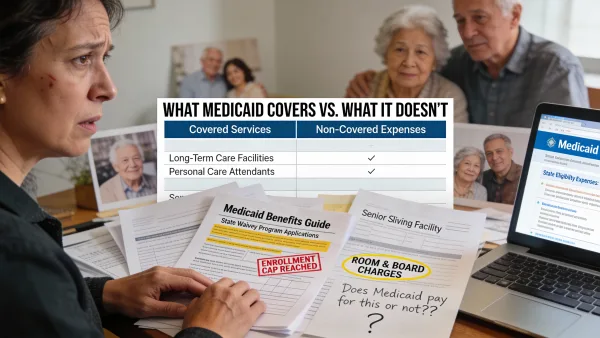
Important Medicaid Coverage Information
This article provides general educational information about Medicaid coverage for senior living based on current program rules. Medicaid coverage varies significantly by state, and eligibility requirements and benefits change periodically. For decisions related to Medicaid coverage or eligibility in your state, confirm current benefits and requirements directly with your state Medicaid office or a qualified Medicaid planner.
Does Medicaid Cover Senior Living?
Medicaid covers less senior living than you think.
Here's the hard truth: Medicaid provides comprehensive coverage for nursing home care but offers only limited assistance for assisted living and memory care, and that assistance is available only in certain states through waiver programs with waiting lists. Medicaid doesn't cover independent living at all.
If you're exploring Medicaid as a way to pay for your parent's move to assisted living or memory care, understand from the start that Medicaid coverage for these settings works completely differently than nursing home coverage. Even when coverage is available, it doesn't pay for room and board, which typically represents the largest portion of assisted living costs.
This guide explains what Medicaid does and doesn't cover, how coverage differs by state, eligibility requirements as of 2025, and where to find accurate information for your specific situation. Because Medicaid rules change and vary by state, verify all information with your state Medicaid office before making financial decisions.
What Medicaid Calls Senior Living vs. What You Call It
Where this gets confusing is that the terms you use to describe senior living options don't match the terms Medicaid uses, and Medicaid's willingness to pay depends entirely on which type of care you're seeking.
Nursing Homes: Covered
Medicaid provides comprehensive coverage for nursing homes, which Medicaid calls "nursing facilities" or "skilled nursing facilities." This coverage is an entitlement, meaning if you meet the financial and medical eligibility requirements, your state must provide coverage. There are no waiting lists, enrollment caps, or limited slots.
Medicaid pays for the full cost of nursing home care including room, board, nursing services, personal care, meals, and medical services. In exchange, beneficiaries must contribute most of their income toward the cost of care, keeping only a small personal needs allowance (typically $30-$75 per month depending on your state).
For many families, this creates confusion. They assume that if Medicaid covers nursing home care comprehensively, it must also cover assisted living and memory care, which seem like less intensive (and less expensive) alternatives. That assumption is wrong.
Assisted Living: Sometimes Partially Covered Through Waivers
Assisted living facilities go by many names depending on your state: residential care facilities, personal care homes, adult care homes, board and care homes, or assisted living residences. Regardless of what they're called locally, Medicaid treats them all the same way.
Medicaid does not directly pay for assisted living. Instead, as of 2024, 46 states and Washington, D.C. offer Home and Community-Based Services (HCBS) waivers that can help pay for services in assisted living settings. These waivers are designed to keep people out of nursing homes by paying for care services in home and community settings, including assisted living.
Here's what makes this confusing: even when your state offers an assisted living waiver, Medicaid coverage is partial, not comprehensive. Federal law prohibits states from using Medicaid funds to pay for room and board in assisted living. Waivers only cover care services like personal care assistance, medication management, nursing services, and care coordination.
Nationally, room and board in assisted living averages approximately $3,000 per month as of 2024, meaning families must find other ways to cover this expense even when Medicaid pays for care services. Some states set maximum rates assisted living facilities can charge Medicaid beneficiaries for room and board, but you're still responsible for paying those costs yourself.
Memory Care: Covered the Same as Assisted Living
Memory care, which is specialized assisted living for people with Alzheimer's disease and related dementias, follows the same rules as assisted living. Some state waivers specifically target individuals with dementia, while others include memory care as part of broader elderly or disabled waivers.
The same limitation applies: Medicaid waivers pay only for care services, not for room and board. Memory care room and board costs are often higher than standard assisted living, creating an even larger gap that families must cover through other resources.
Independent Living: Not Covered
Independent living, active adult communities, 55+ communities, and senior apartments receive no Medicaid coverage. These settings provide housing and amenities but not personal care services, so they fall outside Medicaid's long-term care programs entirely.
Understanding "Room and Board"
The federal prohibition on Medicaid paying for room and board in assisted living and memory care is critical to understand. Room and board includes rent for the living space, utilities, meals, housekeeping, maintenance, and basic amenities. These costs represent 50-70% of total assisted living expenses in most states.
When Medicaid pays for "services" through waivers, this means personal care assistance (help with bathing, dressing, eating, toileting, mobility), medication management and administration, nursing services and care oversight, care coordination and case management, and sometimes additional supports like transportation or specialized dementia care.
You pay for room and board through Social Security income, pension payments, personal savings, proceeds from home sales, or other resources. Some families find that after Medicaid pays for care services, the remaining room and board cost is manageable. Others find it still exceeds available resources.
State-by-State Variations
Medicaid is jointly funded by federal and state governments, with states having significant flexibility in how they structure programs within federal guidelines. This creates enormous variation in what's available and who qualifies.
States Without Assisted Living Waivers
A small number of states offer no Medicaid assistance for assisted living through waivers or state plan services. In these states, families must rely entirely on private pay, long-term care insurance, Veterans benefits, or other resources to afford assisted living and memory care. Verify current availability with your state Medicaid office, as program availability changes.
Common Types of Waiver Programs
States use several different Medicaid authorities to fund assisted living services. Understanding which type your state uses can help you navigate the system, though the practical impact on beneficiaries is often similar.
1915(c) HCBS Waivers are the most common approach, used in most states offering assisted living coverage. These waivers allow states to serve specific populations (elderly, disabled, individuals with dementia) and set enrollment limits. Waiting lists are common.
1115 Demonstration Waivers give states broader flexibility to test new approaches to Medicaid coverage. Some states use these waivers for assisted living programs.
Medicaid State Plan Services provide assisted living coverage as part of the regular Medicaid program in a few states. These programs can't limit enrollment but generally have more restrictive income limits than waivers.
The type of program determines income limits, enrollment capacity, covered services, and application processes. Contact your state Medicaid office to learn which programs operate in your state.
Enrollment Caps and Waiting Lists
Unlike nursing home coverage, which is an entitlement, most assisted living waiver programs have limited "slots" available. States set a maximum number of beneficiaries who can receive waiver services at any time based on budget considerations.
When slots are full, eligible applicants join waiting lists. As of 2024, more than 710,000 people nationwide were on HCBS waiver waiting lists. Wait times vary dramatically by state and waiver program, from a few months to several years.
Waiting list priority typically depends on level of care need, not how long you've been waiting. Someone at high risk of nursing home placement may receive a slot before someone who applied earlier but has less urgent needs.
Eligibility Requirements: Income, Assets, and Care Needs
Where this gets confusing is that income limits work differently than asset limits, different types of Medicaid have different income limits, and being over the limit doesn't automatically disqualify you in all situations.
Income Limits for 2025
Income limits for Medicaid long-term care vary by program type and state. As of 2025, general guidelines include:
For HCBS waivers (assisted living and memory care), most states set income limits at approximately $2,901 to $2,982 per month for a single individual. This limit is based on 300% of the Federal Benefit Rate and adjusts annually.
For Medicaid State Plan services providing assisted living assistance, income limits are typically much lower, around $1,304 to $1,435 per month for an individual, based on 100% of either the Federal Poverty Level or Federal Benefit Rate.
For nursing home Medicaid, income limits generally match the waiver limits of $2,901 to $2,982 per month in most states as of 2025.
These are general figures. Some states use different methodologies or set different limits. New York, California, and several other states have unique income limit structures. Always verify your state's current limits.
What Counts as Income
Almost all income counts toward Medicaid limits, including Social Security benefits, pension payments, IRA and retirement account distributions, wages or salary, investment income and dividends, rental property income, and alimony.
Some income sources don't count in most states: Veterans Aid & Attendance benefits (above the basic VA pension), Holocaust survivor reparations, and certain other specified exclusions.
Income Above the Limit
Being over the income limit doesn't automatically disqualify you. Many states allow the use of Qualified Income Trusts (also called Miller Trusts) to become eligible. These legal instruments allow income above the limit to be deposited into a trust, making you technically under the income limit for Medicaid purposes.
Professional Medicaid planners can help determine whether this strategy applies in your state and assist with proper setup. Improper structuring of finances can trigger penalties.
Asset Limits for 2025
Asset limits are more straightforward than income limits but still vary by state. As of 2025:
In most states, the individual asset limit is $2,000 for nursing home Medicaid, HCBS waivers, and ABD (Aged, Blind, and Disabled) Medicaid.
Some states have higher limits. Michigan uses $9,660 for all programs. New York uses $32,396 for individuals. California has no asset limit for its long-term care Medicaid programs. Florida, South Carolina, Arkansas, and other states have varying limits for different programs.
For married couples with both spouses applying, the asset limit in most states is a combined $3,000 to $12,000 depending on the state and program.
For married couples with one spouse applying, the applicant spouse is limited to $2,000 in most states, but the non-applicant spouse can retain up to $157,920 (in most states as of 2025) thanks to the Community Spouse Resource Allowance. This protection applies only to nursing home Medicaid and HCBS waivers, not to ABD Medicaid.
What Counts as Assets
Countable assets include bank accounts (checking and savings), retirement accounts (IRAs, 401(k)s, etc.), stocks, bonds, and investment accounts, certificates of deposit, cash, second homes or investment property, and any other assets easily converted to cash.
Non-countable assets typically include your primary home (under certain conditions discussed below), one vehicle regardless of value, personal belongings and household goods, irrevocable burial trusts or prepaid funeral arrangements up to certain limits, and certain types of life insurance depending on face value and cash value.
Your Home and Medicaid Eligibility
Your primary residence usually doesn't count against the asset limit if you or your spouse lives there, you intend to return home (even if unlikely), or certain family members live there.
However, home equity limits apply in most states. As of 2025, if your equity interest in the home exceeds $730,000 in most states (some states use $1,095,000), the home may count as an asset. Equity interest means the home's value minus any outstanding mortgage or liens, multiplied by your ownership percentage.
State rules on home protection vary significantly. Some states have more generous protections than others. The home may also be subject to Medicaid estate recovery after your death, meaning the state attempts to recover costs from your estate, often through a lien on the home.
Functional Eligibility: Nursing Home Level of Care
To qualify for Medicaid-funded assisted living or memory care through HCBS waivers, you must meet functional eligibility criteria, typically requiring "nursing home level of care."
This seems contradictory. Why must you need nursing home level care to qualify for assisted living? The answer is that waivers are designed to allow people who need nursing home care to receive that care in less institutional settings.
Nursing home level of care generally means requiring substantial assistance with Activities of Daily Living (ADLs) including bathing, dressing, eating, toileting, transferring (moving from bed to chair, etc.), and mobility. States typically require assistance with two or more ADLs.
They may also consider Instrumental Activities of Daily Living (IADLs) such as meal preparation, medication management, housekeeping, shopping, and managing finances.
Cognitive impairments matter too. People with dementia often meet level of care criteria even if physically capable, due to supervision needs and inability to perform IADLs safely.
A medical professional conducts a functional assessment to determine whether you meet level of care requirements. Having a diagnosis of Alzheimer's disease or dementia doesn't automatically qualify you. The assessment focuses on your actual functional limitations and care needs.
The Five-Year Look-Back Period
Medicaid enforces a look-back period to prevent people from giving away assets to qualify. As of 2025, the look-back period for nursing home Medicaid and HCBS waivers is five years in most states. (Some states use shorter periods for certain programs.)
Any transfer of assets for less than fair market value during the look-back period triggers a penalty period of Medicaid ineligibility. The penalty period length depends on the value of transferred assets divided by your state's average monthly cost of nursing home care.
This rule applies to gifts to family members, selling assets below market value, adding names to bank accounts or property deeds, and other transfers. Certain transfers are exempt, such as transfers to a spouse, transfers to disabled children, and specific other circumstances.
Professional Medicaid planning can help you legally restructure finances to meet eligibility requirements without triggering penalties, but this requires careful navigation of complex rules. Improper planning creates ineligibility when you need coverage most.
How to Find Out What Your State Covers
Given the variation in Medicaid rules and the consequences of misunderstanding coverage, confirming information directly with official sources is essential.
Start with Your State Medicaid Office
Every state has a Medicaid agency (sometimes called by another name, like Medi-Cal in California or MO HealthNet in Missouri). Contact them directly to ask:
What HCBS waivers are available in our state that cover assisted living or memory care? What are the current income and asset limits for those waivers? Is there a waiting list, and if so, how long is it? What services are covered under the waiver? What costs am I responsible for paying? How do I apply?
State Medicaid websites provide program overviews, eligibility criteria, application instructions, and contact information. These sites are the most reliable source for current, state-specific information.
Area Agencies on Aging
Your local Area Agency on Aging can help you understand Medicaid options, navigate the application process, find Medicaid-approved assisted living facilities, and access other resources for seniors.
These agencies provide free assistance and are familiar with local resources and common challenges families face in your area.
Certified Medicaid Planners and Elder Law Attorneys
Professional advisors who specialize in Medicaid planning can assess your financial situation, explain your state's specific rules, implement legal strategies to meet eligibility requirements if you're over the limits, help with the application process, and guide you through complex scenarios like spend-down strategies or spousal protections.
These services involve fees, but for families with assets that exceed Medicaid limits or complex financial situations, professional guidance often proves worthwhile.
What If Medicaid Doesn't Cover What You Need?
Many families discover that Medicaid either doesn't cover assisted living in their state, has waiting lists too long to be practical, or requires them to spend down assets they hoped to preserve. Several alternatives exist:
Veterans benefits: Veterans and surviving spouses may qualify for Aid and Attendance benefits that can help pay for assisted living. These benefits are separate from Medicaid and have different eligibility criteria.
Long-term care insurance: If your parent has an active long-term care insurance policy, it may cover assisted living and memory care. Review the policy carefully to understand coverage limits and requirements.
Reverse mortgages: Homeowners age 62 or older may be able to access home equity through reverse mortgages to fund care costs while remaining eligible for Medicaid (the home isn't counted as an asset if you live there).
Life insurance conversions: Some life insurance policies can be sold or converted to help fund care costs.
Adult day programs and home care: If the primary goal is avoiding nursing home placement, other community-based services funded through Medicaid may provide sufficient support at lower cost than 24-hour residential care.
Shared living arrangements: Some assisted living communities offer companion apartments where two residents share a living space but have private bedrooms. This can reduce room and board costs significantly.
Common Questions About Medicaid and Senior Living
Does Medicare cover assisted living?
No. Medicare does not cover long-term care in assisted living, memory care, or nursing homes. Medicare may cover short-term rehabilitation stays in skilled nursing facilities following hospitalization, but this is not the same as long-term nursing home care. Medicaid, not Medicare, is the program that covers long-term care.
Can I keep my house and still qualify for Medicaid?
In most situations, yes, your primary home doesn't count against Medicaid's asset limit if you or your spouse lives there or you intend to return home. However, home equity limits apply in most states, and the home may be subject to estate recovery after death. State rules vary significantly on home protections.
What happens if I'm on a waiting list and need care now?
Families often must pay privately for assisted living while waiting for a waiver slot to open. Some facilities require a certain period of private pay before accepting Medicaid. In urgent situations, consider whether nursing home care (which has no waiting list) is appropriate, even temporarily, until a waiver slot becomes available.
Do all assisted living facilities accept Medicaid?
No. Because Medicaid reimbursement rates for services are relatively low and don't cover room and board, many assisted living facilities choose not to accept Medicaid waivers. Some require a period of private pay before transitioning to Medicaid. Others set aside only a limited number of beds for Medicaid beneficiaries. Ask facilities directly about their Medicaid acceptance policies.
Can I qualify for Medicaid if I just gave money to my children?
Possibly, but the transfer may trigger a penalty period of Medicaid ineligibility depending on the amount and how recently it occurred. The five-year look-back period means transfers made within five years of applying cause penalties in most states. Consult a Medicaid planner before making financial transfers if you anticipate needing Medicaid coverage.
Important Reminders
Medicaid rules change regularly. Income and asset limits adjust annually on January 1 or July 1 depending on your state and program. State budgets affect waiver availability and waiting list lengths. Policy changes at state and federal levels can modify eligibility criteria, covered services, and program structures.
Before making irreversible financial decisions based on Medicaid planning, confirm current rules with your state Medicaid office or a qualified professional advisor. What was true last year may not apply this year. What applies in your neighbor's state may not apply in yours.
The information in this article reflects general Medicaid rules as of late 2024 and early 2025. For your specific situation, verify all details with authoritative sources in your state before proceeding.