
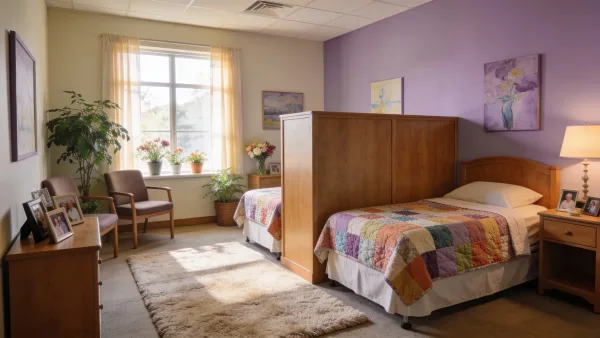
The Martinez family chose a shared room when their father moved into memory care last spring. The $1,500 monthly savings mattered, and the staff assured them that having a roommate would help prevent isolation. For three months, everything went smoothly. His roommate was quiet, kept to himself, and they coexisted peacefully.
Then the facility paired his roommate with a new person who wandered at night, turned lights on repeatedly, and talked loudly to himself. Their father stopped sleeping well. He became agitated and confused. His decline accelerated noticeably within weeks. The family moved him to a private room, accepting the higher cost because shared living had stopped working. Now they pay the full private rate they'd hoped to avoid, plus they've lost those three months when things were stable.
This pattern repeats constantly in memory care communities. Shared rooms work well until they don't. Understanding the real differences between private and shared rooms helps families make smarter decisions upfront.
Cost Comparison: The Numbers
The national median cost for memory care in 2025 is approximately $6,450 per month for a private room. Shared or companion suites typically cost $500 to $1,500 less per month, averaging around $5,500 to $5,950 monthly.
Monthly Cost Comparison
| Room Type | National Median | Typical Range |
|---|---|---|
| Private Room | $6,450 | $4,000 - $11,000 |
| Shared/Companion Suite | $5,500 - $5,950 | $3,500 - $9,500 |
| Monthly Savings (Shared) | $500 - $950 | Varies by market |
Location dramatically affects actual costs. In Washington, private memory care averages $7,020 monthly while in neighboring Idaho the average drops to $4,490. Urban areas consistently cost more than rural communities. High-end communities with extensive amenities charge premium rates regardless of room type.
Real Cost Differences Over Time
Where these numbers become meaningful is when you calculate actual spending over the duration of a memory care stay. The median memory care stay lasts approximately 2-3 years, though some residents remain longer.
One-Year Cost Comparison
- Private room: $77,400 annually
- Shared room: $66,000 - $71,400 annually
- Annual savings with shared room: $6,000 - $11,400
Three-Year Cost Comparison
- Private room: $232,200 over three years
- Shared room: $198,000 - $214,200 over three years
- Three-year savings with shared room: $18,000 - $34,200
These savings assume stable pricing, but most communities increase rates annually by 3-5%. Over a three-year stay, you might see total increases of 9-15%. A community charging $6,450 monthly in year one could charge $7,035 by year three. Both private and shared rates increase proportionally, maintaining the dollar-amount gap between them.
The savings calculation also assumes your parent remains in a shared room for the entire stay. Many families start with shared rooms planning to save money, then move to private rooms when roommate situations fail. You've already paid shared-room rates for the initial period but end up paying private rates going forward, losing the intended savings while your parent experiences the disruption of room changes and roommate conflicts.
Hidden costs can emerge with shared rooms. Some communities charge "room change fees" when switching roommates or moving to a private room. These can range from $500 to $2,000. If your parent goes through multiple roommate situations, these fees add up quickly.
Private rooms avoid roommate-related moves entirely. You pay more upfront but eliminate the risk of forced room changes mid-stay. The stability has value beyond just dollars, particularly for residents with dementia who struggle with environmental changes.
Medicaid complicates the picture significantly. Most state Medicaid programs cover shared rooms in nursing homes but not private rooms unless medically necessary. If your parent will eventually need to transition to Medicaid coverage, starting in a shared memory care room makes the later move to a Medicaid-funded shared nursing home room less jarring. However, memory care itself rarely accepts Medicaid, so this consideration typically applies only to nursing home-level care.
The decision about whether the savings justify the compromises depends on your financial situation. Saving $18,000 to $34,000 over three years matters tremendously to families paying privately. For those with substantial resources, the $500 to $950 monthly premium for privacy may be worth the cost to avoid roommate complications.
Consider your parent's assets and income realistically. If funds are limited and will run out during the stay, maximizing savings early extends how long private-pay lasts before needing Medicaid or other assistance. If resources are adequate for the full anticipated stay, paying for privacy might improve quality of life enough to justify the expense.
Calculate best-case and worst-case scenarios. Best case: shared room works perfectly for three years, saving $30,000. Worst case: shared room fails after six months, you move to private at month seven, and you've saved only $3,000 while your parent endured six months of poor roommate match. Most situations fall somewhere between these extremes.
Private Room Advantages
Private rooms provide complete control over the environment. Your parent doesn't have to accommodate another person's needs, schedule, or behaviors. They can play music, watch TV, rest, or stay awake according to their own patterns without disturbing anyone.
Privacy matters for personal care. Staff assist with toileting, bathing, and dressing in the room. Many families feel strongly that their parent deserves privacy during these vulnerable moments. Shared rooms require either curtains dividing the space or timing care activities when the roommate is out of the room.
Belongings and personalization expand in private rooms. There's more space for furniture, photos, decorations, and personal items that create familiarity. Shared rooms limit what each resident can bring because two people's possessions must fit in one space.
Family visits feel more comfortable in private rooms. You can visit without worrying about disturbing a roommate. Conversations remain private. You're not imposing on someone else's space. Some families avoid visiting shared rooms frequently because they feel like they're intruding on the roommate.
Sleep disruption doesn't occur from roommate activities. If your parent is a light sleeper or wakes frequently at night, they won't be disturbed by a roommate's movements, sounds, or care needs. Poor sleep accelerates cognitive decline in dementia patients, making uninterrupted rest particularly valuable.
Behavioral symptoms are easier to manage in private rooms. Residents who exhibit agitation, verbal outbursts, sundowning, or other challenging behaviors don't disturb roommates. Staff can intervene without affecting another resident.
Shared Room Advantages
The primary advantage of shared rooms is cost. Saving $500 to $950 monthly is substantial when paying privately for memory care. Over years, the savings can extend how long assets last.
Social benefits are real for some residents. Having someone else in the room provides companionship and reduces feelings of isolation. Some memory care residents respond positively to the presence of another person, even without significant conversation.
Cueing happens naturally with roommates. When one resident gets ready for breakfast, their movements cue the other that it's time to eat. One going to an activity might prompt the other to join. These environmental cues help residents maintain routines they can no longer initiate independently.
Safety can improve with roommates. If one resident falls or has a medical emergency, the roommate might alert staff or press the call button. They serve as an extra set of eyes, though this shouldn't replace proper staff monitoring.
Shared rooms may reduce wandering and sundowning in some residents. Waking up to see another person in the room provides orientation and comfort rather than confusion about being alone. The presence of another person can be calming at night.
When Shared Rooms Work Well
Shared rooms succeed when residents have compatible personalities, sleep schedules, and care needs. Ideal roommate pairings involve residents at similar cognitive levels who don't disturb each other.
Two quiet, withdrawn residents might coexist peacefully with minimal interaction. Neither imposes on the other, and they benefit from another person's presence without requiring active socialization.
Residents who enjoyed sharing space throughout their lives (dormitories, military barracks, large families) sometimes adapt well to shared rooms. The arrangement feels familiar rather than invasive.
Early-stage memory care residents with intact social skills can develop genuine friendships with roommates. They might chat, watch TV together, or look out for each other in meaningful ways.
When Shared Rooms Don't Work
In practice, this is where things break down. Shared rooms look great on paper and save money, but the reality involves unpredictable human dynamics complicated by dementia.
Incompatible sleep schedules create immediate problems. One resident goes to bed at 8:00 PM while the other stays up until midnight. One wakes at 5:00 AM, disturbing the other. Chronic sleep deprivation affects both residents' health and cognitive function.
Behavioral symptoms from one roommate disrupt the other. Verbal outbursts, repetitive questions, agitation, or wandering behavior that staff can redirect in common areas becomes problematic when it happens continuously in a shared bedroom. The quieter resident suffers constant disturbance they can't escape.
Different care needs create timing conflicts. If both residents need toileting assistance at the same time, one must wait. If care routines require privacy, staff must coordinate schedules to ensure the roommate is out of the room, which isn't always possible.
Personality conflicts emerge even with careful matching. Two people who both want control over the TV remote, room temperature, or window shades will clash repeatedly. Dementia makes compromise and flexibility nearly impossible.
Hygiene issues affect roommates directly. Incontinence, poor grooming, or reluctance to bathe impacts the other person sharing the space. Staff manage these issues, but roommates still experience the immediate effects.
Room changes disrupt both residents. When one roommate needs to move to a different care level, the remaining resident gets a new roommate and must adapt to another person. The cycle can repeat multiple times, preventing stability for anyone.
Family conflicts add complexity. Both residents' families have opinions about room conditions, care quality, and each other's parent's behaviors. Disagreements about temperature, noise, or care timing create tension that staff must navigate.
Table: Shared Room Challenges
| Challenge | Impact on Residents | Solutions |
|---|---|---|
| Sleep schedule conflicts | Chronic sleep deprivation | Request room change or move to private |
| Behavioral disturbances | Increased agitation, stress | Staff intervention, possible separation |
| Care timing conflicts | Delayed assistance | More staff or private room |
| Personality clashes | Reduced quality of life | Careful matching, mediation, or private room |
| Hygiene issues | Discomfort, health concerns | Enhanced personal care support |
Social Benefits of Shared Living
Despite the challenges, shared rooms do provide social benefits worth considering, particularly for residents who were naturally social before dementia.
Constant human presence reduces loneliness. Even without conversation, knowing someone else is there can be comforting. Many memory care residents become anxious when alone, and a roommate provides reassurance.
Incidental interaction happens throughout the day. Roommates might comment on the weather, compliment each other's clothing, or share brief observations about activities. These small moments of connection matter for people with limited social opportunities.
Shared routines create structure. Getting ready for meals together, preparing for bed simultaneously, and following parallel daily patterns help residents maintain orientation to time and expectations. The other person's actions serve as reminders about what comes next.
Friendships can develop between well-matched roommates. Some pairs genuinely enjoy each other's company, look forward to time together, and provide mutual emotional support. Families report that their parents became more socially engaged after finding the right roommate.
Reduced isolation benefits families too. Knowing their parent has someone with them provides peace of mind. Families often form connections with each other, sharing experiences and supporting one another through the challenges of having loved ones in memory care.
Research suggests that social engagement may slow cognitive decline in dementia patients. While a roommate isn't a substitute for structured activities and social programming, the additional social contact contributes positively to overall well-being when it works.
The social benefits are real but not guaranteed. They depend entirely on successful roommate matching and compatible personalities. When pairing fails, the social benefits disappear and turn into social stressors instead.
Making the Decision
Several factors should drive your choice between private and shared rooms in memory care.
Financial capacity is the most obvious consideration. If budget constraints are severe and the shared room represents the only way to afford memory care at all, the decision is clear. If finances are comfortable, paying for privacy may be worth the expense.
Your parent's personality matters significantly. Lifelong introverts who valued privacy and alone time will likely struggle with shared rooms. Extroverts who thrived on social interaction might benefit from a roommate.
Sleep patterns affect roommate compatibility. Light sleepers or those with irregular sleep schedules often do poorly in shared rooms. Sound sleepers tolerate roommate activities better.
Behavioral symptoms suggest room choice. If your parent exhibits significant agitation, verbal outbursts, wandering, or other disruptive behaviors, a private room protects potential roommates and may be required by the community.
Care needs influence decision. Higher care needs mean more staff presence in the room for personal care, which impacts roommates. Extensive care requirements often work better in private rooms.
Stage of dementia provides guidance. Early-stage residents with intact social skills might thrive with compatible roommates. Late-stage residents with minimal awareness may neither benefit from nor be bothered by roommates.
Trial periods help when possible. Some communities allow starting in a shared room with the option to move to private if it doesn't work. This lets you test the situation while preserving flexibility.
Moving Forward
Private and shared memory care rooms each have clear advantages and trade-offs. Private rooms cost $500 to $950 more monthly but provide privacy, environmental control, and eliminate roommate conflicts. Shared rooms save significant money over time but require compatible roommate matching and involve unpredictability.
The decision should balance financial reality with your parent's personality, care needs, and likelihood of successful roommate pairing. Families who can afford private rooms often find the extra cost worthwhile for peace of mind and stability. Those needing to maximize savings can make shared rooms work with realistic expectations about potential challenges.
No choice guarantees perfect outcomes. Even private rooms have drawbacks, and even difficult shared situations sometimes improve. Make the best decision you can with current information, stay flexible as circumstances change, and remember that room type is just one factor among many in memory care quality.