
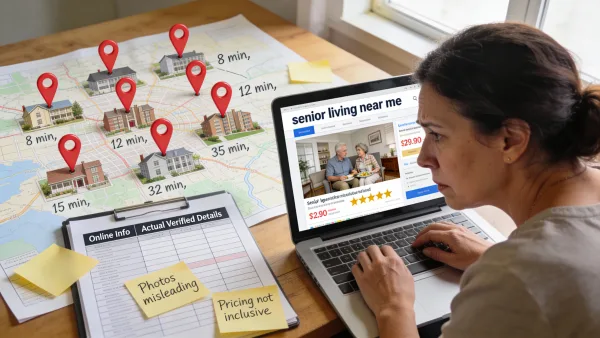
The closest facility isn't always the right facility. That senior living community three blocks from your house might seem perfect because you could visit daily. But if the care quality is poor, the staff turns over every few months, or the programming doesn't match your parent's needs, proximity means nothing.
Distance matters, yes. Being able to drop by frequently, having family nearby for emergencies, staying connected to familiar neighborhoods all provide real value. But they don't outweigh the fundamentals of safety, care quality, and appropriate services.
The search for "senior living near me" is one of the most common starting points for families facing this decision. It makes sense. You want options you can actually get to. You want to evaluate places in person. You need something that works with your family's logistics.
Here's what that local search process actually looks like, including the parts nobody tells you about until you're already in too deep.
Starting Your Local Search: The Basics
Most families begin online, typically through Google searches for "senior living near me" or "assisted living near me." You'll find dozens of results: national directories, local facility websites, review sites, and referral services all competing for your attention.
Use Multiple Search Tools
Don't rely on a single website or directory. Information varies dramatically between platforms. One site might list a community as "accepting new residents" while another shows it has a waiting list. Pricing information often differs by thousands of dollars between sources.
Start with these types of resources: national senior living directories that aggregate facilities across the country, state-specific databases maintained by licensing agencies, rating systems like U.S. News Best Senior Living which analyzed nearly 450,000 resident and family surveys in 2025, and Medicare's Care Compare tool for facilities that accept Medicare.
Each source provides different information. Directories focus on amenities and marketing details. State databases show licensing status and inspection results. Rating systems highlight resident satisfaction and quality measures.
Define Your Actual Search Radius
"Near me" means different things depending on where you live and your family's circumstances. In dense urban areas, you might limit searches to a five-mile radius because traffic makes anything farther functionally inaccessible. In rural areas, you might need to expand to 30 or 50 miles because options are limited.
Consider realistic visiting patterns. Can you get there after work? On weekends? During emergencies? A 20-minute drive in good weather becomes 45 minutes in winter. Factor in traffic patterns, road conditions, and your own availability.
Also think about your parent's social connections. Staying near their longtime neighborhood might mean maintaining friendships, attending their church, or keeping familiar routines. Moving across town could isolate them even if it's more convenient for you.
Red Flags During Local Searches: What Most People Miss
In practice, this is where things break down. Online listings are often outdated. The pricing you see might be from two years ago. That "newly remodeled" claim refers to work completed in 2020. The smiling administrator in the photo left six months ago. You won't know any of this until you dig deeper.
Here's what to watch for when searching locally and what these warning signs actually mean:
Listing Inconsistencies Across Platforms
When the same community shows dramatically different information on different websites, something's off. You might see pricing of $4,500 on one site and $6,200 on another. One directory lists memory care as available while another says it's independent living only. The administrator named on the website doesn't match the person you reach by phone.
These inconsistencies signal poor communication, outdated information, or deliberately misleading marketing. None of these are good signs. Quality communities maintain accurate information across platforms because they have organized systems and care about transparency.
No Recent Online Reviews or Only Glowing Reviews
Look at review patterns carefully. A community with zero reviews in the past year might be wonderful, but it raises questions. Are families not engaged enough to leave feedback? Is the community discouraging reviews? Has there been recent turnover that reset the relationship with residents' families?
Similarly, be suspicious of nothing but five-star reviews, especially if they all appeared in a short timeframe. Real communities have a mix of experiences. Some families are thrilled. Others have legitimate complaints about food, activities, or specific staff members. Exclusively positive reviews often indicate the community is actively managing its online presence rather than showing authentic resident and family experiences.
Vague or Missing Cost Information
When communities refuse to provide even general pricing ranges without an in-person visit, they're usually avoiding transparency. Yes, costs vary based on care needs. Yes, they want to discuss your specific situation. But reputable communities can give you baseline starting prices and explain their pricing structure over the phone or via email.
Facilities that make you tour before discussing money often use high-pressure sales tactics. They want you emotionally invested in the beautiful lobby and friendly staff before hitting you with prices that exceed your budget.
High-Pressure Sales Language
Watch for urgency tactics in online communications or phone calls. "We only have one apartment left." "This price is only good if you sign this week." "Five other families are looking at this same unit." These are sales techniques designed to prevent you from comparison shopping.
Quality communities with good reputations don't need to manufacture urgency. They have consistent occupancy because people want to live there. They're confident you'll choose them based on merit, not pressure.
Management or Ownership Changes
Search for the community name along with terms like "new owner," "acquired by," or "management change." Recent ownership or management transitions often disrupt care quality, at least temporarily. Long-term staff may leave. Policies change. Residents and families experience instability.
Not all ownership changes are bad, but they warrant extra scrutiny. Ask specifically about this during tours and inquire about staff retention during the transition.
Inability to Tour Without Advance Scheduling
While most communities appreciate advance notice for tours, those that refuse to accommodate somewhat spontaneous visits (with maybe a few hours' notice) might be hiding something. The best communities look good on their worst days because they maintain consistent standards.
Flexibility in touring suggests confidence. Rigid scheduling suggests they need time to prepare, clean, or stage the environment before families arrive.
Generic or Outdated Photos
When website photos look professionally staged but don't show actual residents or staff, question what you're seeing. Stock photography and marketing images tell you nothing about the real environment. Look for dated elements in photos: old computer monitors, outdated decor, or seasonal decorations that don't match the supposed photo date.
Some communities use photos that are five or ten years old, from before remodels that never happened or before the quality declined. Request recent photos or video tours that show actual current conditions.
State Inspection Issues
Every state maintains inspection records for licensed senior living communities. These are public information. Before visiting anywhere, look up their inspection history. Search for the facility name along with your state name and "inspection reports" or check your state's health department website.
Look for patterns, not isolated incidents. One minor violation probably doesn't mean much. Multiple serious violations, repeat issues that aren't corrected, or recent enforcement actions are significant red flags.
Pay attention to citations for understaffing, medication errors, safety hazards, resident mistreatment, or food service problems. These directly affect daily care quality.
Difficulty Reaching Staff or Getting Callbacks
If you leave multiple messages without receiving callbacks, struggle to reach anyone beyond a generic voicemail, or get passed between multiple people without getting answers, this reflects how they'll treat you as a resident or family member.
Communication problems during the marketing phase only get worse after move-in. The community should be responsive, helpful, and organized when answering your initial inquiries.
Staff Complaints or Review Patterns
Search for the community name plus "lawsuit," "complaint," or "investigation." Check if staff have left negative reviews on employment sites. While you should read these with appropriate skepticism (disgruntled employees exist everywhere), patterns matter.
If multiple former staff members describe understaffing, poor management, or concerning treatment of residents, believe them. Current marketing staff won't tell you these things, but former employees often will.
Limited or Restricted Family Visiting
Some communities cite COVID policies or "resident protection" to severely limit when families can visit. While some structure is reasonable, policies that make it difficult for families to drop by, share meals, or participate in activities suggest the community doesn't want families observing daily operations.
Transparent communities welcome family involvement. They're proud of their care and want families engaged. Restrictive visiting policies often hide problems.
Making Sense of What You Find Online
Online information serves as a starting point, not a final answer. Treat listings as leads to investigate rather than accurate representations of current reality.
Verify everything. The monthly cost, the services included, the apartment availability, the care capabilities, the staff credentials. Don't assume information is current just because it appears on an official-looking website.
Call and ask specific questions: "When was your base monthly rate last updated?" "Is this price inclusive or tiered?" "Do you currently have availability in assisted living?" "How long has your current administrator been in this role?"
Take notes. Document who you spoke with, when, and what they told you. You'll tour multiple places and details blur together. Written records help you compare accurately and follow up on promises.
The In-Person Visit: What Proximity Actually Gets You
Living near a senior living community gives you one huge advantage: the ability to visit unannounced (or with minimal notice) multiple times at different times of day. Use this.
Tour once during the scheduled time with the marketing person. Then stop by again on a different day, different time. Visit during lunch. Drop in on a Saturday. Observe the community when they're not prepared for you. You'll see more authentic operations.
Living close also means you can talk to residents and families outside the building. Catch someone walking in or out and ask about their experience. People are often more honest away from staff.
The local advantage also extends to checking reputations through community connections. Ask your parent's doctor, their hairstylist, friends who've gone through this process. Small communities yield lots of informal information if you ask around.
When Distance Matters More Than You Think
Sometimes the "wrong" location is actually right. A community 30 minutes away with excellent memory care might serve your parent better than the mediocre facility around the corner. Your ability to visit three times a week instead of daily might be a worthwhile tradeoff for significantly better care.
Consider the full picture: care quality, appropriate services, safety record, staff stability, activity programming, and yes, location. Rank these factors honestly for your specific situation.
If your parent is in early stages of needing care and you're involved primarily for oversight and social connection, proximity matters a lot. If your parent needs specialized memory care and you're mostly coordinating with staff rather than providing hands-on help, care quality may matter more than location.
Questions to Ask Every Community
Regardless of where they're located, ask these questions:
What's your current occupancy rate? (High occupancy often indicates satisfaction; very low raises concerns)
How long has your administrator been here? Executive director? Director of nursing? (Stability matters)
What's your staff-to-resident ratio during daytime? Evening? Overnight? (Ratios directly affect care quality)
What's included in your base rate and what costs extra? (Get specifics in writing)
How do you handle care needs that increase? (Understand their process and costs)
Can we see your most recent state inspection report? (They should provide this readily)
What happens if we're unhappy with something? (Understand their complaint process)
How much advance notice do you require if we decide to leave? (Affects your flexibility)
Making the Decision
Finding senior living near you starts with convenience but ends with fit. Use proximity to your advantage for thorough evaluation, but don't let it override serious quality concerns.
The closest facility might genuinely be the best option. Or it might just be the most convenient compromise. Your job is figuring out which one applies to your situation.
Visit multiple places. Compare honestly. Trust your instincts about staff interactions, resident satisfaction, and overall atmosphere. And remember that "senior living near me" is a starting point for your search, not the end of it.